



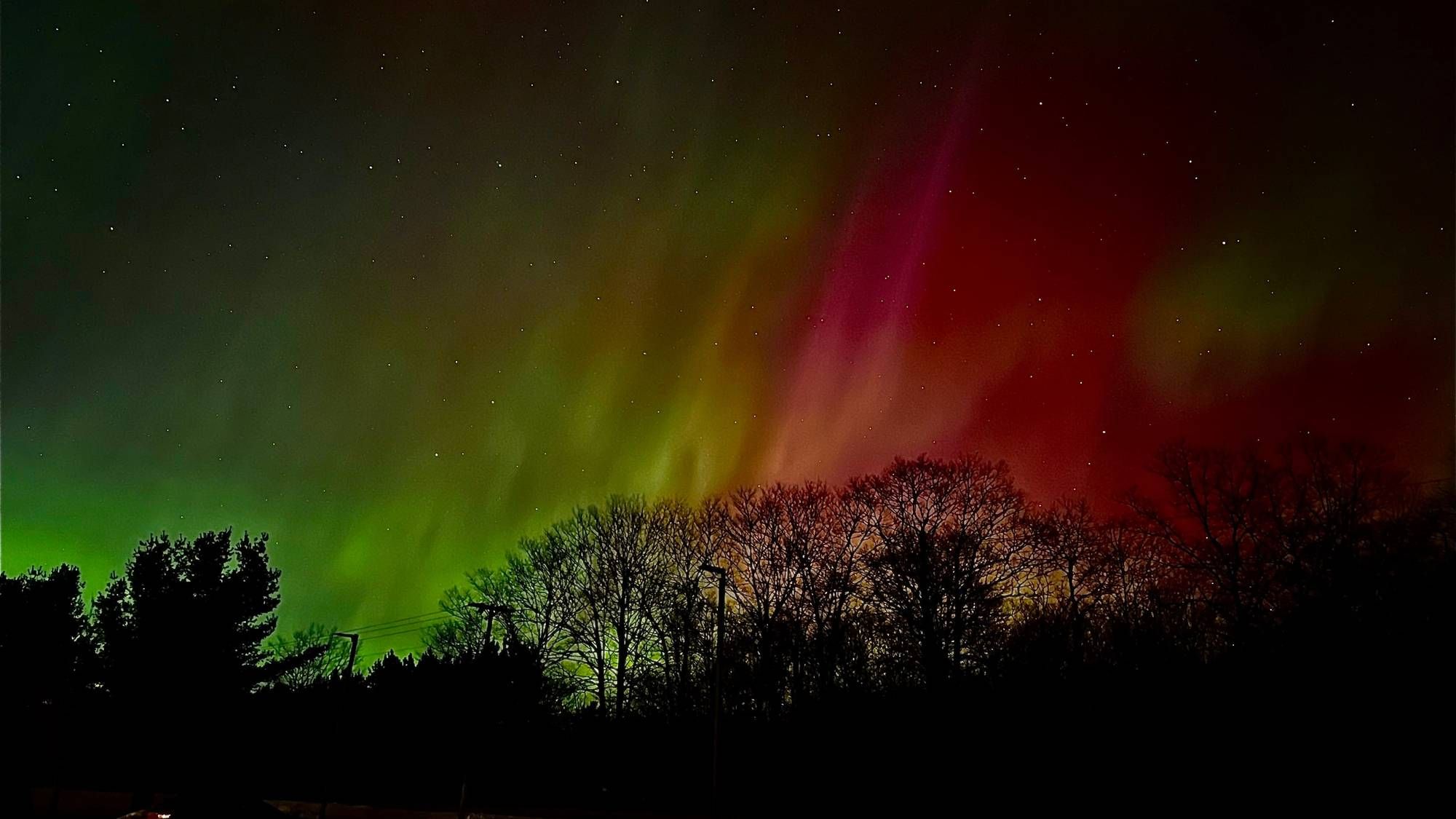
DETROIT (WWJ) - Stargazers across Michigan, but especially in Metro Detroit, are in for a rare opportunity to see the aurora borealis which is forecasted to dance overhead in clear skies Sunday night into Monday morning.
According to the National Oceanic and Atmospheric Administration's Space Weather Prediction Center, the celestial lights will be visible for most of the overnight hours as far south as Detroit, Toledo, Chicago and into areas of Pennsylvania between April 23-24 as forecasts show a high potential for geomagnetic storms.
Experts explained that a coronal mass ejection (CME), or large expulsion of plasma and magnetic field from the sun's atmosphere, was observed on Friday, April 21, and is forecasted to impact Earth's magnetic field on Sunday, prompting a space weather watch.
"The CME is likely to cause G1 (Minor) to G2 (Moderate) geomagnetic storming beginning late on 23 April to 24 April (UTC)," the prediction center added.
As explained by NOAA's space weather scale, a G2 storm can potentially result in some transformer damage depending on the length of the storm and may require spacecraft operations to enact corrective actions on orientation.
A G2 storm is considered "moderate" on the prediction scale, but it also forecasts how active and intense the aurora will be and how far north or south it can be seen.
In this case, the stunning views of the northern lights are likely to be seen way further south, close to the 50° geomagnetic latitude.
The Northern Lights, also known as the Aurora Borealis, are "an atmospheric phenomenon that's regarded as the Holy Grail of sky watching," according to Space.com.
While the event may not be as vivid as the aurora outburst seen in Northern Michigan last month, it is nonetheless a rare sight for Metro Detroiters and other residents across the southern regions of the state.
While it will be chilly, the forecast calls for clear skies on Sunday evening into Monday morning creating the most favorable viewing experience in the Midwest, Great Lakes and the Great Plains.
Stargazers could also see shooting stars on Sunday night following the peak of the Lyrid meteor shower earlier in the weekend.
Experts released the following tips for the best viewing experince:
• Location: Go towards the magnetic poles. The north magnetic pole is currently about 400 km (250 miles) from the geographic pole and is located in the islands of north east Canada. Find a place where you can see to the north ( or south if you are in the southern hemisphere). Given the right vantage point, say for example on top of a hill in the northern hemisphere with an unobstructed view toward the north, a person can see aurora even when it is 1000 km (600 miles) further north. It should be noted that if you are in the right place under the aurora, you can see very nice auroral displays even with low geomagnetic activity (Kp = 3 or 4).
• It must be dark: Go out at night. Get away from city lights. The full moon will also diminish the apparent brightness of the aurora (not the actual brightness). One caveat that people often neglect to think of is that the high latitudes where aurora occur are also latitudes where it doesn't get dark in the summer. So combining a summer vacation to the arctic with aurora watching usually doesn't work. The aurora may still be there but it is only visible when it is dark.
• Timing: Best aurora is usually within an hour or two of midnight (between 10 PM and 2 AM local time). These hours of active aurora expand towards evening and morning as the level of geomagnetic activity increases. There may be aurora in the evening and morning but it is usually not as active and therefore, not as visually appealing. The best Seasons for aurora watching are around the spring and fall equinoxes. Due to subtleties in the way the solar wind interacts with Earth's magnetosphere, there is a tendency towards larger geomagnetic storms, and thus better auroras, to occur near the equinoxes. However, the number of hours of darkness decreases (increases) rapidly near the spring (fall) equinox so this caveat must be considered for those traveling to see the aurora.


