


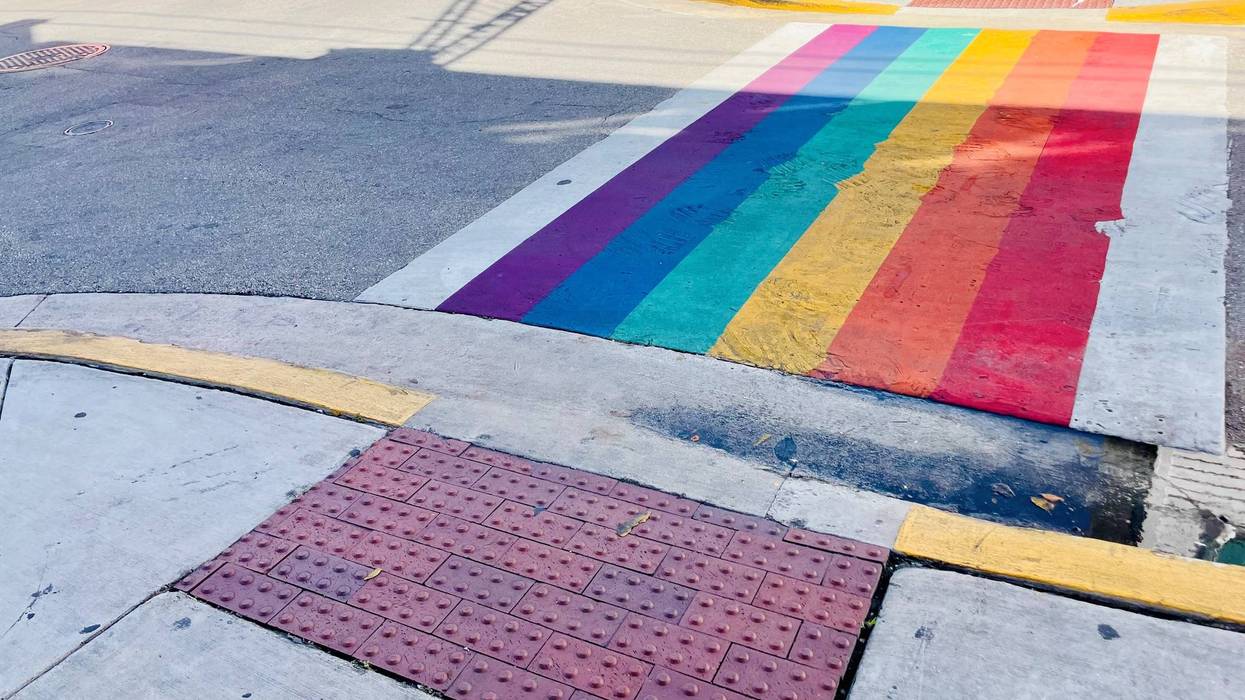

The City of Dallas has notified the Texas Department of Transportation that it will remove rainbow and other decorative crosswalk designs, including those in the Oak Lawn area, as part of a statewide directive requiring “non-standard” pavement markings be brought into compliance within 90 days.
The move follows a Jan. 31 deadline under pressure from state officials who said failure to act could put Dallas’ state and federal transportation funding at risk, and comes after the city’s appeal of the order was rejected by TxDOT.
Gov. Greg Abbott’s October executive order directed the Texas Department of Transportation to enforce removal of roadway markings that do not meet uniform traffic control standards, which state officials say include political or symbolic designs.
Dallas officials have said the crosswalks pose no documented safety hazard and were funded privately, but TxDOT rejected the city’s request for an exemption and the city subsequently submitted a plan to comply.
City records show 30 decorative crosswalks are affected by the state directive, spread across several high-traffic intersections in North Dallas and Oak Lawn.
Four intersections feature “lettered” crosswalks, each with markings on all four approaches: All Lipscomb Way at South Malcolm X Boulevard, All Lipscomb Way at South Ervay Street, Martin Luther King Jr. Boulevard at Colonial Avenue, and Martin Luther King Jr. Boulevard at South Malcolm X Boulevard.
The largest cluster of multi-colored crosswalks runs along Cedar Springs Road, including Douglas Avenue, Knight Street, Throckmorton Street, Reagan Street, and Oak Lawn Avenue, accounting for 10 crosswalks in that corridor alone. Additional individualized designs are located at Mahon Street and Routh Street, Mahon Street and Fairmount Street, and Lemmon Avenue at McKinney Avenue, bringing the total to 30 citywide.
City leaders say they will engage with affected neighborhoods to explore other forms of public art that reflect community identity once the markings are removed, while advocates in some areas express concern about the loss of neighborhood symbols and identity.