

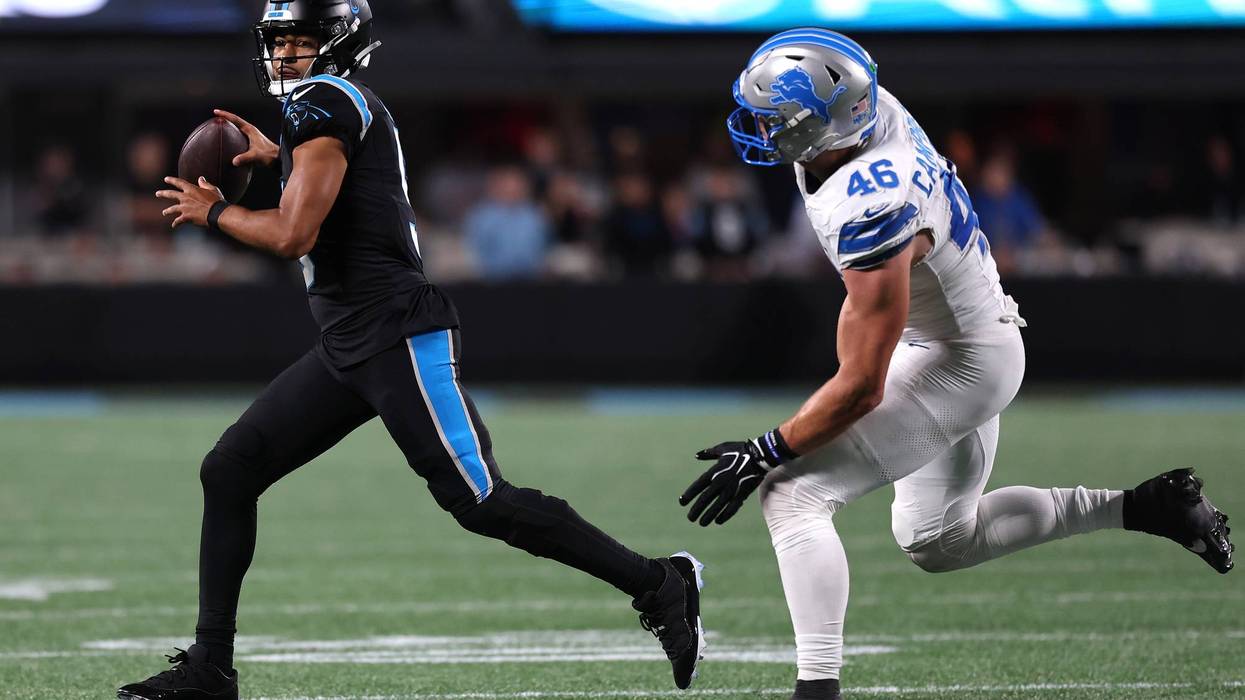

Two things can be true, and one can be more troubling than the other.
The Lions' offense is costing them points. The Lions' defense is costing them games.
With this offense and an average defense, it would be hard to dispute Detroit's Super Bowl aspirations. You could at least plot the path to contention. With this offense and this defense, the path doesn't exist. It leads, instead, to the same wilderness they wound up in at the end of last season: on the outside looking in.
The Lions came within 30 minutes of the Super Bowl in 2023 with the NFL's fifth-ranked scoring offense and 23rd-ranked scoring defense. They were talented enough on one side of the ball and at least connected enough on the other to go toe to toe with any team.
These Lions look more like the Saints of the early 2010s, who had a top-10 offense for six straight years led by one of the best pocket passers in the game, a bottom-five defense for all but two of them, and two playoff wins to show for it. They went 7-9 each of the last three seasons while ranking first, second and first in the NFL in total offense.
The Lions are 7-9 over their last 16 games, with a top-10 offense and a bottom-five defense.
Their offense should and likely will be better, especially as a young offensive line comes together. Dan Campbell isn't wrong to demand more out of his stars on that side of the ball. The starts have been slow, the missed opportunities have been costly, and the pre-snap penalties are piling up.
For as poorly as the defense has played, the Lions are likely 3-1 if Jameson Williams tracks a deep ball that all but hit him in the hands in the first quarter last week. It would have gone for an 89-yard touchdown and given Detroit a 10-0 lead over the Panthers. That's but one example of the offense leaving game-changing plays behind.
"We came into this thing saying that we had our standards for the way we wanted this offense to run," Campbell said this week. "That was my message to the offense. So, if we're OK offensively with what we've done, then we're not looking at it the right way because it's not good enough ... We can do a lot more over there. I feel like we haven't scratched the surface of what we're capable of for 60 minutes yet. It's come in flashes, and when we become more disciplined, which I hit the team on this morning, and more consistent, that's going to go a long way."
As for the defense, who knows. Brian Branch will certainly help; he's slated to make his season debut on the other side of the bye against the Packers. So would a trade for a proven cornerback after the Lions missed out on Joey Porter Jr. In fact, after Campbell confirmed the Lions' aggressive pursuit of Porter -- and their ongoing search for help in the secondary -- it will be fair to say that if Brad Holmes doesn't add a defensive back of note by the Nov. 10 trade deadline, he will have failed his most critical assignment of the season.
But the deficiencies in the back of Detroit's defense do not excuse the way that Kelvin Sheppard's unit has performed as a whole. The Lions are healthy in the front seven. Their defensive line is humming, especially in terms of putting heat on the quarterback. It just looks too often like the defense is operating as three separate position groups rather than as a whole. That falls on coaching.
Sheppard talked on Thursday about cracks in the dam that can cause the whole thing to collapse. But the bridges from one level of the defense to the next were apparently never built. The gaps in zone coverage between the safeties and linebackers, for example, couldn't be linked by the Gordie Howe. It's no coincidence that the Lions have allowed the most catches, most touchdowns and second most yards in the NFL to tight ends. Next up: Trey McBride.
The Lions are last in the NFL in total defense, passing defense and third down defense. They're second to last in scoring defense and red zone defense. They switched to a more zone-centric scheme in year two under Sheppard with the idea of keeping more plays in front of them -- i.e. cutting down on the explosives -- and creating more takeaways. They've allowed the most explosive plays in the NFL and have one takeaway in the last three games.
In fact, Sheppard said at the outset of this season that "the explosive plays will be limited this year, if we do nothing else." The Lions allowed four plays of 20-plus yards per game last year. This year they're allowing more than six. Maybe most troubling is that their most dependable defensive player has looked out of sorts for most of the season. Jack Campbell has been chasing plays instead of making them.
"There’s been plenty of mistakes by me in the past four games, 100 percent," the All-Pro linebacker said Thursday. "But for me, that’s in the past. Let’s move forward. Right now it’s terrible, though. I mean, based off where our defense is right now, I’m not gonna sugarcoat it. It’s not good enough. And it’s not gonna win football games. We’re still 2-2, thankfully to our offense and special teams because they’re playing unbelievable. But defensively it’s not good enough, and that’s everybody in the room. And it starts with me."
There you have it, from their defensive leader: the Lions are going nowhere with a defense like this. That's not news, of course, just a refreshing reminder of how to divide the blame pie for Detroit's disappointing start. Sheppard's unit gets one half to itself. Offense and special teams can split the other.
In his weekly press conference Thursday, Sheppard was defiant. He stood firmly behind his blitz calls in the Lions' loss to the Panthers, despite the questionable matchups and rather disastrous results. Asked if he might have misevaluated what his players can do well in building this defense, Sheppard replied, "Absolutely not." Those are conflicting sentiments.
If he didn’t misevaluate what his players can do well, that would suggest they’re fully capable of executing this scheme. But if the calls are correct and the players aren’t executing them, that would mean, indeed, that he misevaluated what they can do well.
Dan Campbell's message to the defense is simple: "Let's just get in the right position. Let's be where we're supposed to be. We'll make a couple little tweaks here personnel wise and get these guys in the proper places. It won't be perfect, but at least if we know that we're fitting the right gaps and we're where we're supposed to be in these zone drops, we give ourselves a better chance."
It actually rings pretty true talking to Jack Campbell. Detroit's linebackers, who have allowed 40 completions on 47 targets in coverage, per PFF, are representative of the defense's larger struggles to adopt a zone-oriented scheme. While some of those completions are just guys getting beat, a lot of them owe to swaths of open space in the middle of the field. Everything happening behind the defensive line is just disjointed.
When the Lions' linebackers blitz, quarterbacks are throwing to the vacated areas. When they drop, quarterbacks are throwing over them in front of the safeties.
"I can speak on myself, the situations that I got in (against tight ends), I just put myself in bad position," said Campbell. "I wish I would have been a little further off the ball pre-snap, but I live and I learn from it. But again, if I’m in 1-on-1 with a tight end, I’m gonna go challenge. I’m gonna use my strengths and then in the back of my mind I gotta know where my weaknesses are at in the coverage, where are the holes ... If I know where my help is, I’m gonna play underneath a route every time."
"The defense as a whole," Campbell added, "has to heighten their awareness to where our weaknesses are."
If the opposition keeps finding them first, it won't matter how many strengths the Lions possess on offense.