

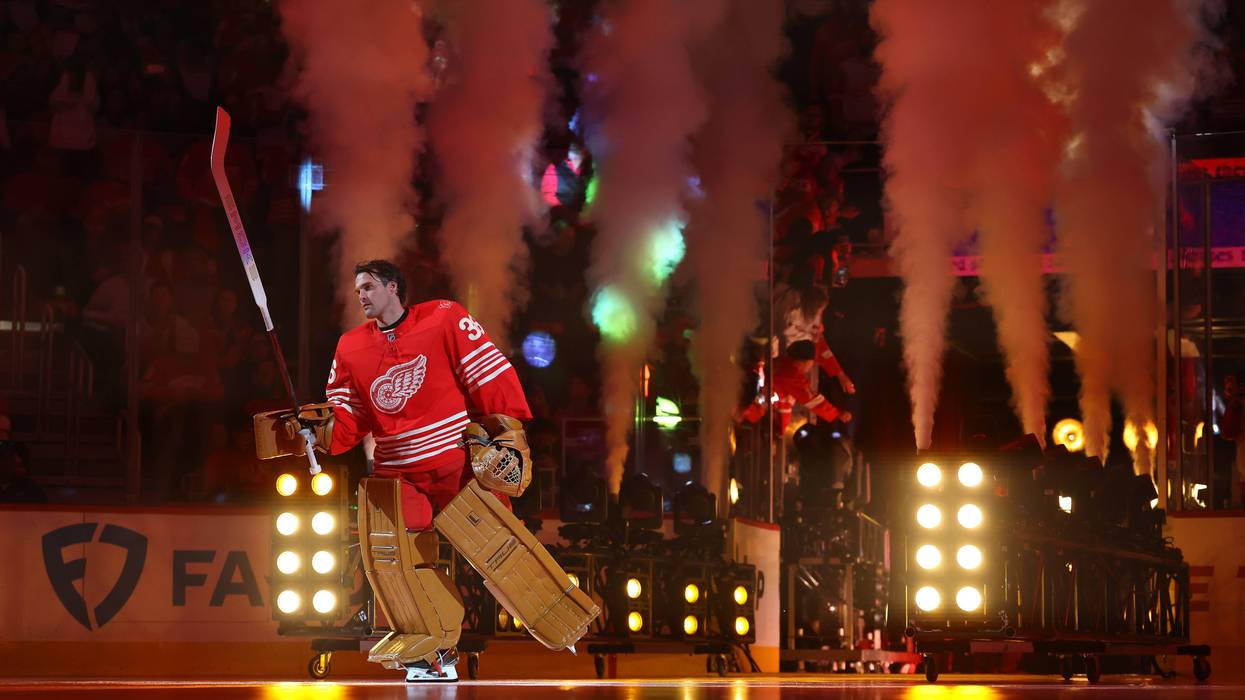

John Gibson isn't taking the bait. Not from reporters with their questions. Not from shooters with their dekes, like Scott Laughton on a penalty shot in the Red Wings' win in Toronto in last week. Not even from teammate Cam Talbot, who likes to remind Gibson that when they squared off in the second round of the playoffs in 2017 and Gibson's Ducks beat Talbot's Oilers in seven games thanks in part to a controversial non-goalie-interference call that helped the Ducks steal Game 5, "You know we should've won that series, right?"
"But he doesn't bite," Talbot said with a smile.
For about a month now, Gibson has been asked a different version of the same question: What's changed? And "I've said the same answer numerous times: Just playing my game." He's been good-natured but a little guarded about his turnaround, which is the biggest reason for the Wings' continued success. Gibson is 17-2 with a .931 save percentage since December, both tops in the NHL, after struggling badly through his first two months in Detroit.
"Everyone's asking me to dissect my game, and I just go out there and play," Gibson said. "I'm trying to give the team a chance to win every night and be consistent as possible."
Gibson's long tenure with the Ducks didn't end well, marred by injuries and decline behind a rebuilding team that often hung him out to dry. And his tenure with the Red Wings started rather horribly. Gibson ranked among the worst goaltenders in the league with an .865 save percentage through November. He looked lost, at times, in his search for pucks. His shoulders slumped as shots slipped past him. Confidence is crucial in the crease.
Surely, now, Gibson is in a better place psychologically.
"Just playing hockey, man," he said with a shrug.
Maybe it's as simple as a goalie getting used to a new environment, a new locker room, a new city, a new team after spending the first 12 years of his career in Anaheim. Maybe he's grown accustomed to new foes in a new conference: Gibson allowed 25 goals in his first six games against teams in the East, as many as he allowed in his first 10 games against teams he knows well in the West. Maybe goaltending really is just voodoo and we should stop trying to figure it out altogether.
Or maybe Talbot has some answers. "Been playing against him a long time," Talbot said.
Talbot and Gibson spent eight years as Western Conference counterparts, the first four of those in the Pacific Division. Gibson was 22 years old and in his second season with the Ducks when Talbot joined the Oilers, 23 when he led Anaheim to the Western Conference Finals in 2017 at Edmonton's expense.
"I've had an appreciation for his game since back then," Talbot said. "I feel like now he's a little more composed, a little more mature in his game, where back then it was pure athleticism and a little bit more flash. Right now it just looks easy. As you get older, your body can't do what it did when you were 21, 22 years old, so you evolve, and I feel like his game keeps evolving. He still has that (flash) in his game when he needs it, but the more composed and the more effortless it looks, I feel like that's when he's at his best."
Talbot's game has waned this season as Gibson's has taken off, but it was Talbot who kept the Wings afloat in the early going. The current arrangement is what Steve Yzerman envisioned when he acquired Gibson last summer for second- and fourth-round picks (and Petr Mrazek's salary), betting that Gibson's improved play in the second half of last season was real.
It's paying dividends now. Gibson has started 19 of Detroit's 27 games since December, with Talbot, 38, spelling him sporadically. The Wings might actually need to lighten Gibson's workload to ensure that he's fresh down the stretch and quite possibly into the playoffs. The Olympic break will come at a good time.
To Talbot's trained eye, Gibson does look a little different in net than he did earlier this season. Of course he does. The word Talbot keeps coming back to is 'calm,' which could indeed speak to a human growing more comfortable in his surroundings. In Talbot's view, it speaks to a goalie who "isn't chasing the game."
"He's just letting the game come to him. When things aren't going well, it's easy to start chasing things, try to overplay the position, and that's when things start to go sideways and you let in the leaky goals. The calmer you are, the more composed you are, that's when he's at his best. And you can see it, there never seems to be any panic in his game," Talbot said.
The defensemen in front of Gibson sense the same thing. This is important for a pretty green blueline. Moritz Seider said that Gibson exudes "so much calmness, almost to a point where it turns into swagger, and that replicates and accumulates on the D and then hopefully the forwards, too." Ben Chiarot said that "Gibby's demeanor is really in control," especially when there's chaos in front of him.
"He's been around a long time, so he knows what he likes, what he likes to see, and he tells us," said Chiarot. "He's in command back there and we just try to do the best job we can for him. He's been huge. He's been a game-changer for us. He's got an edge to him and a confidence about him that feeds throughout the room."
The Red Wings' place in the standings somewhat belies their performance the past couple months. They've generally been outplayed at even strength since December, but have outscored the opposition. In fact, they have the best record in the NHL over this stretch while ranking toward the bottom of the league in expected goals share at five-on-five because Gibson has often been their best player. This is not a crime, for the record. Indeed, it's about time the Red Wings have a goalie who can steal a few games.
They haven't had a true No. 1 since Jimmy Howard, which is part of the reason they've been so slow to rise out of their rebuild. Over the prior 10 seasons, the Red Wings allowed the most goals per game (3.2) in the NHL. They haven't ranked in the top half of the league in save percentage over an 82-game season since 2015-16, which happens to be the last time they made the playoffs. Last season they ranked 20th.
This season 12th.
"I'm just trying to help the team win hockey games and make the playoffs. I've said it simple since the beginning, and I'm sticking with that," said Gibson.
The end of Gibson's time with the Ducks tarnished his numbers and, to an extent, his reputation. Under siege on bad teams and battling injuries, Gibson looked like a goalie whose best years were behind him. He allowed 200 goals in 2022-23 when he finished with the worst goals against average (3.99) in a single season by an NHL netminder in the last 31 years. By the time he arrived in Detroit, it was easy to forget how well Gibson had played behind good teams at the start of his career.
Over his first five seasons, Gibson was tied for the second best save percentage (.921) in the NHL, among goaltenders with at least 60 starts. Carey Price over this stretch checked in at .920, Andrei Vasilevskiy at .919. Howard was at .911.
"He's always been, in my opinion, one of the best goalies, and you can see that," Talbot said. "I think right now, if you're Team USA and something happens (to one of the other goalies on the Olympic roster), it'd be hard not to bring him. And honestly if you're voting for the Vezina right now, I feel like he's gotta be up there as well. It's been fun to watch. I keep telling him that after every game, like, 'Just keep doing your thing, it's fun to watch.' I'm his biggest fan right now."
The Vezina conversation is premature for someone who still ranks 16th on the season in save percentage (.906) and 17th in goals against average (2.62). And Team USA should be just fine in Milan next month with the trio of Connor Hellebuyck, Jake Oettinger and Jeremy Swayman, while Gibson will enjoy the rest. But at this rate, it's not a stretch to suggest that Gibson is reemerging as one of the better goalies in the league, and one of the better bargains in net with a $6.25 million cap hit through next season.
"Obviously Gibby's riding a phenomenal hand," said Seider, "and hopefully can continue his streak."
Gibson was 31 years old when he joined the Red Wings, "looking for a fresh start," as Yzerman said at the time of the trade. Seven months later, he looks 32 years young.