

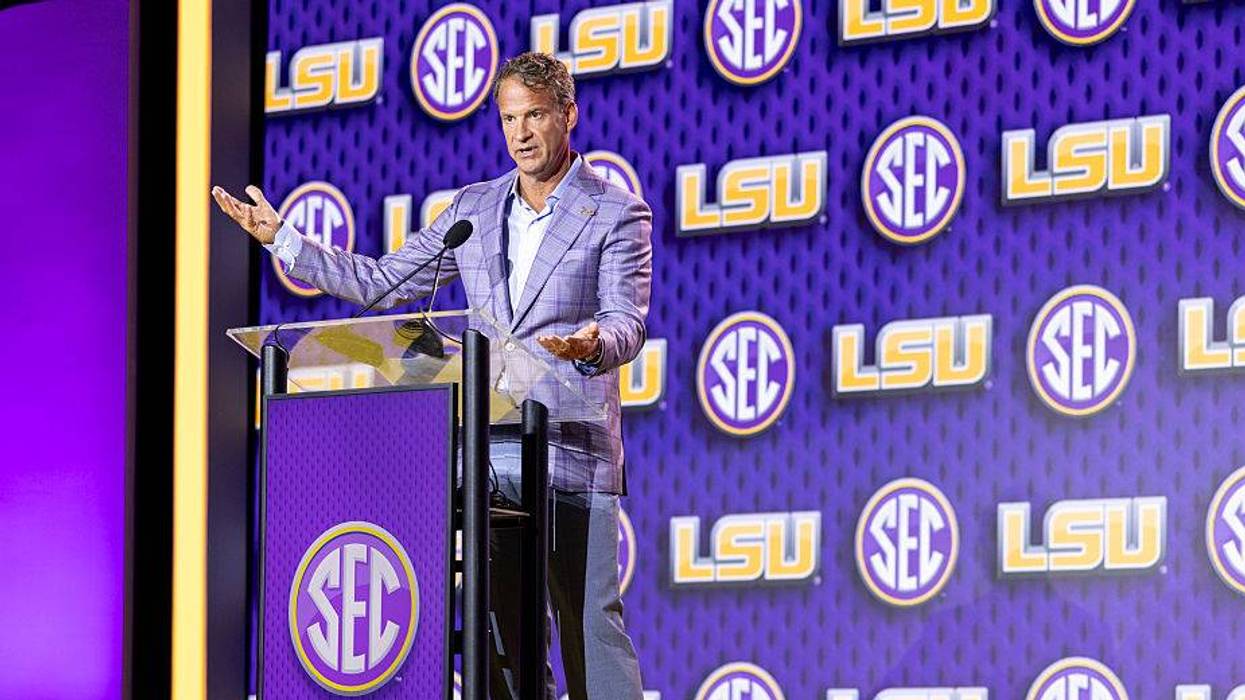

The Lane Kiffin era in Baton Rouge is just getting started, but first, a date with the podium for a state of the program address to assembled media at SEC Media days.
The questions were limited, though, at least in that setting. Kiffin's opening comments lasted for nearly 16 minutes, with only four questions posed by reporters. LSU's head coach did field questions from reporters at other times during the event, held this year in Tampa, Florida.
Despite the limited time for questions, Kiffin did touch on a variety of topics, including why he suddenly departed social media, the reasoning for leaving QB Sam Leavitt back in Baton Rouge, challenging realities of NIL and the transfer portal and why he'd endorse an NIL salary cap for programs and particularly freshman. He also shared his reasoning why he's against the SEC's new nine-game schedule format.
Scroll below for the top 10 quotes from LSU's new coach this week.
LSU’s Warm Welcome
Kiffin opened his remarks by reflecting on the personal and professional transition after accepting the LSU head coach job in December. He highlighted the daily realities of life in Baton Rouge for both himself and his family, emphasizing how the environment has matched the program’s culture.
“These 7 months at LSU have been awesome. It’s been amazing, you know, to come into Baton Rouge and the state of Louisiana and the acceptance and how great they’ve been to my family, and the commissioner talked about, to have a son, Knox, playing on campus and every morning they practice and he can just walk over from practice on the campus is really special and how the community has been to us, as family, and the state. You know, over 7 months, just seeing that Louisiana is built of hard-working people who are really passionate and that love football, and I think that really fits in well with our staff and the values and principles that we bring into our organization, into our football program, so that’s been great. There’s so many things to do in Baton Rouge, and then New Orleans is right up the road, it’s been great for our staff and for our families.”
Top-Down Program Alignment
Kiffin stressed that one of the strongest early impressions at LSU has been institutional unity.
“One of the things that has really stuck out to me has been the alignment at LSU, from the top down. You know, from President [Wade] Rousse, to Verge Ausberry, our athletic director, to our board of supervisors. You know, that alignment has been great from the first time I met with them. A lot of times people, schools recruit just like coaches do, and then is it that way when you get there, and it’s been amazing that alignment and commitment to building a championship program.”
NIL Branding Advantage
Discussing LSU’s unique recruiting appeal, Kiffin pointed to NIL advantages that set the program apart nationally.
“We talk about it being just different. You know, this week I was meeting with our Nike rep, think about how different it is for kids and NIL opportunities, to come to LSU. We have 12 football players that have NIL deals with Nike. No school in America has more than eight, so think about the difference of that as branding to come to LSU as a football player. Jordan Seaton, our left tackle, has an NIL deal with Nike. There has never been an offensive lineman ever to have one in college with Nike, so that’s just one of the many things when you talk about LSU being different, and why it is a different place to come and when you come and in association with LSU and the branding that goes with that nationally has really been amazing to see.”
Building a Dual Roster
Kiffin outlined the deliberate strategy of blending elite high-school talent with high-end portal additions to create both immediate competitiveness and long-term depth. He noted that the current roster already reflects that dual approach.
“We’re coming to LSU to sign the best players in the country out of high school and then mix that with the best portal players in the country and put them together, and that’s led us into this roster that we have now, which is a really good mixture of that. You have some elite high school players. We just signed some of the best D-linemen in America that will be true freshmen, and then some elite, portal, first-round portal players coming into that combination. That roster is exciting to work with. I can’t wait to get to the field, get back to fall camp to do that, but it also excites me about the future of LSU, too. Not just this year. We’ve put together a roster that can win now, but as I look at when you build the program, where it really will go to another level is how you build your depth.”
Embracing LSU’s Pressure/Discomfort
Kiffin described the move to LSU as intentionally uncomfortable, citing the heightened demands and sky-high expectations. He framed those external pressures as a positive force that prevents complacency.
“This job has really pushed me out of comfort, to take a new job, to be at LSU, like everyone talks about, the pressure of LSU and what comes with that, and there is more things to be done as the head coach of LSU than anywhere I’ve been, that are asked of me, and I’ve really enjoyed that and it’s been exciting to do that, and to rebuild within a program a roster, and to come in and a team come off of a 7-6 season, and then the expectations that everybody in the media has that we’re supposed to be this great team right away. That’s an awesome challenge. You know what I’m talking about, getting uncomfortable, that does it. Expectations make you uncomfortable, they make you not be able to just go through motions in any aspect of your program, so that’s been awesome.”
Picking Three Players
Explaining the difficult selection of which three players to bring to SEC Media Days, Kiffin noted that the group was chosen to represent the modern realities of college football—portal movement, loyalty amid coaching change, and high-school commitment. He also mentioned leaving quarterback Sam Leavitt behind to help drive player-led practices scheduled for that morning.
“The three players today that we brought, that wasn’t an easy choice. We’ve got a lot of really, really good players. We brought three players, we left Sam [Leavitt], our quarterback. This is an interesting time where the spell, we actually this morning had player-led practices, and so Sam was able to stay for that and Sam is doing an amazing job. These three players that we brought I think are an interesting combination because you get a little bit of everything, to me, of what college football is now. You know, [LB TJ Dottery] coming through the portal, coming from Ole Miss to LSU, having been here before with another school. You’d never thought that happened years ago, and so to have a portal player that left the team to come to us, and then you have [LB Whit Weeks], who had a chance to go to the NFL draft and a lot of people would’ve in his situation, with a coaching change and having played really well. Whit decided to stay. He wanted to see LSU return to dominance, to return to the style of play that he grew up watching, which was the reason why he came here and he wanted to come back to make sure he was part of that. And then you have [TE Trey’Dez Green], someone that in high school, stayed in Louisiana, went to LSU and now playing great and also had a chance to go into the portal, like all kids, and decided to stay with a new staff.”
Life Without Social Media
Kiffin detailed how his son Knox used reverse psychology to challenge him to quit social media entirely. What began as a personal experiment quickly became a broader lesson he now shares with players, friends, and coaches about presence and comparison.
“If you really want to keep growing, a lot of people add things as they go versus subtracting things that are issues, whether that’s diet, whether that’s my situation, alcohol, whether that’s things that are subtracted along the way, toxic relationships, things that as you grow you decide OK, I’m going to continue to grow. And Knox, one day he’s like, 'dad, there’s no way you can get off social media,' and if you know me, like, that’s the best thing to do, my kids have learned that, too. If they really want something, just say that I can’t do it and I’m gonna do it. And so I’m like, well, I bet I can, and it really wasn’t a plan, and so I got off of all of it, and then it was still on there, and I’m like, OK, I’m going to go to another level and I just deleted the apps, and it wasn’t a long-term plan, and it was really interesting to see as I went through it, because Knox pushing me to do that, challenging me, allowed me to help other players, friends, coaches to say man, you should try this sometime, because once you remove something from your life, you start to realize how many other people are addicted to it, or need it.”
Nine-Game Schedule Concerns
Addressing the SEC’s move to a nine-game conference slate, Kiffin voiced disagreement with the commissioner while acknowledging the difficulty of the decision. His primary worry centers on the erosion of meaningful nonconference games and the current playoff selection process’s inability to properly value strength of schedule.
“The other question I get is the nine-game schedule, and like I said, I don’t always agree with the commissioner, but he has hard decisions to make and I understand that. My concern was about the nine games, is that you’re going to lose nonconference games. Teams will eventually get out of the bigger nonconference games because the selection process is not fixed. Until that is fixed, to really, truly reward strength of schedule, I was against it, because I think what you’re going to have is more conference losses and you don’t prove anything. We’re all in the same conference, we keep playing each other, we don’t really prove that we’re better than anyone else and we’re taking away out of conference games, so I just think that’s it’s going to cause issues that we’ve already seen, until we can get into a world where people can actually look at teams and say that team, that is 9-3 with their schedule, is a better team than that 11-1 in a different conference.”
Flawed NIL Cap Reality
When asked whether he thought program NIL budgets would eventually become public knowledge across the sport, Kiffin expressed skepticism and used the opportunity to critique the current system. He argued that without a true hard cap and transparent long-term contracts, programs will continue to be forced to lean heavily on the transfer portal.
“I don’t know that we’re gonna see that day. I think that, again, this is a really hard thing to get to, but if to do it right, just like the scheduling would need to be fixed and would need to be to have a real salary cap and I know what looked like it was going to be implemented, coming with the revenue sharing. I think I’ve always been the coach up here to just tell you how it is, that’s not being followed because it’s not a real cap, it’s not a hard cap and you can go above it. It’s just really a poor system and, like you said, things aren’t public, you know, the contracts aren’t public, so different from the NFL where everybody has the contracts of the players and the other teams and everything and you have long-term contracts."
Vanity Fair Word Choice
Responding to questions about controversial comments he made to a Vanity Fair reporter on some of the challenges of recruiting players to Ole Miss due to the school's checkered past when it comes to race relations. Kiffin offered a reflective apology.
“I made a challenging decision in change, and I think as I look back to that, I thought I could find a way for everybody to understand and now as I look back later on, that was never going to happen. ... I was actually talking to [Yahoo! Sports reporter] Ross Dellenger and I kind of said something that might sound funny to you, but you know, I watched the Hulk Hogan special and I realized, I was like, we’re all gonna die, and so some of the things that we put importance on, we worry about, what this person says and that, really aren’t going to matter, and when I lost my dad I started thinking that, and I really started thinking, when I grew up, there were two people that I thought just wouldn’t die, my dad and Hulk Hogan, and when I watched that special, Hulk Hogan died, too, and like, there’s no way Hulk Hogan was never going to not wrestle and die, and he did. And so it just made me really reflect, really on like, I can’t be so concerned about little things and what people say and this, and you‘ve got to make decisions, you’ve got to go with them and you do things and you make really good decisions and you make poor decisions, and that was a poor usage of a term that I believe, just like many coaches that have been there before. It was factual, but over the course of a long interview, it was bad timing and bad usage of the words, so it is what it is. I apologized when I said it, and moving on.”