


It was hard to know exactly when “Deep Gras” became a part of our vocabulary to describe the final seven days before Fat Tuesday - most of us heard it from someone who heard it from someone else who heard it from someone else, then suddenly it was everywhere.
Not everyone liked that. Cue the “Nolier-than-thou” debates, cue the eyerolling, cue the Reddit and Facebook threads endlessly chirping about who gets to define Mardi Gras and who doesn’t.
But how many people actually stopped to ask the person who first said it what it meant to them?
We tracked down Dominique LeJeune, a New Orleans musician and artist whose ancestry in Louisiana stretches back to the 1700s and whose family members are everywhere in the city’s musical history. She has earned the right to leave her fingerprints on this city’s inheritance, and she is the first person who used the term “Deep Gras” on Instagram a few years ago.
What began as slang, just something playful she would attach to moments that felt heightened or intense, ended up sticking to that stretch between Chaos and Rex, when the entire city seems to shift into another gear.
Asked to define “Deep Gras,” her answer wasn’t an ironic Dirty Coast t-shirt or some sort of transplant Carnival rebrand that nobody asked for. It was something far more evocative.
“Something happens to our state of mind during this last week where we kind of just let go of control,” she said. “We’re kind of going through this inner journey of trying to have fun, of connecting with community, of reliving nostalgia… There’s so much inside of us that comes out during this final week.”
Anyone who has lived here long enough knows that feeling. Offices close, kids are out of school, our routines turn inside out. Yeah, there are morons in the neutral ground, but even if they are total strangers, they’re your people. There's magic in the air and music in your heart. Marching bands, jazz bands and brass bands electrify our neighborhoods. Your metabolism slows down. The rhythm of daily life loosens. And for one sublime week, we lift up above the clouds and bask in the fact that we really are the most beautiful, most alive, most defiantly human city in America.
LeJeune reminded us that Carnival’s roots go back to medieval Europe, when social hierarchies temporarily relaxed and satire was not only permitted but expected. Masks allowed people to mock power without fear of reprisal. Laughter served as a pressure valve and the ritual had a purpose.
“It was all about this kind of mockery of the church and the elite… We see that a thousand years later happening here in New Orleans in the exact same way.”
That continuity is easy to overlook when you’re stuck on the bridge behind floats or stepping over beads in the gutter or chasing frat boys off your lawn. But the masked riders, the political floats, the irreverence and exaggeration - none of that is random, and none of it is unimportant. They’re part of a tradition designed to release tension and rebalance our community.
“It really does renew my sense of love for my community and the traditions and how we all grow together so beautifully year after year, despite what’s going on politically, socially, or even personally here in New Orleans,” LeJeune continued.
Think about everything this place has endured and continues to endure: colonial rule, slavery, firestorms, epidemics of yellow fever and cholera, occupation, Reconstruction, racial violence, lynchings, the 1927 flood, wars, hurricanes Betsy, Camille, Katrina, Ida, levee failures, mass displacement, public housing, public housing demolition, oil busts, oil spills, crack, blight, the poverty, the inequality, the corruption, COVID, the crime, the decay, the brain drain, population loss, coastal erosion.
Carnival doesn’t ignore all that; it absorbs it, transforms it, and earnestly hands it back to us, bedazzled.
Outsiders often see only the surface. The Bourbon Street excess, flashes for beads, a weeklong excuse to drink. But as LeJeune put it, the deeper current runs through families and neighborhoods, through generations.
“It’s so deeply ritualistic. It’s so deeply ingrained in our families… It’s a way of carrying culture and a love for our city, our history, our lineages, and the fact that we’re still here year after year.”
Still here.
May that be your quiet refrain underneath every noisy moment.
We are still here.
Remember to say that to yourself when you see something beautiful this week.
Mardi Gras is an indulgence before Lent, yes. It’s color and chaos and noise and laughter. But it is also a communal spiritual act - one of remembrance and renewal. It gives us permission to let go of control, to do what ya wanna, to mock what feels heavy, to stand shoulder-to-shoulder with neighbors we may disagree with politically or even dislike personally - but we share a bucket of Popeyes with them anyway.
“Deep Gras” isn’t about days on a calendar, it isn’t about Instagram, it isn’t about Millennial wordplay. It’s about recognition. It names the intensity of this time - the way it pulls something out of us and pushes us back together.
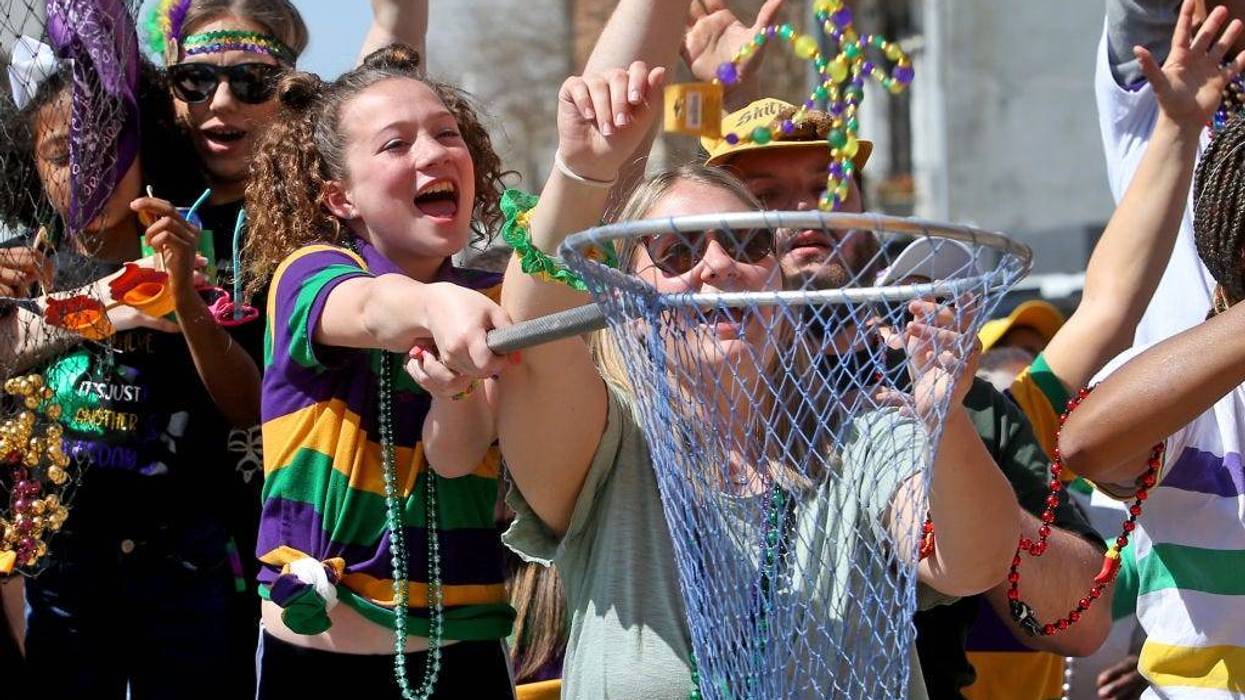
The party is always visible. Often, the deeper ritual is not. But you’ve felt it, standing in the cold waiting for a parade, watching a panoply of kids toss footballs and frisbees to each other between krewes, laughing with strangers, riding on a float in the rain and getting soaked and not caring, watching a marching band or a jazz ensemble and feeling something ancient in the rhythm - that’s when you understand the deep. That’s when you understand what’s deep underneath the beads and beer and glitter.
Your people that came before are there with you.
Your people that will come after you are there with you.
Past and present, satire and survival hold fast together in a loving, eternal embrace.
And there’s a city rehearsing, once again, how to stay whole.