


One of the big conversations going on in America is how to deal with protesters. Protests can start out peaceful and end up chaotic. On rare occasions, people have been shot and killed during law enforcement’s attempts to keep protesters under control.
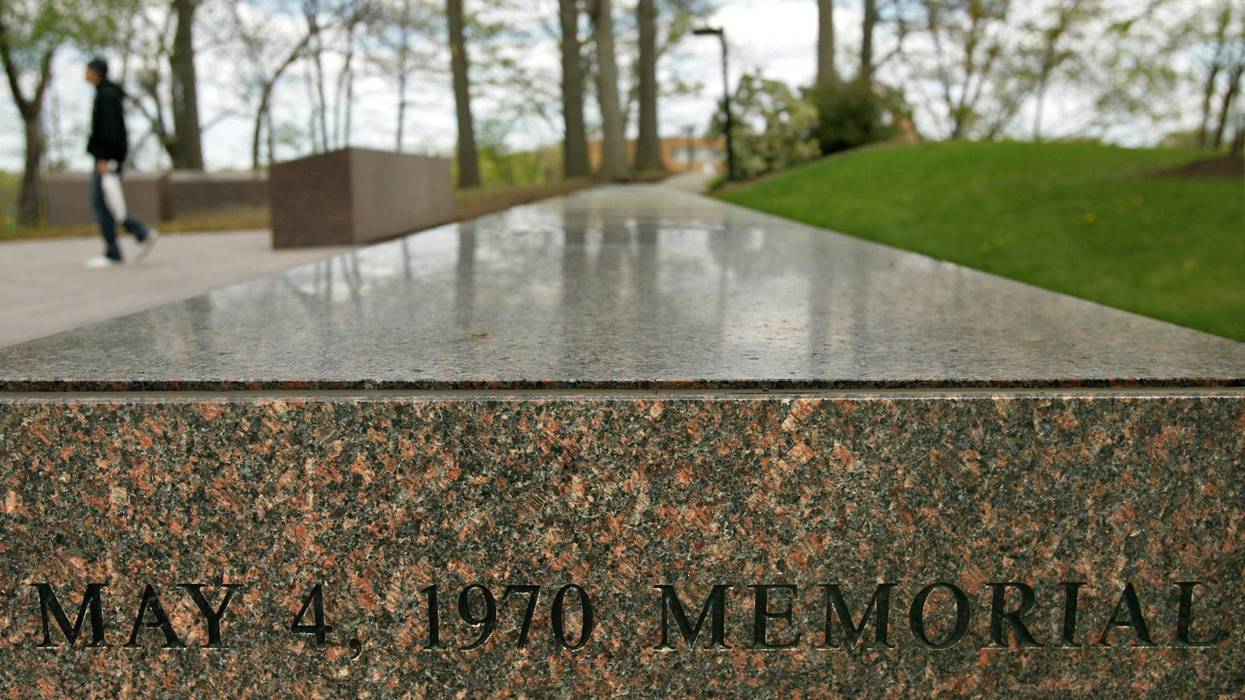
Fifty-one years ago today, an unspeakable act occurred. This is the day in 1970 that the U.S. National Guard troops opened fire on a student protest at Kent State University during the Vietnam War. The Kent State shootings, aka The May 4th Massacre, left America stunned.
4 students were killed and 9 others injured, one suffering permanent paralysis. The Kent State shootings were the first time in U.S. history that a student was killed during an anti-war protest.
In 1970, the Vietnam War was extremely unpopular among the Baby Boomer generation. Protests against the war were common with the young, anti-establishment generation from the 60s. In anticipation of a peaceful protest that was promoted for the Kent State campus, Ohio Governor James Rhodes ordered the National Guard to the campus.
The student protest at Kent State University was promoted and began as a peaceful protest against President Richard Nixon’s expansion of the Vietnam War into Cambodia. As members of the National Guard moved toward the student protest, tensions grew.
Some students began throwing rocks at the troops. No one is certain who gave the order to open fire on the student protest. Of the 77 National Guard troops on the scene, it is believed that at least 29 fired their rifles at the students. A total of 67 rounds were fired, lasting about 13 seconds.
The massacre touched massive protests with more than 4 million students participating in walk-outs on hundreds of college and high school campuses across the country.
Neil Young of Crosby, Stills, Nash & Young was so disturbed by the fact that U.S. troops had fired on and killed and injured students, including two students who were not actually protesting at the time they were shot, that he immediately began writing the band’s hit, “Ohio.” Lyrics included:
Tin soldiers and Nixon coming
We’re finally on our own
This summer I hear the drumming
Four dead in Ohio
Ten days after the massacre the song “Ohio” was produced and released and became one of the iconic protest songs of that era. But that was not the only music connection with the Kent State shootings.
Jerry Casale and Mark Mothersbaugh were both on the Kent State campus and stunned by what had happened. Jerry and Mark knew the National Guard would be on campus during the protest, but neither actually believed the troops had live rounds in their rifles. Jerry Casale was one of the protesters who had experienced tear gas prior to the shooting starting. Jerry told Songfacts.com “The bullets just went everywhere, it was like a scatter-gun approach, like shooting geese.”
Jerry Casale and Mark Mothersbaugh were motivated to push their ideology and formed the band, Devo. Devo stood for “De-Evolution,” the idea that humankind was regressing.
To attract attention, the band wore haz-mat suits and moved robotically on stage. That was the visual signature of the band that rose to popularity in the early 80s with the song, “Whip It.” Devo’s visual image and the music was a culmination of what both Jerry and Mark witnessed on this day in 1970 on the Kent State campus.
A freshman at Kent State during the massacre dropped out of school to become a waitress before moving to England. That freshman was Chrissie Hynde who formed the Pretenders.
Chris Butler was also there; and one of his friends, Jeffrey Miller, was one of the 4 students killed that day. Chris started the band, The Waitresses, which had 2 hits, “I Know What Boys Like” and the holiday song, “Christmas Wrappings.”
“Kent is completely what influenced my whole life and career,” Chris said. Continuing, “When you have that kind of event happen to you, it spins you off in a direction where you can’t abide by the existing system, because it tried to f***ing kill you. And you’re going to have to make your own way if you’re at all true to any of the creative parts of yourself.”
Other songs directly related to the May 4th Massacre were “The Knife” (1970) by Genesis, “Turn to Stone” (1972) by Joe Walsh, and Yes’ “Long Distance Runaround” (1971).
And that’s the backstory of some of the music connections that were inspired by the tragic moment when U.S. troops shot and killed and injured students protesting a war.