



Governor Jeff Landry has signed his first three new laws into effect.
On Monday, Landry signed bills that set Louisiana’s new congressional district boundaries, set aside state dollars to inform residents of those district changes, and introduce closed party primary elections for some elections.
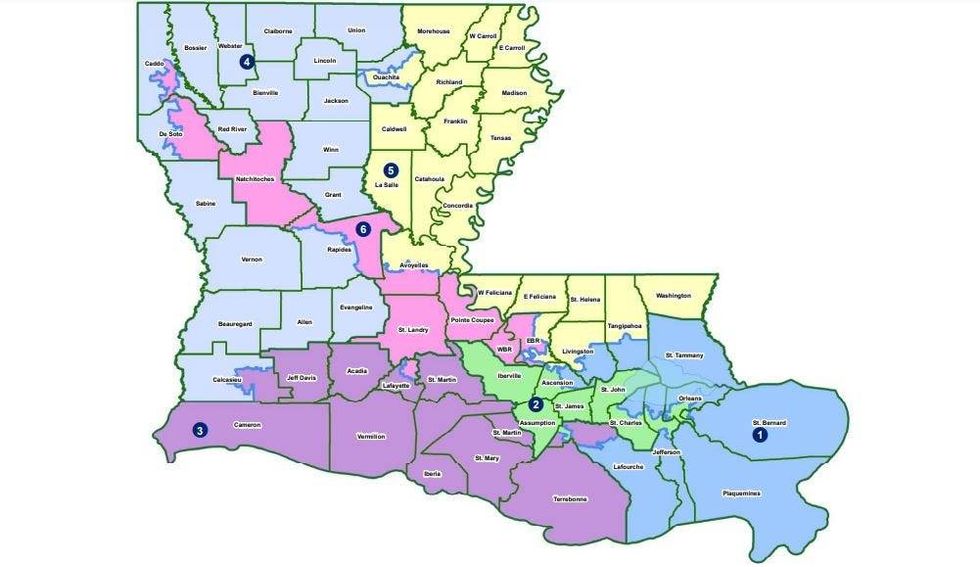
Senate Bill 8 creates a second majority-Black congressional district. The legislature approved the new House district map after a federal judge ruled that the previous map ordered lawmakers to redraw the boundaries to create a second majority-minority district. Judge Shelley Dick’s order came amid a lawsuit against the state, which claimed that lawmakers intentionally deprived Black voters an opportunity to elect candidates of their choosing because only one out of six districts was majority-minority while the state’s population is one-third Black.
 Louisiana Senate
Although Landry has signed this bill into law, Judge Dick will make the final decision as to whether the new congressional map takes effect. Dick will now review the new boundaries to make sure they comply with the Voting Rights Act. There’s no word on when Judge Dick will render her decision.
House Bill 16 appropriates $1.4 million to the Secretary of State’s office to send out mailers to Louisiana residents informing them of the changes to the state’s congressional districts.
Further changes to congressional elections will come thanks to House Bill 17. That bill will shift Louisiana’s congressional elections from the jungle primary system currently used to a closed party primary system. In addition, Public Service Commission, Board of Elementary and Secondary Education, and Louisiana Supreme Court elections will also move to the closed primary system under this new law. The act grants voters who registered as “No Party” the option to vote in either the Republican or the Democratic primary.
However, voters who registered as “Independent” or as members of a third-party will not be allowed to vote in either primary. Furthermore, no-party or third-party candidates will not longer be allowed to pay an entry fee to run in the race. Candidates running for Congress, BESE, or the PSC will have to receive at least 1,000 signatures from voters in the district in which they are running to get on the general election ballot. Supreme Court candidates will need 5,000 petition signatures to appear on the general election ballot.
House Bill 17’s provisions will not impact the 2024 or 2025 election cycles. That law will take effect beginning with the 2026 midterm elections.
“Today, we began the process of necessary structural change to our election system, allowing for a cleaner, simpler final ballot, and we took the pen out of the hand of a non-elected judge and placed it in the hands of the people,” Gov. Landry said on his official Twitter page after signing the bills.
However, polls show that House Bill 17 is unpopular with a majority of Louisiana residents, many of whom will be shut out of primary elections under the closed party system. According to JMC Analytics pollster John Couvillon, this new law will impact around 956,000 no-party and third-party voters, nearly 31 percent of the state’s electorate. A poll recently conducted by Couvillon found that 56 percent of respondents opposed the change from an open primary system to closed primaries, while only 26 percent of respondents supported the new law.