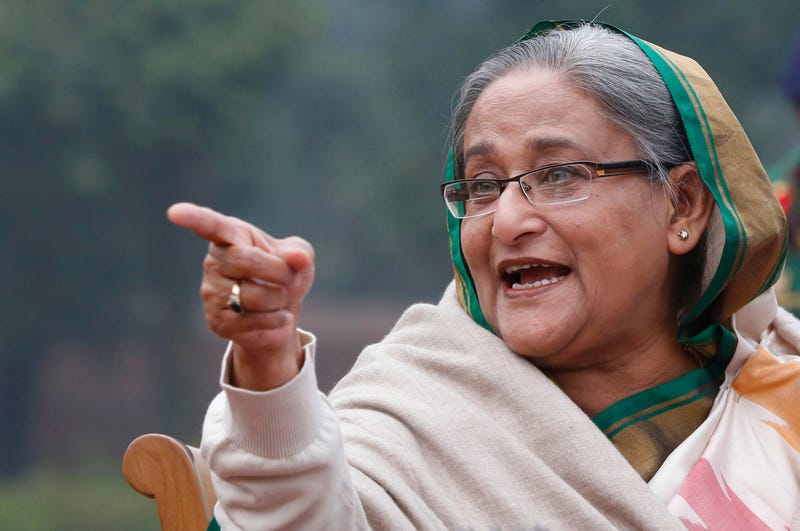
DHAKA, Bangladesh (AP) — From her exile in India, Bangladesh’s ousted leader Sheikh Hasina has slammed the country’s upcoming election after her party was barred from the polls, remarks that could deepen tensions ahead of the pivotal vote next month.
Hasina, who was sentenced to death for her crackdown on a student uprising in 2024 that killed hundreds of people and led to the toppling of her 15-year rule, warned in an email to The Associated Press last week that without inclusive and free and fair elections, Bangladesh will face prolonged instability.
She also claimed that Bangladesh's interim government led by Nobel Peace Prize laureate Muhammad Yunus deliberately disenfranchised millions of her supporters by excluding her party — the former ruling Awami League — from the election.
“Each time political participation is denied to a significant portion of the population, it deepens resentment, delegitimizes institutions and creates the conditions for future instability," she wrote.
"A government born of exclusion cannot unite a divided nation,” Hasina added.
A fraught election
More than 127 million people in Bangladesh are eligible to vote in the Feb. 12 election, widely seen as the country’s most consequential in decades and the first since Hasina’s removal from power after the mass uprising.
Yunus' interim administration is overseeing the process, with voters also weighing a proposed constitutional referendum on sweeping political reforms. Campaigning started last week, with rallies in the capital, Dhaka, and elsewhere.
Yunus returned to Bangladesh and took over three days after Hasina fled to India on Aug. 5, 2024, following weeks of violent unrest. He has promised a free and fair election, but critics question whether the process will meet democratic standards and whether it will be genuinely inclusive after the ban on Hasina's Awami League.
There are also concerns over security and uncertainty surrounding the referendum, which could bring about major changes to the constitution.
Yunus’ office said in a statement to the AP that security forces will ensure an orderly election and will not allow anyone to influence the outcome through coercion or violence. International observers and human rights groups have been invited to monitor the process, the statement added.
The Election Commission says some 500 foreign observers, including from the European Union and the Commonwealth, are expected to watch the polls on Feb. 12.
Worries over what's ahead
Since Hasina's ouster, Bangladesh has faced a slew of political and security challenges.
Human rights and minority groups have accused the interim authorities of failing to protect civil and political rights. Hasina’s party has alleged arbitrary arrests and deaths in custody of its members, claims that the government has denied.
Critics have also voiced alarm over the growing influence of Islamist groups and attacks on minorities, particularly Hindus.
There are also growing concerns over press freedoms under Yunus, with several journalists facing criminal charges and the offices of the country’s two leading dailies coming under attack by angry protesters.
Meanwhile, the Bangladesh Nationalist Party, led by Tarique Rahman, 60, has emerged as the leading contender in the vote.
Rahman, the son of former Prime Minister Khaleda Zia — Hasina’s chief rival who died last month — returned home in December after more than 17 years in self-imposed exile. He has promised to work for the stability of this South Asian nation of 170 million people.
Rahman's main rival in the February vote is a coalition of 11 allied groups headed by an Islamist party, the Jamaat-e-Islami.
Under Hasina, Jamaat-e-Islami was under severe pressure and barred from elections. Its top leaders faced executions or prison terms on war crimes charges related to Bangladesh's independence war against Pakistan 1971.
The Bangladesh Nationalist Party, or BNP, boycotted elections in 2014 and 2024. It took part in 2018 but later accused Hasina of rigging the polls.
Hasina says the nation must ‘heal its wounds’
Critics have long accused Hasina of presiding over an increasingly authoritarian system. She also faced criticism over suppression of dissent and of her political opponents, with security agencies under her government facing charges of enforced disappearances.
Still, Hasina has dismissed the Bangladesh court that sentenced her to death in absentia on charges of crimes against humanity over the uprising killings as a “kangaroo court."
International rights groups have raised concerns about the fairness of the trial.
In her email to the AP, Hasina said that to move forward, Bangladesh needs to break the cycle of political bans and boycotts. She contended that under her government, some elections were "not truly participatory because major political parties chose to boycott democratic processes.”
“I recognize this was far from ideal,” she said, adding that Bangladesh’s political parties must now end that cycle. “Otherwise, there will be no redemption.”
The country, she added, “needs a legitimate government” that would govern “with the genuine consent of the people.”
“That is the best way for the nation to heal its wounds,” she said.
___
Saaliq reported from New Delhi.