



Today is Piping Plover Appreciation Day. There’s a group of volunteers who look after the endangered shore birds who would tell you that’s really every day, especially when they’re on local beaches in spring and summer.
They’re in their wintering grounds now.
And we’re looking back at a banner year for the little birds.
The US Fish and Wildlife Service says this was the “most successful year” for the Great Lakes population since the birds were listed as endangered in 1986.
99 nesting pairs. Up from 88 last year. 160 wild chicks and 24 captive-reared chicks.
There were a record-breaking 184 fully-fledged chicks, meaning they grew all their feathers and were capable of sustained flight.
"There were so many challenges between wildfire smoke and the crazy weather and all this stuff, but the plovers are made of tough stuff and the numbers just keep on growing and hopefully we crack that hundred number next year," said John McElhattan, the Chicago Piping Plovers lead monitor. "That would really be something to be thrilled about."
The results were mixed on beaches where they nest in Chicago and Waukegan.
None of the three chicks that hatched in Waukegan survived.
Two of the four that hatched on Montrose Beach in Chicago survived.
"It hurts when you lose two, you know, we were all gutted when all that happened," McElhattan told WBBM. "We'd love to have all four chicks fledge and fly south, but two is great. It's the numbers we need for recovery."
He said when you take emotion out of the equation, the birds that hatched at Montrose beat the odds.
“It is complicated in wildlife work, you know, we take it so personally because we’re out there, but when you’re talking in a more scientific perspective, fledging two chicks like we did at Montrose and having two migrate is above the average per pair for wild piping plovers.”
Four eggs were saved from the season's first nest in Waukegan that was washed away by waves. They later hatched in captivity.
The birds have come a long way since the plovers named Monty and Rose made history in 2019, becoming the first to nest in Chicago in about 70 years.
Tamima Itani, who coordinates volunteers at Montrose, wrote, "It was the beginning of a seemingly improbable survival story that has turned into generations of Piping Plovers nesting on Chicago’s shoreline."
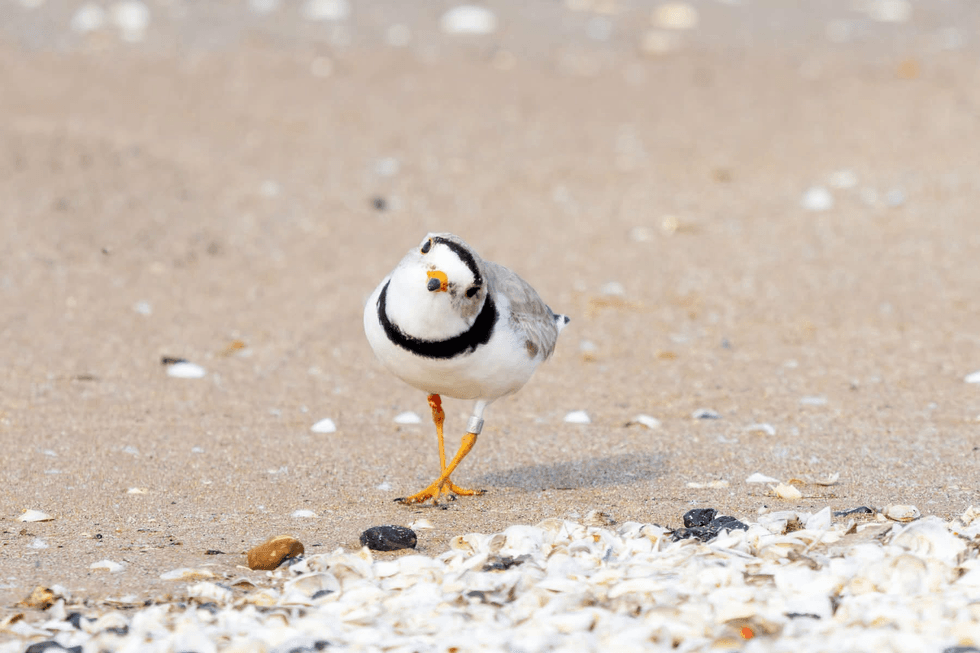 A piping plover on Montrose Beach in ChicagoChicago Piping Plovers
Press release:
The U.S. Fish and Wildlife Service announced results from the Great Lakes piping plover nesting season, marking 2026 as the most successful year since the population was first listed as endangered in
1986. Notable results include:
—99 piping plover pairs nested in the region this year, up from 88 pairs in 2025
—160 wild chicks and 24 captive-reared chicks fledged, bringing the total to a record-breaking 184 fully-fledged chicks
—13 zoos participated in the captive rearing program
—Piping plovers nested on all five Great Lakes, an ongoing trend since 2017
“Local volunteers continue to play a vital role, contributing many hours of their personal time to monitoring, outreach and education,” said Jillian Farkas, U.S. Fish and Wildlife Service lead biologist for Great Lakes piping plovers.\
“With 99 pairs nesting in 2026, we remain hopeful that it’s possible for these plovers to reach their recovery goal of 150 breeding pairs.”
Effective strategies like captive rearing, nest monitoring and habitat restoration have been consistently employed thanks to support from a network of partners and volunteers. This season, captive rearing efforts resulted in 24 chicks fledging that, otherwise, would not have survived.
There were once an estimated 500 to 800 pairs of piping plovers nesting in the Great Lakes region, but by 1990, that number declined to about a dozen pairs, all in northern Michigan.
This year’s milestones continued an upward trend thanks to decades of recovery efforts, a dedicated community of conservationists, and a bit of luck.
Although the birds have now flown south for the winter, everyone can play a role in piping plover conservation.
Remember to give shorebirds plenty of space, keep dogs on leashes, and support conservation efforts that ensure beaches remain dynamic ecosystems.
You can report piping plover observations through various citizen science projects.
Since 2010, the U.S. Fish and Wildlife Service’s restoration work and recovery efforts for the Great Lakes piping plover have been bolstered by funding from the Great Lakes Restoration Initiative, a collaborative effort led by the Environmental Protection Agency with 16 federal agencies.
Post by Chicago Piping Plovers
Reflections on this Plover Appreciation Day
When Rose and Monty chose Montrose Beach for nesting in 2019, it was the beginning of a seemingly improbable survival story that has turned into generations of Piping Plovers nesting on Chicago’s shoreline.
We became part of something bigger, Great Lakes bigger.
Piping Plovers, small, sand-colored shorebirds, nest on beaches across the Great Lakes where thousands of us walk, swim, and play every summer.
The endangered Great Lakes population of Piping Plovers has fewer than 100 breeding pairs left in the world.
That’s changing, for the better.
Every year, we come together during breeding season to keep these little families safe. Community protecting community.
The recovery effort is a model of community science and civic engagement. Scientists, researchers, local, state, and federal agencies and institutions, and volunteer monitors work in coordination to give a fragile species room to survive wherever they choose to nest from the remote to alongside a major metropolitan area.
On this Plover Appreciation Day, it's worth reflecting on what "sustainable city" really means for us in Chicago.
It is not just energy or transit, but whether our urban ecosystems can still support wild things.
Chicago's motto is "Urbs in Horto." City in a Garden. The plovers are a measure of whether we mean it.


