

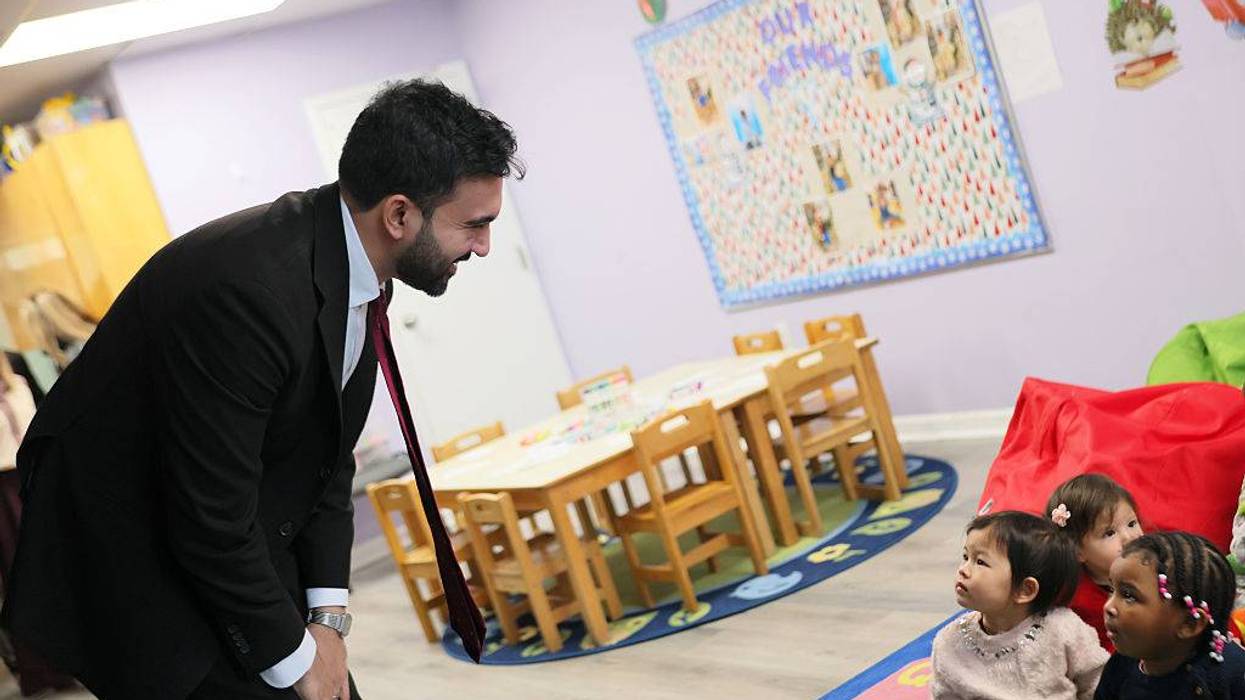

NEW YORK (BLOOMBERG) — Mayor Zohran Mamdani’s promise to expand universal child care to babies as young as six weeks of age was part of the affordability message that propelled him to a surprise victory in last year’s election. So far, his administration has focused on extending existing programs for 3- and 4-year-olds — at schools, centers or home-based daycares — to 2-year-olds.
But new research suggests many parents want something different for younger children, raising questions about what “free universal child care” should actually look like for New York City toddlers and infants.
A survey of 4,306 city parents and caregivers found an overwhelming preference for parental or other informal care during a child’s first two years. Only 13% of respondents said they would favor formal daycare or school-based programs for infants, rising to 27% for a 1-year-old, according to the survey, led by the Robin Hood Foundation and New America’s New Practice Lab. Seven in 10 said they would prefer care by a parent for babies under a year old, and four in 10 said the same for 1-year-olds. The balance shifted at age 2, when about half said they would choose a formal child-care or school-based program.
“A universal child care strategy cannot fully meet parents’ needs without addressing their ability to take time away from work” during a child’s first year, researchers wrote in the report released Thursday. They urged city and state officials to also consider expanding subsidies or other direct financial support for families who prefer parental care or help from relatives and other informal caregivers.
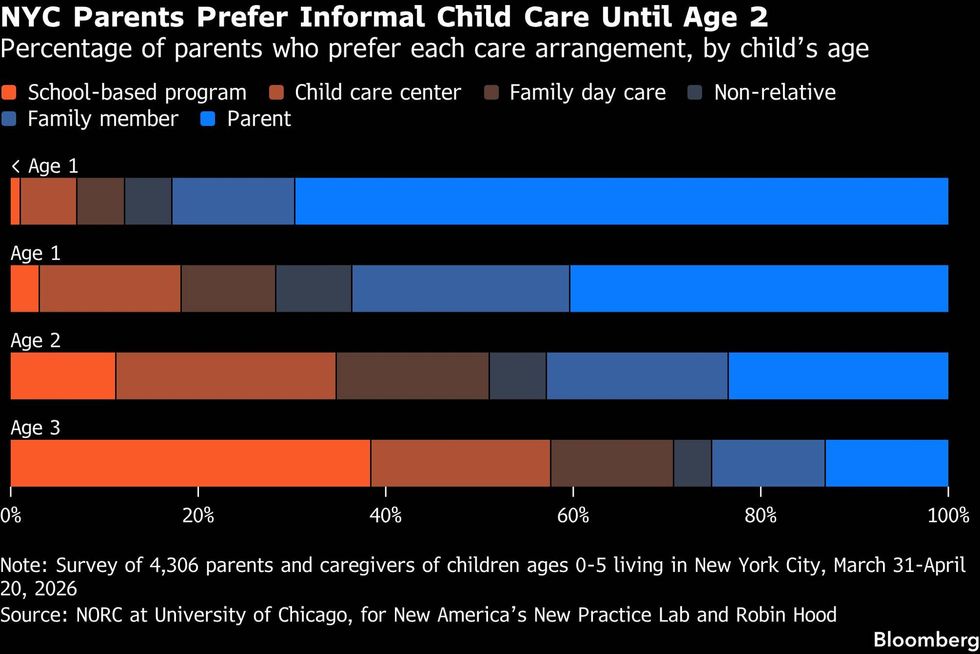 Graphic on the percentage of parents who prefer different childcare arrangements using information from NORC at University of Chicago.Bloomberg
Mamdani has yet to spell out what universal child care would look like for children younger than 2. Before last year’s primary, he said the city would “subsidize child care at home, for families who prefer to have a trusted neighbor or relative take care of their child,” but offered few details on how that would work. Around the same time, he estimated that a universal child care plan could cost $6 billion a year.
Outside groups that have assessed his proposals have generally assumed that care would be provided in formal settings. Those estimates have put the annual price tag at about $9 billion, with infant care almost twice as expensive as care for older children.
Universal pre-kindergarten and 3-K have been popular New York City entitlements since they were introduced under former Mayor Bill de Blasio. Mamdani and New York Governor Kathy Hochul have begun extending the model to 2-year-olds in select neighborhoods, with 2,000 seats this year and plans to reach 12,000 in 2027.
In a statement announcing the survey results, Mamdani said parents’ voices “must be our north star” in mapping out a plan.
“These findings affirm both the scale of the work ahead and the direction we are taking: expanding 2-K and 3-K, helping families get the care they need, and building a system that works for every family, not just those who can afford it,” he said. The statement didn’t address a potential program for the youngest children.
Still, expanding parental leave or offering direct payments to parents who stay home or rely on a family member could prove politically and financially complicated. New York State already has one of the most generous parental leave plans in the nation, providing up to 12 weeks at two-thirds of a worker’s average weekly wage, capped at $1,228.53. The benefit is funded by employee payroll contributions.
Researchers acknowledged that making formal child care programs free could increase demand among families with younger children. But they also encouraged the city to build “individualized, informal arrangements for those parents who want them” into any universal system. Enhancing parental leave, they said, could be more appealing to families and more efficient, given the relatively high cost of formal infant care.
“We're in this moment where we're collectively defining as a city what ‘universal child care’ means and what it should be,” said Alyson Silkowski, a senior policy adviser at New Practice Lab.
While New Yorkers are more willing than parents elsewhere to embrace formal child care as children get older, their preference for looking after their children themselves during the first year roughly matches that of parents elsewhere in the country. “With this survey and with this study we now have directionally a pretty strong signal as of what the interest is” among parents for different types of care in 2026, Silkowski said.
The survey also suggests that the neighborhoods currently receiving free 2-K seats may not be those where demand is strongest. Parents in high-income areas like Brooklyn Heights, Williamsburg, the Financial District and the Upper East Side were more likely to prefer center-based care for 2-year-olds. By contrast, neighborhoods where seats are currently being offered, like Fordham and Washington Heights, ranked in the bottom half of districts by demand. Nonetheless, more than 5,700 families applied for those limited seats, the city has said.