


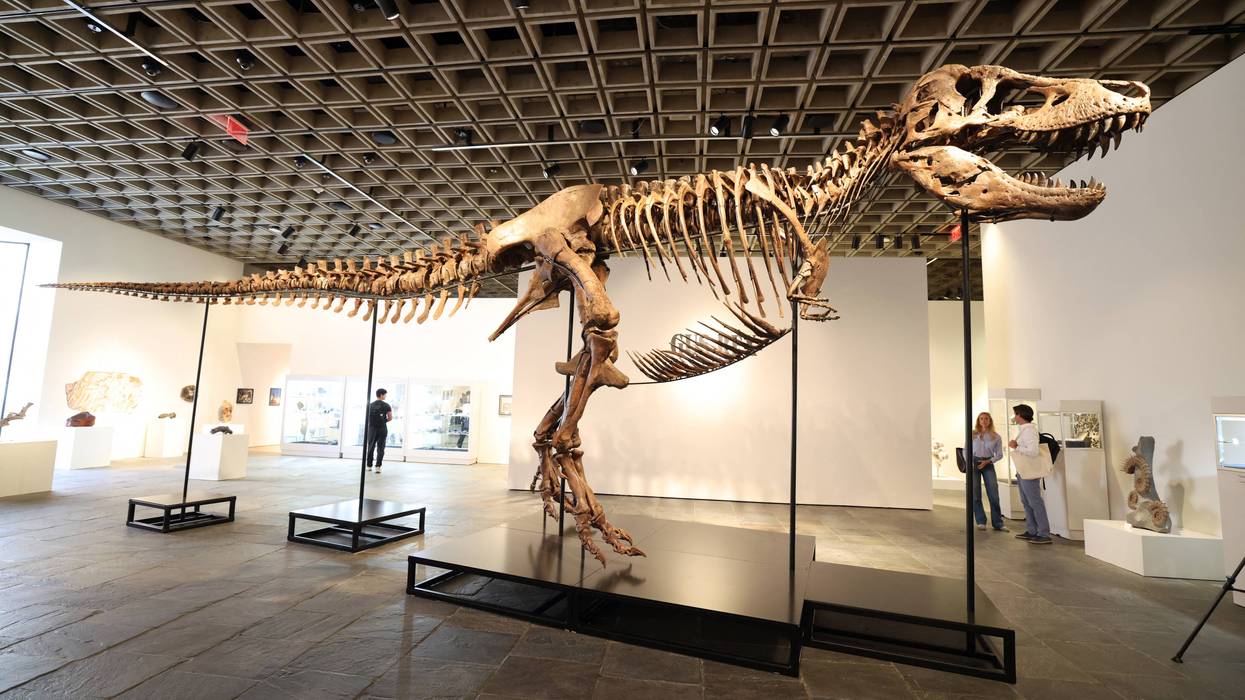

NEW YORK (BLOOMBERG) -- A Tyrannosaurus Rex named Gus sold for $50.1 million on Tuesday, the highest price ever paid for a dinosaur at auction.
Gus, described by the auction house Sotheby’s as one of the largest and most complete dinosaur skeletons ever discovered, was sold after 10 minutes of bidding. It wasn’t immediately clear who the buyer was.
The previous record for a dinosaur fossil at auction was the $44.6 million financier Ken Griffin bid for a stegosaurus named Apex in 2022. The most paid previously for a T. Rex was fetched by a specimen named Stan, which sold at Christie’s in 2020 for $31.8 million, nearly four times its top presale estimate. The winner turned out to be an Abu Dhabi state entity and Stan now graces the newly opened Natural History Museum Abu Dhabi.
Gus was discovered on a cattle ranch in Harding County, South Dakota, and is 61% complete by bone count and as much as 80% complete by bone mass, according to Sotheby’s. Stan was about 65% complete by bone count, which is a measure of how many of a dinosaur’s fossilized bones are real.
“Tyrannosaurus Rex is the most iconic pre-historic species in the fossil record, and Gus stands firmly among the greatest examples ever found,” Cassandra Hatton, head of science and natural history at Sotheby’s, said in a statement announcing its sale.
Dinosaur fossils have drawn increasing interest from investors in recent years as wealthy collectors seek out novel corners of the collectibles market that spark passion and curiosity while also having potential for an attractive return.
The sale of fossils, especially significant ones like Gus, is controversial. Many scientists oppose their private ownership on the grounds that these specimens are rendered inaccessible for research. Even if owners offer to lend their fossils to museums or other institutions for display and scientific study — as many do — they say science requires permanent open access so studies can be revisited and replicated.
The Society of Vertebrate Paleontology, an organization focused on advancing fossil science, put out a statement ahead of Tuesday’s auction reiterating their position that fossils should be permanently held by public research institutions.
“While spectacular dinosaur fossils capture the imaginations of people around the world, SVP emphasizes that specimens of this scientific importance represent far more than rare collectibles,” the statement read.
Still, ultra-wealthy collectors have found ways to collaborate with institutions. Todd Graves, founder of Raising Cane’s Chicken Fingers chain, loaned his triceratops skull to the Louisiana Art & Science Museum, while Griffin’s stegosaurus Apex is on loan to the American Museum of Natural History in New York.
More stories like this are available on bloomberg.com.