
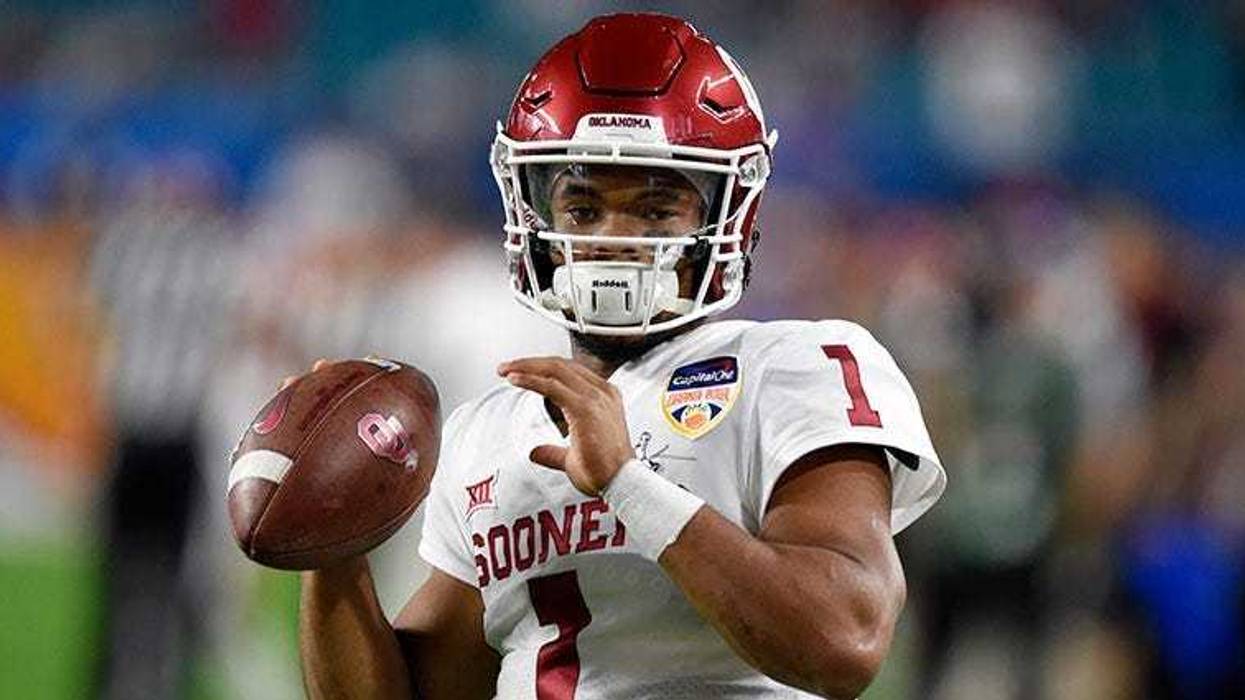

Perhaps the most polarizing player in the 2019 draft class, the Heisman Trophy winner has received a fair amount of praise for his performance in 2018, but he has also seen quite a few join those criticizing Kyler Murray, more so for what he has done away from the football field than on it.
Prior to the June 2018 Major League Baseball Draft, Murray assured general managers that he was fully committed to playing professional baseball. The Oakland Athletics believed the then back-up quarterback was going to bypass the gridiron for a career on the baseball diamond, selecting him with the ninth overall pick. The outfielder had shown potential, batting .296 with ten home runs, 47 RBIs and ten stolen bases that season, a vast improvement from his 2017 college season, when he struggled to a .122 average through twenty-seven games.
Most other baseball organizations discounted the possibility of Murray ever playing the sport professionally, especially after he announced that he would return to school in 2018 to become the starting quarterback, and eventual Heisman Trophy winner, for Oklahoma. A's decision maker Billy Beane believed that Murray's desire to play baseball in the future had raised his draft stock from being a mere flyer to a serious prospect, as Beane surprised most observers by taking him so high.Not everyone was convinced he was truly bent on giving up football, after being one of the top players in the country since his high school days.
However, within a couple of days of drafting him, the A's announced that the two sides had agreed on contract demands. A's scouting director Eric Kubota explained his team's decision to draft him thus: "I think, as a staff, we just felt like Kyler was a unique talent, and it's something that you come across rarely in what we do. The risk of the football was, in our opinion, outweighed by the upside on the baseball field."
Murray had reached that "sports crossroads" in the past, as he decided to not enter the 2015 MLB draft while coming out of high school to concentrate on playing football. At Allen (Tex.) High School, the consensus five-star recruit led his team to three straight state titles, as he never lost a game as a starting quarterback (43-0). He rolled up 14,500 rushing and passing yards and totaled 186 touch-downs in his three seasons. He went on to become the first player ever selected to play in Under Armour All-American games for both football and baseball.
Murray first enrolled at Texas A&M, the university where his father, Kevin, starred as a running back (1983-86) and finished career holding virtually every season and career passing record. Kevin was also inducted into Texas A&M Athletic Hall of Fame in 1999 and the Cotton Bowl Hall of Fame in 2012. His son lasted eight games at the school, starting three of the eight games he appeared in during the 2015 season.
That year, Murray connected on 59.5% of his tosses (72-of-121) for 686 yards, five touchdowns and seven interceptions, adding 335 yards and a score on 63 carries (6.3 ypc). He then transferred to Oklahoma, sitting out the 2016 campaign before backing up 2017 Heisman Trophy winner, Baker Mayfield.
With Mayfield having been selected first overall by Cleveland in the 2017 draft, the Oakland A's granted him permission to return to school and play football in 2018. He would go on to have a banner season, as the consensus All-American completed 260-of-377 passes (69.0%) for 4,361 yards, 42 touchdowns and seven pass thefts. He also rushed for 1,001 yards and twelve scores, joining Clemson's Deshaun Watson (4,104 yards passing, 1,105 rushing in 2015) as the only players in NCAA Football Bowl Subdivision annals to pass for at least 4,000 yards and run for at least 1,000 yards in the same season.
Having ease some concerns about his height and weight at the 2019 NFL Scouting Combine (checked in at 207 pounds and measured 5:10.1), Murray breaks the mold for teams that generally feel a tall quarterback was designed by the football gods. The Sooner has shown good long ball accuracy, as he led the nation with an average gain of 11.58 yards per pass attempt. Among the draft eligible passers, he ranks seventh with an average depth-of-target gain of 11.66 yards.
Only late round/free agent, Taryn Christion (107.9) recorded a better passer rating than Murray's 103.3 when under pressure, as the Sooner completed 37-of-66 of those attempts with six scoring strikes. Like Penn State's Trace McSorley, Murray did not fare as well when having to air the ball out, as he ranked 18th in the deep passing category, hitting on just 49.35% of those chances (38-of-77) for 1,468 yards and sixteen touchdowns, but five of his seven interceptions came from tossing the long ball. Working with much more inferior receivers, McSorley only completed 20-of-59 deep passes (33.89%).
Murray is a shorter quarterback prospect with adequate bulk on his frame, but it is his athleticism that truly stands out. He has that blazing speed and impressive elusiveness to escape pressure and create big plays running through tight quarters. He is no by a strong athlete, but more like a speedy outfielder, but that burst allows him to accelerate well once he gains a step. With over 1,000 yards rushing, he can certainly create with his legs once he gets into the open field.
Murray also displays enough short area quickness to make things happen, but his lack of bulk and power could lead to injury issues vs. massive NFL defensive linemen. For his size, he showcases a solid arm, as he can spin a clean football, snap his wrist to generate torque and can get the pigskin down the field. His deep ball troubles begin when he fails to keep a natural base.
Size issues are evident vs. a big defensive line, forcing Murray to bounce up and down in order to see over the line of scrimmage. When he does have a clean throwing lane, he's very accurate with the football, showcasing natural rhythm for the passing game. Known for his ability to be a creative passer on the move, he will miss on his long throws and his accuracy will suffer when he doesn't stay balanced with his base.
When Murray is pressured, he has the ability to gain huge chunks of yardage on the ground (averaged 7.1 yards as a collegian). He's also conscious of protecting the ball, turning it over via fumbles just twice last season. When he looks for the "home run," he can be effective, but there are times, mostly due to his height, that he struggle to find secondary receivers in their routes. He does exhibit a good feel for twists and stunts, keeping his eye level down the field to side-step pressure without much effort and he's also a tough cookie who will deliver the throw in the face of a rush.
NFL draft analysis provided exclusively to 92-9 The Game courtesy of The NFL Draft Report...