

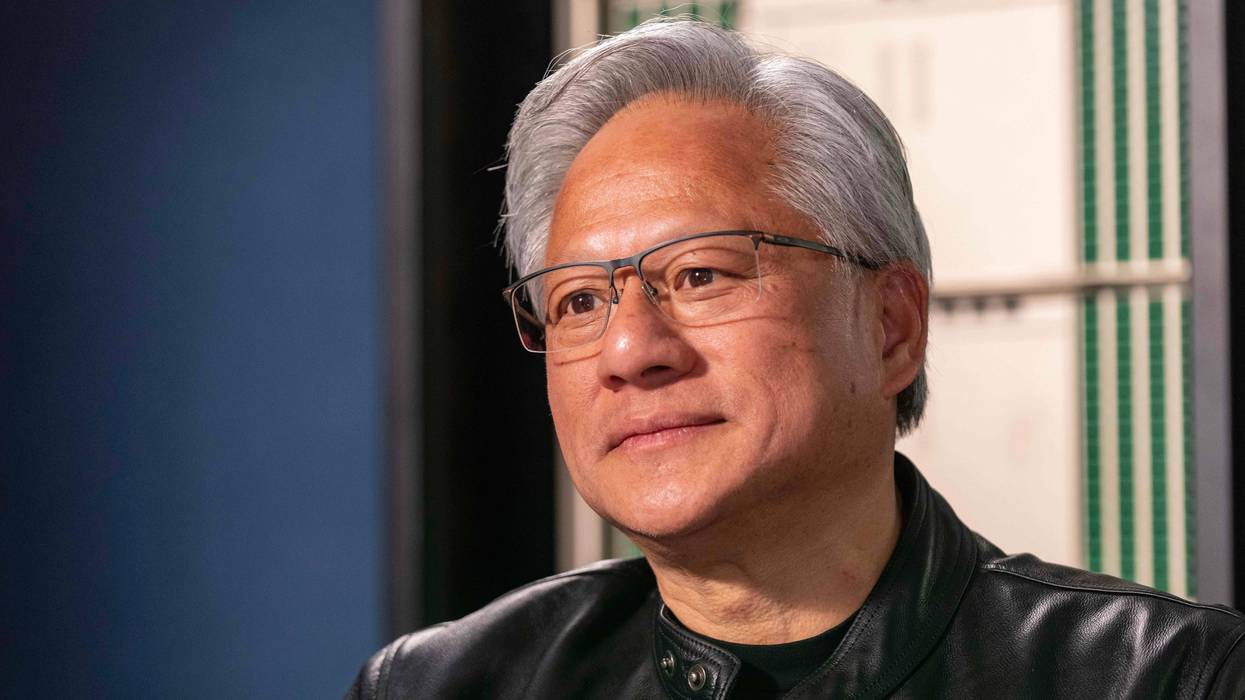

SHERMAN, Texas (AP) — Nvidia CEO Jensen Huang — whose work helped enable artificial intelligence — stressed in an Associated Press interview Tuesday that society has no choice but to change in the advent of AI.
Huang has been optimistic about the technology’s potential to rapidly change society, creating faster economic growth and more scientific breakthroughs. But as the head of a computer chip company now developing AI systems, Huang has felt obligated to respond to critics who warn of job losses and threats to humanity itself.
“We need to create new social norms,” Huang said in an interview. “I would advocate that everybody use AI. Just go engage it.”
Huang made his case as AI has emerged as a political flashpoint, with objections to plans to build more data centers and fears that the speed with which it’s being adopted could spur the layoffs of workers who might not have a safety net. Such questions have threatened public support of the technology.
His close relationship with President Donald Trump has been a source of criticism among Democrats, even as he makes the case that the computing power created by AI is key to adding the factory jobs that have been promised for decades without much enduring success.
He said the ability of AI to build a website, analyze complex documents, guide advanced research or even plan a kitchen remodeling has helped to close the technological divide in America. People can now do advanced work on computers without having to know how to program or write software, he added.
Huang stressed that there is a need for government regulation and safety standards for AI, emphasizing that national security also needed to be a priority for the technology that has been powering stock market gains and much of the U.S. economy in recent years.
The head of the world’s most valuable company said society will adapt to AI just as it did to automobiles. He said cars were once portrayed as killing children, but the world changed its norms by having sidewalks and crosswalks and stopping kids from playing in the streets.
“When I was growing up, I used to play in the streets,” Huang said. “When cars came along, you obviously can’t play in the streets now.”
Huang skeptical of what government ownership of AI companies would achieve
With a market capitalization of roughly $5 trillion, Nvidia has soared in valuation in recent years to become the world’s most valuable company. AI modeling companies OpenAI and Anthropic are potentially set to also clear the $1 trillion mark once their stocks are publicly traded.
That explosive surge in wealth concentrated in AI companies has prompted renewed worries about economic inequality. Trump has tried to defuse those concerns, recently musing about the prospect that the U.S. government could own some shares in AI firms, so any windfalls would be more broadly shared with the public. That idea has also been advanced by Sen. Bernie Sanders, I-Vt., and even OpenAI CEO Sam Altman.
Huang expressed skepticism about the idea, saying he expects the country will already benefit broadly from AI advancements.
“I’m not exactly sure what they’re trying to achieve,” he said regarding government ownership. “I haven’t had a dialogue with them about that. But just remember that these are American companies. Their success benefits the stock price, of which many Americans are investors in. It generates taxes, which helps many Americans. It creates a lot of jobs.”
He noted that AI companies could also lead to higher profits for energy, construction and hardware technology firms.
“Americans have a stake in American companies already, naturally, in a whole lot of different ways,” Huang said.
Huang says national security needs to be a priority on AI
The Trump administration has recently reversed course from using a light touch on regulating AI to taking a heavier hand.
It placed export controls on the AI company Anthropic’s latest models, leading the company on Friday to shutter all public access to those models over security concerns. Trump, a Republican, also signed an order to have new AI models voluntarily vetted by the government.
Huang said the government was properly focused on national security issues, but it was important to provide clear guidance when taking restrictive actions, as doing so could lead to unintended consequences.
“National security should always be the top concern of all technologies,” Huang said. “But having said that, you know, you have to be very specific about the risk that you’re concerned about, before setting up policies for export controls.”
During the Biden administration, Nvidia pushed back against export controls that were designed to restrict its ability to sell chips to China, rejecting the administration’s premise that a ban would guarantee an American edge on AI. Huang had warned that the export controls might limit America’s ability to develop the world’s AI ecosystem, as China would respond with its own advanced chips.
Huang says energy is key problem for America’s AI development
Huang stressed that while the U.S. has many strengths on AI, it is vulnerable because of a lacking energy infrastructure. The data centers performing the computations used in AI are creating a huge demand for electricity, which could be a strain on the power grid.
Some data centers will be constructed with their own electricity sources, but Huang said the U.S. is starting from a disadvantage on energy. And without more energy, it can be harder to play to American strengths in its AI infrastructure, models and computer chip development.
“The United States is woefully behind in energy production,” Huang said. “We just suffocated energy production for too long.”
Huang complimented Trump on his approach to seeking to increase energy production. The president has aggressively supported the use of oil, coal and natural gas, but he has scorned the use of solar and wind power.
The Nvidia CEO was not commenting on Trump's opposition to climate-friendlier energy sources, but the gap he identified goes to some of the fears that U.S. households have about AI increasing their utility bills.
Huang was speaking Tuesday in Sherman, Texas, at an expansion of the Coherent factory to develop a laser for transmitting data among chips, which could cut power use by AI systems by up to 50%.
Trump’s fondness for Huang started at a Mar-a-Lago dinner
Trump, not known for technological expertise, quickly developed a friendship with Huang. The president has called him “smart,” a “friend” and “amazing," insisting that Huang accompany him on foreign trips. Most recently, Trump had Air Force One pick up the leather-jacketed CEO in Alaska while en route to his state visit to China.
Their relationship started last year with an invitation to dinner at Mar-a-Lago, Trump’s home and private club in Florida. Huang was in the area to receive the Edison Achievement Award for his AI work.
“He says drop by for dinner, and so I did,” Huang said. He went with his wife, Lori.
“He was incredibly engaging, incredibly charismatic, conversational, asked a lot of questions,” Huang recalled. “From the moment that I met him, the only thing that he’s ever talked to me about is creating more jobs, reindustrializing the United States, protecting national security, winning.” He added that Trump "calls me in the middle of the night and wants to talk about one of these topics.”
But his proximity to Trump has also led to criticism from Democratic lawmakers. Sen. Elizabeth Warren, D-Mass., objected to Huang not testifying before a Senate committee even as “he has time to attend a $1 million-a-head dinner at Mar-a-Lago."
Huang said he wants the U.S. president and other officials — regardless of party — to succeed. “We could differ with politics, but we should want him to succeed," he said. "Because when President Trump succeeds, our country succeeds.”