

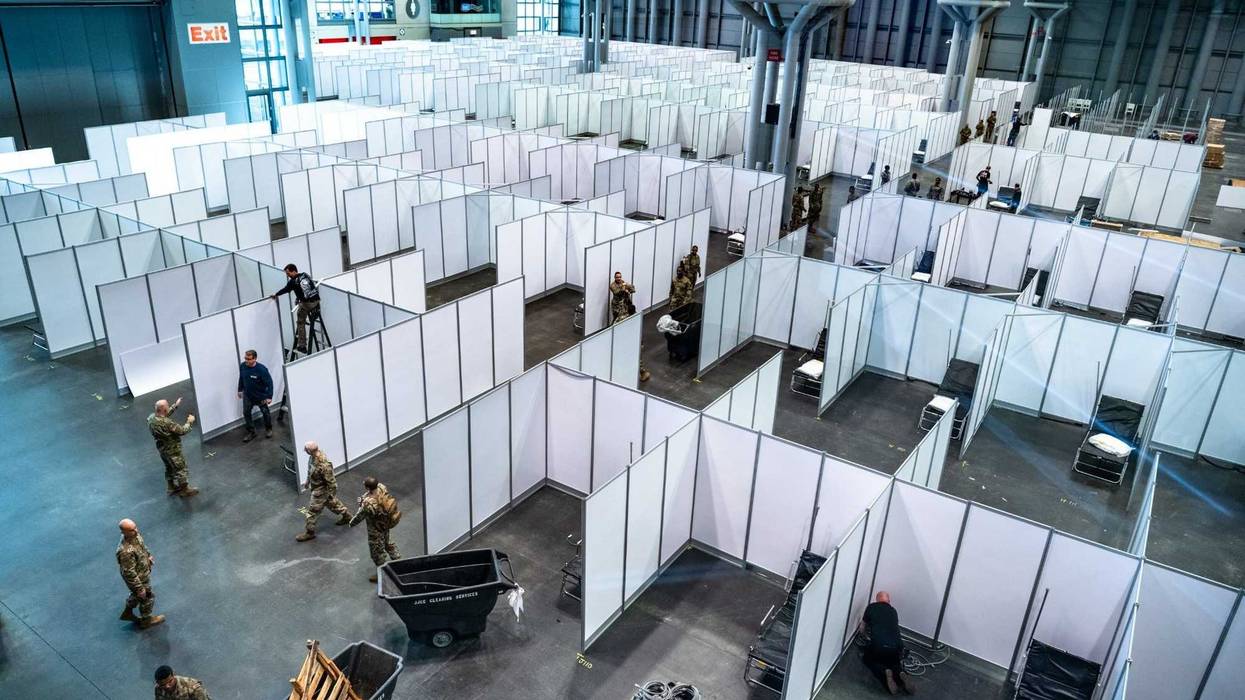

Across the globe, Department of Defense personnel are graduating early, coming out of retirement, and deploying to help in the fight against COVID-19. The country has seen makeshift hospitals, renovations, mobile testing centers, National Guard activations, and more.
But the Department of Defense is seeing higher rates of infection among its own ranks than the general civilian population. So, what is the Department of Defense doing to protect its own? While the Pentagon has hesitated to implement force-wide policies — with the exception of a stop movement order and increasing the health threat level on all installations to HPCON Charlie — branches are implementing some of their own policies.
Air Force
Last week, Ramstein Air Base in Germany sent an En-Route Patient Staging System (ERPSS) to Aviano Air Base in Italy. The ERPSS was delivered to the Italian Ministry of Defense to aid with the country's ongoing battle against coronavirus.
The US Air Force flew this patient staging center to Italy to help
But from last Sunday to Thursday, the Air Force saw a 209 percent increase in reported COVID-19 cases with a total of 105 airmen testing positive.
A cadet at the Air Force academy also tested positive one day after the university announced that a faculty member had also tested positive.
Most space-available travel has been suspended and non-essential personnel are working remotely, but the Air Force continues flight operations and basic military training.
Army, National Guard
The Army, like some other branches, has shifted recruiting efforts to a virtual platform, made temporary changes to retention and promotion processes, and adopted the Department of Defense's force-wide elevated health protection levels.
And as of Sunday morning, more than 14,000 Air and Army National Guard personnel had been activated in the fight against COVID-19.
Concerns remain, however, that directives from senior officials in the Pentagon are not trickling down to installation-level operations, putting service members at unnecessary risk.
How do you social distance in formation, on submarines, and in tanks? You don't
Military personnel from installations across the globe reached out to Army Times through a solicited call for conditions reports. At all of these installations, daily operations, PT formations, close-quarters training has gone on uninterrupted with no moves to implement CDC guidance. Service members exhibiting symptoms are being turned away for testing — back into the field with countless other soldiers, according to the Army Times report.
Esper said in a press briefing on Monday that he is aware of these inconsistencies.
"It's unique by the type of unit. It's unique by the mission. It's unique by the location and any other number of factors," Esper said. "Now, in other cases where we could clearly have done better, we clearly could have done better, and we will continue to work to do better. But again, I have to trust our commanders and our senior NCOs are taking all the right precautions."
Of the two Department of Defense-affiliated COVID-19 deaths, one was an Army spouse based out of Joint Base Langley-Eustis in Virginia. The other was a Defense contractor working out of Crystal City also in Virginia.
Navy and Marine Corps
Over the weekend, the second of the Navy's two hospital ships left port to support COVID-19 measures. The USNS Comfort arrived in New York City Monday and will begin seeing patients on Tuesday. The USNS Mercy is performing a similar mission in Los Angeles, California.
Navy Hospital ship, USNS Comfort heads to NYC
The Navy has been hit disproportionately hard by the virus — accounting for roughly a third of all Department of Defense active-duty COVID-19 cases by the end of last week.
An entire carrier, the USS Theodore Roosevelt, is testing its 5,000-member crew for the virus after the number of cases on board began to quickly escalate.
Coronavirus sends deployed USS Theodore Roosevelt to port, all crew members to be tested
When cases aboard vessels began to increase some weeks ago, the Navy released press information regarding what was being done on those ships in order to hopefully mitigate the spread of COVID-19. These measures included bleach cleanings and minimizing the number of individuals who were able to travel on and off ships.
How the Navy is trying to stop the spread of the coronavirus on its ships
The Navy has also shut down its barbershops, relaxing some grooming standards to encourage social distancing that's not possible with frequent visits to get haircuts. The Marine Corps did not follow suit on this measure.
The Marine Corps was also directed to begin recruiting virtually — and as of Monday all shipments of new recruits to Marine Corps Recruit Depot Parris Island have been halted.
Space Force
Luckily, one branch has remained largely unhindered by COVID-19.
Space Force continues to stand up despite coronavirus pandemic
Gen. John Raymond the commander of the Space Force says they are following the government's guidance for preventing the spread of COVID-19, and forward progress in standing up America's newest branch of service continues unabated.
—
Want to get more connected to the stories and resources Connecting Vets has to offer? Click here to sign up for our weekly newsletter.
How are DoD personnel on the frontlines fighting COVID-19? 1
 DVIDS
DVIDSHow are DoD personnel on the frontlines fighting COVID-19? 2
 DVIDS
DVIDSHow are DoD personnel on the frontlines fighting COVID-19? 3
 DVIDS
DVIDSHow are DoD personnel on the frontlines fighting COVID-19? 4
 DVIDS
DVIDSHow are DoD personnel on the frontlines fighting COVID-19? 5
 DVIDS
DVIDSHow are DoD personnel on the frontlines fighting COVID-19? 6
 DVIDS
DVIDSHow are DoD personnel on the frontlines fighting COVID-19? 7
 DVIDS
DVIDSHow are DoD personnel on the frontlines fighting COVID-19? 8
 DVIDS
DVIDSHow are DoD personnel on the frontlines fighting COVID-19? 9
 DVIDS
DVIDSHow are DoD personnel on the frontlines fighting COVID-19? 10
 DVIDS
DVIDSHow are DoD personnel on the frontlines fighting COVID-19? 11
 DVIDS
DVIDS