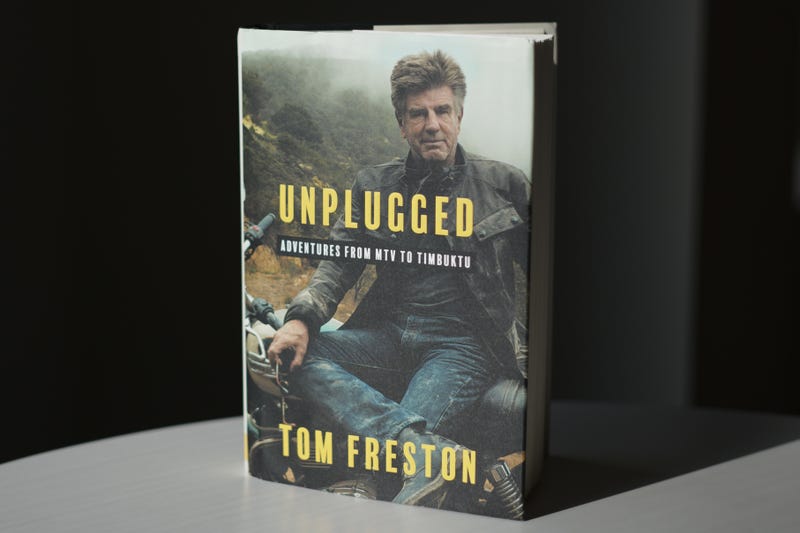
NEW YORK (AP) — Tom Freston could easily fill a book with stories from the formative days of MTV and his celebrity encounters — Bono would merit a few chapters on his own. Ultimately, though, Freston feels that his life has a more valuable lesson to offer.
His memoir, “Unplugged,” shows by example that trying to follow a straight line to success is not the only path.
Freston, 80, was at MTV from the start and became its leader, along with sister networks Comedy Central, VH1 and Nickelodeon, at their greatest periods of success. He rose to become CEO of parent corporation Viacom before chairman Sumner Redstone's impatience led to his ouster in 2006.
Since then Freston has largely freelanced, advising the likes of Oprah Winfrey and Vice, before its implosion. He made a memorable return to business in Afghanistan, and has been chairman of the ONE Campaign, the anti-poverty organization devoted to Africa that Bono spearheaded, for nearly two decades.
“I was improvising,” he said. “It was like a bebop lifestyle, hitting notes instead of having a long, set classical structure.”
His wanderlust unsettled Freston's suburban Connecticut parents when he took a gap year after earning an MBA at New York University. They had reason to believe he had gotten it out of his system when he took a job at a Madison Avenue advertising agency in the early 1970s.
Saying no to a life convincing people to squeeze the Charmin
He soon faced a crossroads when he couldn't muster enthusiasm for a role on his agency's important Charmin account. An old girlfriend said to him: “All those years of school, that fancy MBA degree, and you are selling toilet paper? You're better than that.”
She had a point. It was January 1972, and the woman invited him to hitchhike through France and Spain, then eventually into the Sahara Desert. He left the agency behind.
Thus began several years of travel, where he particularly fell in love with Afghanistan and India. Freston started a business importing clothing from Asia. The company, Hindu Kush, was successful for a time before restrictions on imports during the Carter administration killed it.
Freston landed back in New York. He read an interview where an executive in the nascent cable television industry talked about starting a music network built on videos and reached out for an interview for a marketing job. He met with a 26-year-old Bob Pittman, who wondered about the appearance of “Afghanistan” on his resume.
Pittman suspected Freston was a hashish smuggler, but that “seemed to make him like me more,” he wrote. Hey, it was rock ‘n’ roll. Freston got the job.
To encourage cable systems to carry the new network, Freston directed film crews that ambushed Pete Townshend on a London Street and David Bowie on a Swiss ski slope to record ads saying “I want my MTV.” Its rapid rise has been well documented, and by 1987 Freston was running MTV Networks.
Music always played in Freston's office, giving the young, creative employees the sense that it wasn't a suit in charge. Former employees say he wasn't afraid to take risks and empower people. It was almost a requirement — particularly
once MTV decided it needed to reinvent itself every few years to appeal to young people, rather than follow its original audience as it aged.
His international experience helped him create MTVs for different countries all around the world.
“It was irreverent and edgy and nonhierarchical, a lot of creative people,” he said. “If you tried to run it in a classic MBA style, it would have been rejected.”
Looking in on a ghost network
Several factors led to MTV's demise, among them the rise of streaming that turned many once-popular cable destinations into ghost networks. Record companies wouldn't grant MTV' streaming rights to play music videos online, undermining chances for a digital transformation, he said.
Now, when Freston lands on MTV, “it’s like seeing your old high school burning down,” he said.
From his book, Freston is clearly still stung by his sudden ouster from Viacom. He makes it a point to tell of attempts to get him back. But in retrospect, the timing couldn't have been better.
“It was a good thing, because I'm a loyal guy and I probably would have stayed longer,” he said. “In a way I got fired at the apex of the TV revolution. The digital guys were just starting to have an impact in a big way. So I really didn't have to deal with those unpleasant facts and challenges.”
He was suddenly a free agent, but in demand. Most rewarding was a return to Afghanistan, and working with an entrepreneur, Saad Mohseni, on a television network for the people there. The Taliban put an end to that when they returned to power in 2021 but recently have let Mohseni produce educational programming for girls.
Freston hasn't been back since the takeover. “I had a death sentence put on me by the Taliban,” he said. “They say we're all friends now, but I don't want to take the chance.”
I still haven't found what I'm looking for
It's hard to resist one Bono anecdote. The singer's seduction of Freston to join the ONE Campaign's board was sealed on a late night of partying in the Riviera. It was 5 a.m., closing time at a disco and Bono, a Dublin buddy and Freston were the only ones left besides a few busboys and a waitress.
On the way out, Bono spied a microphone connected to a karaoke machine. “Pick a U2 song,” Bono told the server. “Any one!” She chose “I Still Haven't Found What I'm Looking For,” and the famous frontman channeled Frank Sinatra as he sang his classic. The waitress was the only one left to clap.
Who wouldn't want to have this CEO's life?
Readers of Freston's memoir probably won't greet the dawn with rock stars. He hopes they appreciate the musical notes of his life and apply it to their own.
“Ideally, younger people would find some inspiration in the fact that you don't have to graduate from college and start the next day at Goldman Sachs, and if you don't you have a panic attack,” he said.
“If you're young, you should take some chances,” he said. “Take a risk. Go see the world. The world is the best classroom. Look at the United States from another person's perspective. You'll make yourself more interesting as a candidate for a job when you come back."
___
David Bauder writes about the intersection of media and entertainment for the AP. Follow him at http://x.com/dbauder and https://bsky.app/profile/dbauder.bsky.social.