


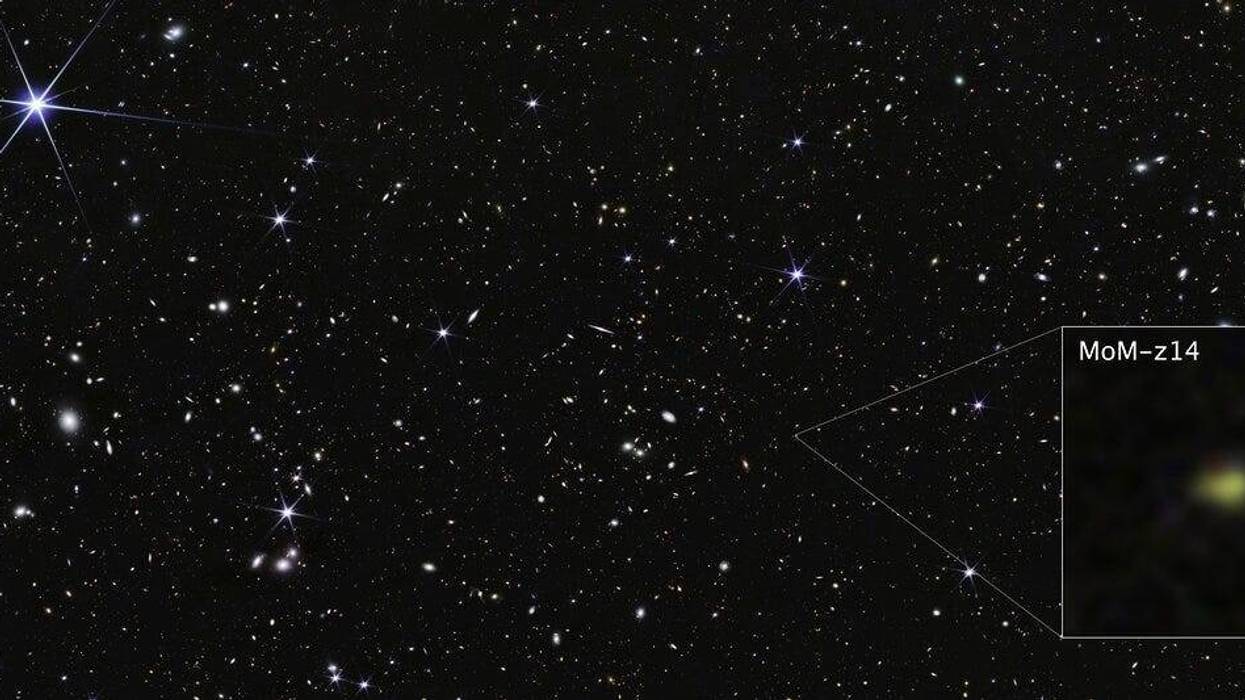

The NASA/ESA/CSA James Webb Space Telescope has once again pushed the limits of cosmic exploration by confirming the existence of a galaxy that formed just 280 million years after the Big Bang—a time in the Universe's history that has long been difficult to study.
The galaxy, known as MoM-z14, was observed using Webb's powerful Near-Infrared Spectrograph (NIRSpec), which allows scientists to precisely measure how much the light from distant objects has been stretched by the expanding Universe—a phenomenon called redshift. Webb's measurements show that MoM-z14 has a redshift of 14.44, meaning its light has been traveling toward us for nearly 13.5 billion years.
What makes MoM-z14 particularly intriguing is that it is brighter than expected for such an early galaxy—about 100 times more luminous than models predicted. These surprisingly bright galaxies are becoming more common in Webb's observations, suggesting that the early Universe may have been more dynamic and complex than scientists originally thought.
Researchers are now grappling with new questions about how galaxies like MoM-z14 formed so quickly and how their environments may have differed from later cosmic epochs. Some early stars in our own Milky Way show unusual chemical signatures—such as elevated nitrogen—that match features seen in distant galaxies like MoM-z14, offering a valuable clue about the first generations of stars.
Another key discovery from MoM-z14 is that it appears to be clearing away the dense, primordial hydrogen fog that filled the early Universe in an era known as reionization—a major cosmic milestone when the first stars and galaxies began to let light travel freely through space. Webb's sensitivity to infrared light is finally making this phase of cosmic history accessible to direct study.
Overall, Webb's continuing observations are reshaping astronomers' picture of the earliest Universe, revealing galaxies that are not only farther away but also more active than expected. Each new discovery sheds light on how the cosmos evolved in its first few hundred million years—bringing us closer to answering fundamental questions about the dawn of galaxies.