

Why did the US want to capture Venezuelan President Nicolas Maduro?

When President Donald Trump announced during the early morning hours Saturday that Venezuelan President Nicolas Maduro, 63, and his wife Cilia Flores had been apprehended by the U.S., it fulfilled a goal stemming from his first term in office.
In 2020, during the last year of the president’s first term, Maduro was charged in the Southern District of New York for narco-terrorism. He was also charged with conspiracy to import cocaine and conspiracy to possess machine guns and destructive devices.
At the time, then-Attorney General William Barr said that “Maduro and a number of high-ranking colleagues allegedly conspired with the [Fuerzas Armadas Revolucionarias de Colombia, also known as FARC], causing tons of cocaine to enter and devastate American communities.” FARC is designated as a foreign terrorist organization in the U.S.
A reward of up to $15 million was announced and that was increased to $50 million this August. In an announcement about the reward increase, the U.S.
Department of State explained that Maduro became president of Venezuela following Hugo Chavez’s death in 2013. It also noted that he “declared victory in a presidential election in 2018,” but that the National Assembly of Venezuela invoked the Venezuelan constitution and declared that Maduro had usurped power and was not the president.
“Since 2019, more than 50 countries, including the United States, have refused to recognize Maduro as Venezuela’s head of state,” the State Department added.
Still, the State Department said that Maduro declared himself the victor in the July 2024 election, “despite evidence to the contrary,” and the U.S. joined other countries again in refusing to acknowledge Maduro as a legitimate leader. Per the State Department, Maduro also “helped manage and ultimately lead the Cartel of the Suns, a Venezuelan drug-trafficking organization comprised of high-ranking Venezuelan officials,” and that he “participated in a corrupt and violent narco-terrorism conspiracy,” with FARC.
According to an article published by the Center for Strategic & International Studies this November, Maduro is unpopular in Venezuela and a recent country-wide poll indicated that most respondents did not consider him to be a legitimate president. It said: “This makes sense after an election that could most generously be called disputed (more accurately, stolen).”
While many Venezuelans dispute Maduro’s legitimacy, the CSIS said his regime has set up checkpoints where officials force people to unlock their phones and check for anti-regime content. It said there is even a “snitching app,” that encourages citizens to report everything they see.
“Perhaps most alarmingly, a Venezuelan citizen was imprisoned for a ‘hate crime’ over a WhatsApp post about gas shortages, and another person was recently detained for posting an AI-generated image showing U.S. military assets off the island of Margarita,” the CSIS said. “These postelection crackdowns on domestic dissent pose real threats to the human rights of Venezuelans; they also signal increasing levels of regime desperation and weakness.”
It also said the situation left room for the U.S. to apply more pressure on Venezuela.
In a press release issued last month regarding sanctions on Maduro’s “illegitimate regime in Venezuela,” the U.S. Department of the Treasury said that former President Joe Biden granted relatives of Maduro clemency in 2022. It also said it was “reversing Biden’s deal with Venezuela.”
Audacy station KCBS reported late last month that the U.S. had carried out its first military action inside Venezuela, a strike ordered by Trump on a Venezuelan dock area that was allegedly associated with a drug boat. Then came his Saturday announcement, followed by a press conference at his Mar-a-Lago estate in Florida.
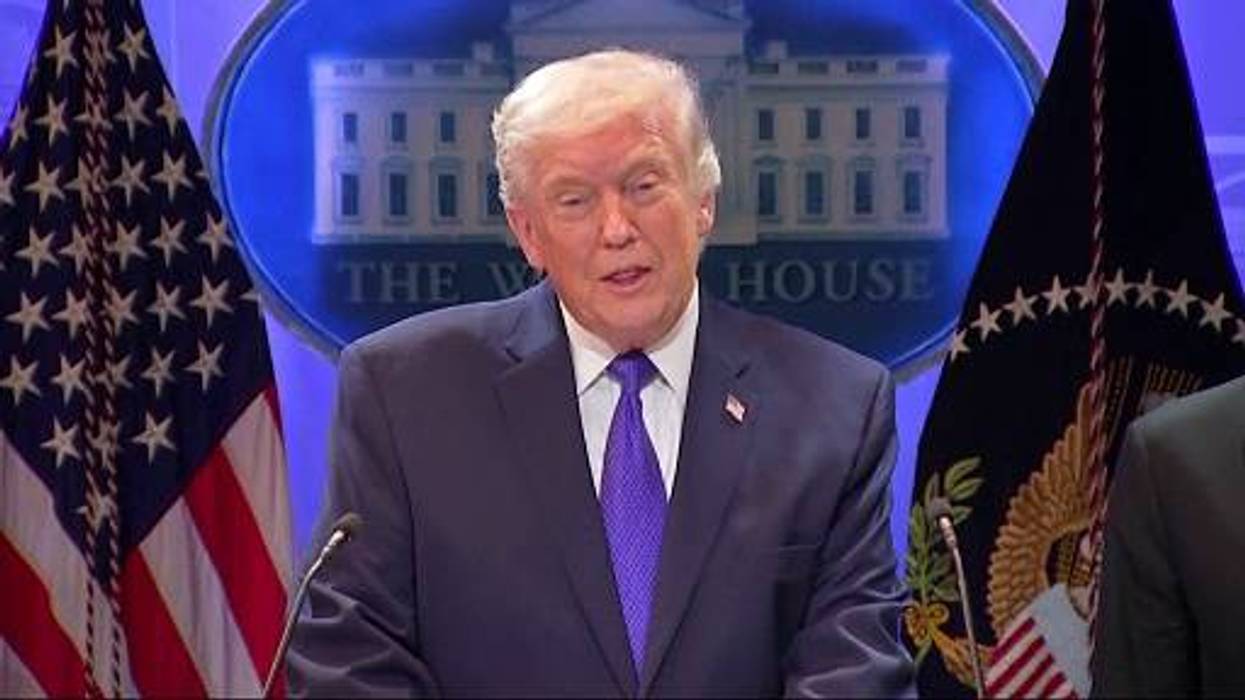
“The United States of America has successfully carried out a large-scale strike against Venezuela and its leader, President Nicolas Maduro, who has been, along with his wife, captured and flown out of the Country,” he said in a Truth Social post. “This operation was done in conjunction with U.S. Law Enforcement.”
During the press conference, Trump said: “We’re going to run the country until such time as we can do a safe, proper and judicious transition.”
Secretary of War Pete Hegseth also spoke during the conference, along with other Trump administration officials. He praised the U.S. forces and law enforcement that worked to apprehend Maduro and highlighted some further reasoning for the action.
“He effed around and he found out,” said Hegseth of Maduro. He also said that “President Trump is deadly serious about stopping the flow of gangs and violence to our country, deadly serious about stopping the flow of drugs and poison to our people, deadly serious about getting back the oil that was stolen from us.”
ABC News said in a Saturday article that Trump’s explanations for actions regarding Venezuela seemed to be “shifting,” over the course of 2025. This shift moved from Trump’s concerns about drug trafficking to his claim that Venezuela and Maduro “stole” oil from the U.S.
“Trump appeared to be alluding to work done in the 1970s in Venezuela by Western oil companies before the government there opted to nationalize its reserves, eventually forcing out American companies,” ABC News said.
Audacy station KYW Newsradio reported that Maduro and wife were on a U.S. warship headed to New York, as of Saturday afternoon and that they are expected to face a trial in U.S. for narco-terrorism. KYW also said that the operation “has faced bipartisan criticism, many questionings whether it was carried out legally,” as Congressional approval is typically needed to carry out acts of war.
Outside of the U.S., a statement issued by United Nations Spokesperson Stéphane Dujarric said: “The Secretary-General [Antonio Guterres] is deeply alarmed by the recent escalation in Venezuela, culminating with today’s United States military action in the country, which has potential worrying implications for the region.”
Dujarric went on to say that Guterres is “deeply concerned that the rules of international law have not been respected.” Other UN officials stressed the importance of keeping Venezuelan civilians safe and note that the country has declared a state of emergency, “with casualty figures and the extent of the damage yet to be confirmed.”
The Venezuelan Government has denounced the act, as has Russian Federation President Vladimir Putin, who called for a full meeting of the UN Security Council, according to The Hill. Trump has been trying to work with Putin – who has received criticism for his own moves to change the Russian constitution in 2020 and declare himself president for life – on securing peace in Ukraine after a years-long Russian invasion of the sovereign nation that is widely seen as illegal.
In the U.S., the actions in Venezuela and the apprehension of Maduro and his wife have also received criticism, mainly from Democratic lawmakers. However, The Hill said that Reps. Thomas Massie (R-Ky.) and Marjorie Taylor Greene (R-Ga.) joined the “chorus of Democratic criticisms.”
“Let’s be clear. Nicolas Maduro is an illegitimate leader,” said Rep. Gregory Meeks (D-N.Y.), a ranking member of the House Foreign Affairs Committee, in a Saturday statement. “But using the U.S. military to attempt regime change in a sovereign foreign nation, without approval from Congress, without a defined objective or plan for the day after, and without support from our allies, risks entangling the United States in an open-ended conflict in Venezuela that could destabilize the entire region. This action is also a violation of international law and further undermines America’s global standing.”
House Minority Leader Hakeem Jeffries (D-N.Y.) also called Maduro a “criminal and authoritarian dictator,” but criticized Trump for not seeking congressional authorization for use of military force.
“Far too many questions remain unanswered, including with respect to whether further military actions are planned,” said Jefferies. “First, how many American troops remain on the ground in Venezuela? Second, what does America is going to run Venezuela until a judicious transition takes place mean? Third, were these military strikes about seizing foreign oil to benefit friends of the Trump administration? Fourth, why did Donald Trump pardon the former Honduran President, a narco trafficker convicted in an American court of law, but is willing to take us to war in Venezuela in connection with similar allegations?”
Many Republicans, however, lauded the president and his administration’s actions.
“The operation carried out last night capturing Nicolas Maduro is another win by President Trump to protect our homeland and clean up the backyard of the United States, which began on January 20, 2025,” said Rep. Brian Mast (R-Fla.), House Foreign Affairs Committee chairman. “Drug lords and terrorists will no longer operate freely in our hemisphere, and drugs and illegals will not flow into our country. Thank God the American military is positioned off American shores to protect the people of the United States of America!”
“Nicolás Maduro is a narco-terrorist who is responsible for the deaths of many Americans. I applaud President Trump, our national security leaders, and our military personnel responsible for apprehending Maduro,” said U.S. Rep. Ken Calvert (R-Calif.) “He will now face justice for his deadly crimes. I spoke with Secretary of War Pete Hegseth earlier this morning and congratulated him for a successful mission. I was relieved to hear no service members were killed during the operation. Over the past year, the world has seen America will no longer tolerate anyone who harms our people, including drug trafficking. The Trump Administration is correctly making the safety of America our highest priority.”