

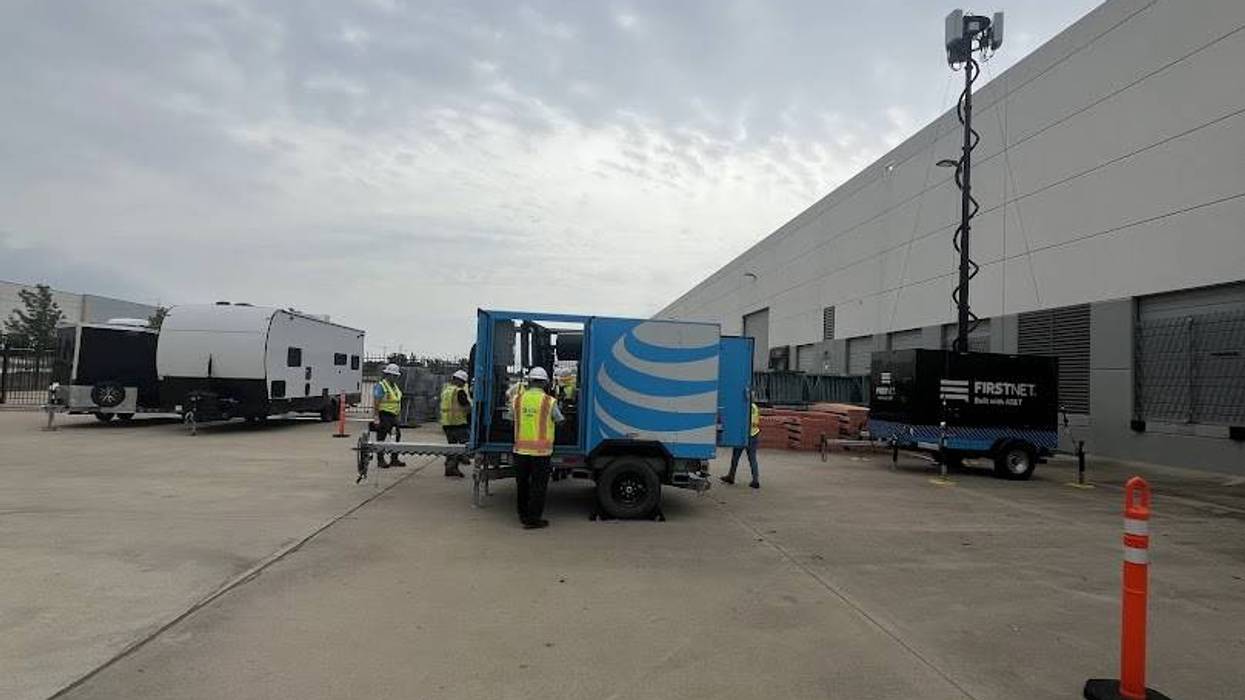

AT&T has brought employees from 14 other states to Texas this week for training on how to respond to a disaster. The company says workers are learning and getting certification for tasks like how to move and set up generators or mobile cell sites.
"It's a lot of complexity, a lot of equipment out there. We couldn't do it without those other AT&T employees who come out to help," says the company's Kelly Morrison. "This basic training is about their safety and so they know our processes."
Network Disaster Recovery support teams include employees who might typically work in AT&T offices or technicians.
"They've decided they want to be part of a team whose mission is bigger than just a cell phone," says AT&T's Shannon Browning. "As such, they come and join the team. Tomorrow, you might see that person in an AT&T store helping you with your bill. Today, they're out here training."
Employees worked with equipment and worked together toward common goals.
"This week is all about getting more employees across AT&T into the pool of responders so we can have a greater presence across the organization," says Juli Whitehead, an employee who was working on a support team. "This week, I'm learning about technology, I'm learning how to communicate during a disaster. We're learning about being on-call, learning how to tow generators and how to turn on a generator, bring power in, how do you set up satellite technology?"
Whitehead says support teams train together and will be prepared for different seasons where snow and ice might cause different types of damage than tornadoes or flooding.
"This is the 'why.' Connectivity really does change everything," she says. "Going in and seeing our first responder teams being unable to communicate with search and rescue until we get there, giving them the connectivity they need in order to do their job and give families answers."
She says workers practice together on different jobs from operating technology to running the fleet of cars and trucks. The company's Browning says AT&T has five hubs spread across the country that can respond quickly whether they are called to a flood, wildfire, tornado, hurricane or other disaster.
"No matter where we are in the United States, we have crews, we have assets that can marry up to meet those parameters," he says.
Browning says the different hubs can keep equipment most likely to be needed in that region. He says AT&T maintains $1 billion worth of trucks, generators and other equipment.
"No disaster is the same. No community is the same," he says. "You don't have the same disaster in Iowa that you do in Florida or California. Because we want to be agile and adapt as quick as possible for the customer, that is why you'll see such a variety of equipment in our warehouses."
Browning says temporary equipment like mobile towers and generators can give first responders the ability to communicate, but they can also reconnect families.
"If you have family or friends being impacted, your whole world might be impacted. How do you give them the ability to connect back in?" he says. "A phone call is two-way, right? If they don't have connectivity to pick up, that gives the same level of anxiety, so we try to focus on the public safety perspective but also from a humanitarian perspective as well."
AT&T's Morrison says training is taking place over two days. Employees are learning how to set up equipment but also how to operate fork lifts and trucks they might need to use in the field. They are also learning how to use different equipment they might see in warehouses.
Morrison says they also learn other aspects of the job they might encounter while responding to a disaster like how to cook their own meals or set up a camp.
"When we go into an area that's been heavily impacted by a disaster, we don't assume we'll be able to go to restaurants or get hotel rooms," he says. "We want our responders to be able to focus on the mission, which is out there recovering our network. We have a logistics section that takes care of the physical needs of the site, so food, water, sanitation, security. So as a responder, I know I'll be able to get breakfast and a hot meal when I come back."
Morrison says AT&T will often set up in a parking lot with bunk trailers, kitchens, showers and bathrooms.
"I remember at the inception of this program, we had gallons of water. We were pouring it over our heads. Clean is not clean if you don't sleep as well without a shower, so having that ability for our team members during an event allows them to get the propert amount of sleep, so they're the best version of themselves. At the end of the day, all this is in vain if we're not helping customers, and we can't truly help our customers if we're not the best version of ourselves."
Morrison says training gives employees a chance to work together and use equipment so they would be ready in a real disaster. He says equipment is always changing, so training helps them adjust to new technology.
"Our charge for our customers is to use those emerging technologies to serve them as quickly as we can and lets us do a much more rapid response," he says, poining to a mobile tower. "Probably an hour, hour-15 minutes to set up one of these. For an experienced crew, probably less than 30 minutes on this guy."
More information about AT&T's Network Disaster Recovery is available here.