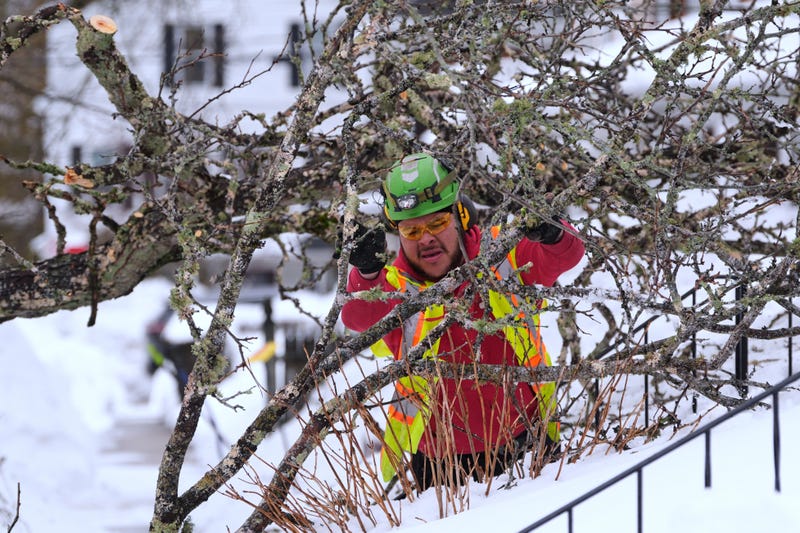
PROVIDENCE, R.I. (AP) — Power failures, waist-high canyons of snow and more flurries Wednesday bedeviled parts of the Northeast in the aftermath of a massive storm that dumped icy piles on streets and sidewalks from Maryland to Maine.
The fallout persisted across the region: In Rhode Island, where 3 feet (0.9 meters) of snow surpassed the record set in the Blizzard of 1978, people were stuck in their homes for a third straight day as residential streets remained unplowed, trash pickup got postponed in places and some schools went virtual.
More than 138,000 customers were still without power Wednesday afternoon, nearly all of them in Massachusetts and particularly in Cape Cod, according to poweroutage.us. Utility crews were working 18-hour shifts to restore electricity and people huddled in warming shelters for respite and to recharge phones.
Anny Enos took her three grandchildren to a warming station in Barnstable, Massachusetts, on Wednesday to charge their devices and get a change of scenery. She said she hasn’t had power since Sunday afternoon and was afraid that she might not get it back until Friday.
She threw out most of her fridge Tuesday and was just hoping for the best.
“I hate to say it but it doesn’t seem like they were ready,” she said.
Reinforcements, overtime and thousands of ‘emergency shovelers’
The storm created “thousands” of damage sites that required workers in some cases to remove big snow piles with backhoes before new poles could be installed or old ones repaired, according to Doug Foley, president of electric operations for Eversource in Massachusetts. More crews from other states arrived to help on Wednesday.
Most unwelcome, up to 3 more inches (7.6 centimeters) of snow fell early Wednesday, adding to slippery conditions before temperatures rose, creating slushy messes.
The gigantic snowstorm this week has cities working overtime to clear towering heaps.
In New York City, Mayor Zohran Mamdani got creative: in addition to spreading 143 million pounds (65 million kilograms) of salt by Tuesday evening, the city signed up at least 3,500 people as emergency shovelers, working $30-per-hour shifts to clear snow from bus stops and streets.
Police said carbon monoxide poisoning killed a man in an area of Rhode Island that had lost power. Joseph Boutrous, 21, had told a fellow Salve Regina student he was going to charge his phone in his car, Newport Police Capt. Joseph Carroll said. The exhaust pipe was obstructed by snow, police said, calling his death accidental. The sophomore from Bohemia, New York was an offensive lineman on the football team. A social media post said his teammates are heartbroken.
Some sidewalks are impassable for people with disabilities
There was plenty more work left to do. Parts of New York have people feeling marooned, according to Jeff Peters, spokesperson for the Center for Independence of the Disabled, New York.
“You’ll find a portion of a sidewalk that is clear, and then there’s maybe a 6-inch (15-centimeter) pathway that can only be walked with one foot in front of the other and no room for a stroller, rollator, walker or crutches,” Peters said. “Then you get to the corner and not only is it unshoveled, but you have basically a glacier at the end of it.”
Tina Guenette, who uses a motorized wheelchair, had to shovel out her yard this week after more than 33 inches (84 centimeters) fell in Harrisville, Rhode Island, a town about 17 miles (27 kilometers) northwest of Providence.
“I really have no choice if my service dog wants to go outside,” Guenette said. Harrisville's volunteer snow-shoveling program hasn't had volunteers for years, she said.
The storm unleashed massive amounts of snow
Monday’s storm blanketed the region with snow, canceled flights, disrupted transit and downed power lines.
Crunching the numbers, meteorologist Ryan Maue, former chief scientist at the National Oceanic and Atmospheric Administration, calculated that all that snow held a total of 2.5 trillion gallons of water.
If all the snow that fell from Maryland to Maine fell just on Manhattan, it would have towered over a mile high. If the snowfall blanketed only on Rhode Island, which got hit hardest, it would bury the entire Ocean State in more than 92 feet of snow, The Associated Press estimated.
Melted, it's enough to fill the Empire State Building with water more than 9,000 times. New York State got the water equivalent of 680 billion gallons, while Pennsylvania got 410 billion gallons and Massachusetts got 28 billion.
When it eventually melts, it will help mitigate the drought affecting parts of the Northeast, Maue said, but right now it's adding misery to an already punishing season.
“I think this storm took a severe winter and turned it into an extreme winter or a record extreme winter,” he said.
In New York City, workers were setting up massive basins of warm water where large amounts of snow and ice will be dumped, acting Sanitation Commissioner Javier Lojan said. They helped melt 23 million pounds (11.5 metric tons) of snow during last month’s storm.
Snowbound Providence, Rhode Island, is trucking snow to five locations, and more dumping grounds may be added, according to Josh Estrella, communications director for the city government.
Schools in NYC returning to normal. Not so much in Rhode Island, parts of Massachusetts
Some large school districts moved back to in-person classes on Wednesday, including Philadelphia, which had switched to online learning during the first two days of the week. Schools reopened in Boston after being closed since last week for the winter break.
But in hardest-hit Rhode Island, Providence officials decided to keep schools closed and switch to virtual learning for the rest of the week.
In New York City, it was another regular school day for more than 900,000 students in the nation’s largest public school system, but many students and their caregivers had to scramble over mountainous snow banks and dodge salt spreaders during the morning drop-off.
Thousands of flights in and out of the U.S. have been canceled in recent days. By Wednesday the disruptions seemed to be subsiding, with nearly 200 grounded, according to the flight tracking website FlightAware. Rhode Island's T.F. Green International Airport reopened Tuesday. Some flights departed Wednesday, while others were canceled.
When Jamie Meyers' flight landed in New York from Buenos Aires, Argentina, Tuesday evening, the cabin full of relieved passengers burst into applause. The Manhattan resident was supposed to arrive home Sunday but faced a cancellation and significant delay.
___
Kruesi reported from Providence and Barnstable, Massachusetts; Willingham from Boston; and Offenhartz from New York; Associated Press writers Matt O'Brien in Providence, Rhode Island; Seth Borenstein in Washington; Jennifer Peltz and Philip Marcelo in New York; Mike Catalini in Morrisville, Pennsylvania; Mark Scolforo in Harrisburg, Pennsylvania; Kathy McCormack in Concord, New Hampshire; Hallie Golden in Seattle; Rebecca Boone in Boise, Idaho; and Audrey McAvoy in Honolulu contributed.