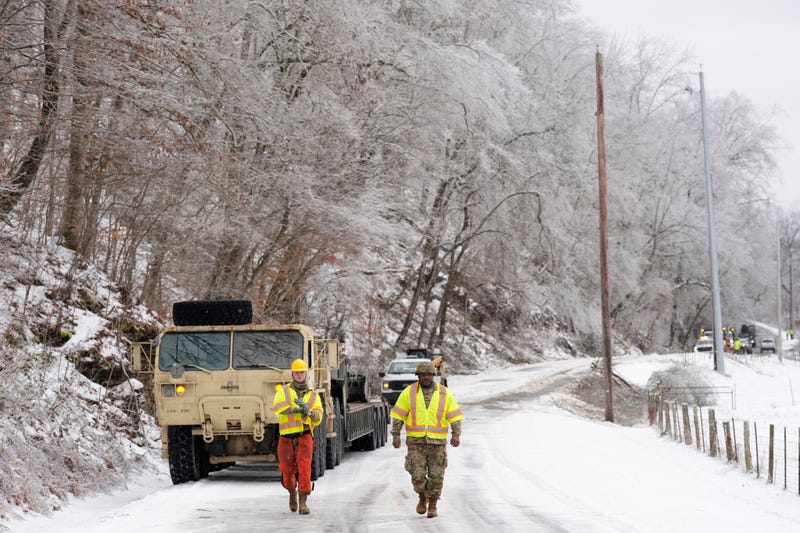
BELZONI, Miss. (AP) — As tens of thousands of people endured nearly a week with no electricity, another storm loomed on the East Coast where residents braced for near-hurricane force winds, heavy snow and potential flooding.
More than 230,000 homes and businesses were without electricity Friday, with the vast majority of those outages in Mississippi and Tennessee, according to the outage tracking website poweroutage.us.
In Mississippi’s Lafayette County, where about 12,000 people were still without electricity mid-day Friday, emergency management agency spokesperson Beau Moore said he knows not everyone will get power back before the cold hits.
“It’s a race against time to get it on for those we can get it on for,” Moore said.
Workers are attacking the project by ground and air. A video on the Tennessee Valley Authority’s Facebook page shows a worker sitting on the skids of a hovering helicopter so they can repair a giant power structure.
Arctic air moving into the Southeast will cause already frigid temperatures to plummet into the teens (minus 10 Celsius) on Friday night in cities like Nashville, Tennessee, where many still lacked power nearly a week after a massive storm dumped snow and ice across the eastern U.S., the National Weather Service said.
Forecasters say the subfreezing weather will persist in the eastern U.S. into February and there’s high chance of heavy snow in the Carolinas, Virginia and northeast Georgia this weekend, possibly up to a foot (30 centimeters) in parts of North Carolina. Snow is also possible along the East Coast from Maryland to Maine.
On Saturday night and early Sunday, forecasters expect wind and snow that could lead to blizzard conditions before the storm starts to move to sea.
Snow should pile up in the Carolinas
Several inches of snow, possibly 1 foot (30.5 centimeters) in some locations, were forecast statewide, particularly in eastern counties.
Hundreds of state National Guard soldiers were ready to help. State workers have also been preparing roads.
In Myrtle Beach, South Carolina, a town more accustomed to hurricanes, traffic jams and tourists, the National Weather Service predicted 6 inches (15 centimeters) of snow.
The city has no snow removal equipment. Mayor Mark Kruea said they will “use what we can find” — maybe a motor grader or bulldozer to scrape streets.
“With a hurricane you can storm proof many things," Kruea said Friday. "But at a place like this, there is only a few things you can do to get ready for snow."
In Wake Forest, North Carolina, people filled propane tanks Friday at Holding Oil and Gas, where employee Stanley Harris disconnected one tank, set it aside with a clank and then hooked up another.
In Dare County to the east, home to much of North Carolina’s Outer Banks, longtime resident Bob Woodard said he's worried about that more unoccupied houses in communities like Rodanthe and Buxton could collapse into the Atlantic Ocean.
Hypothermia risks grow
With the wave of dangerous cold heading for the South, experts say the risk of hypothermia heightens for people in parts of Mississippi and Tennessee who are entering their sixth day trapped at home without power in subfreezing temperatures.
“The body can handle cold temperatures briefly very well, but the prolonged exposure is a problem,” said Dr. Hans House, University of Iowa professor of emergency medicine.
People who are more vulnerable — the elderly, infants and those with underlying health conditions — may have started experiencing hypothermia symptoms within hours of exposure to the frigid temperatures, explained Dr. Zheng Ben Ma, medical director of the University of Washington Medical Center’s northwest emergency department. That can include exhaustion, slurred speech and memory loss.
“Once you get into days six, seven, upwards of 10, then even a healthy, resilient person will be more predisposed to experiencing some of those deleterious effects of the cold temperature,” he said.
Frostbite is also a concern in southern states, where people might not own clothes for northern winters, said Dr. David Nestler, an emergency medicine specialist at the Mayo Clinic in Minnesota.
Mississippi and Tennessee still seeking full power
Mississippi officials say it’s the state’s worst winter storm since 1994. About 80 warming centers were opened in one of the nation’s poorest states. National Guard troops were delivering supplies by truck and helicopter.
Yazoo Valley Electric Power Association workers, some of whom don’t have power at their own homes, are working 16-hour days to restore electricity in Mississippi. Workers cut their way through downed trees to reach some areas for repairs, said Michael Neely, CEO and general manager.
Worker Ethan Green, 21, said he feels pressure to get the job done quickly. “We can only go so quick,” he said. "In order to do it safely, we have to take our time.”
In Tennessee, crews were also distributing supplies, said Gov. Bill Lee.
Nashville residents' criticisms have grown louder over their utility's storm preparations and recovery, as more than 70,000 homes and businesses it serves remained powerless with frigid temperatures expected. Nashville Electric Service has defended its approach, saying it was an unprecedented storm. At the peak, about half of its customers in and near the capital city lost power.
Nearly 90 people have died in bitter cold from Texas to New Jersey. Roughly half the deaths were reported in Tennessee, Mississippi and Louisiana. While some deaths have been attributed to hypothermia, others are suspected to be related to carbon monoxide exposure.
The arctic cold was expected to plunge as far south as Florida.
___
Bynum reported from Savannah, Georgia, and Thanawala from Atlanta. Associated Press writers Jeff Martin in Kennesaw, Georgia; Jeffrey Collins in Columbia, South Carolina; Gary Robertson in Raleigh, North Carolina; Jonathan Mattise and Travis Loller in Nashville, Tennessee; Allen G. Breed in Wake Forest, North Carolina; Sarah Brumfield in Washington; David Fischer in Fort Lauderdale; Devi Shastri in Milwaukee and Hallie Golden in Seattle contributed to this report.