


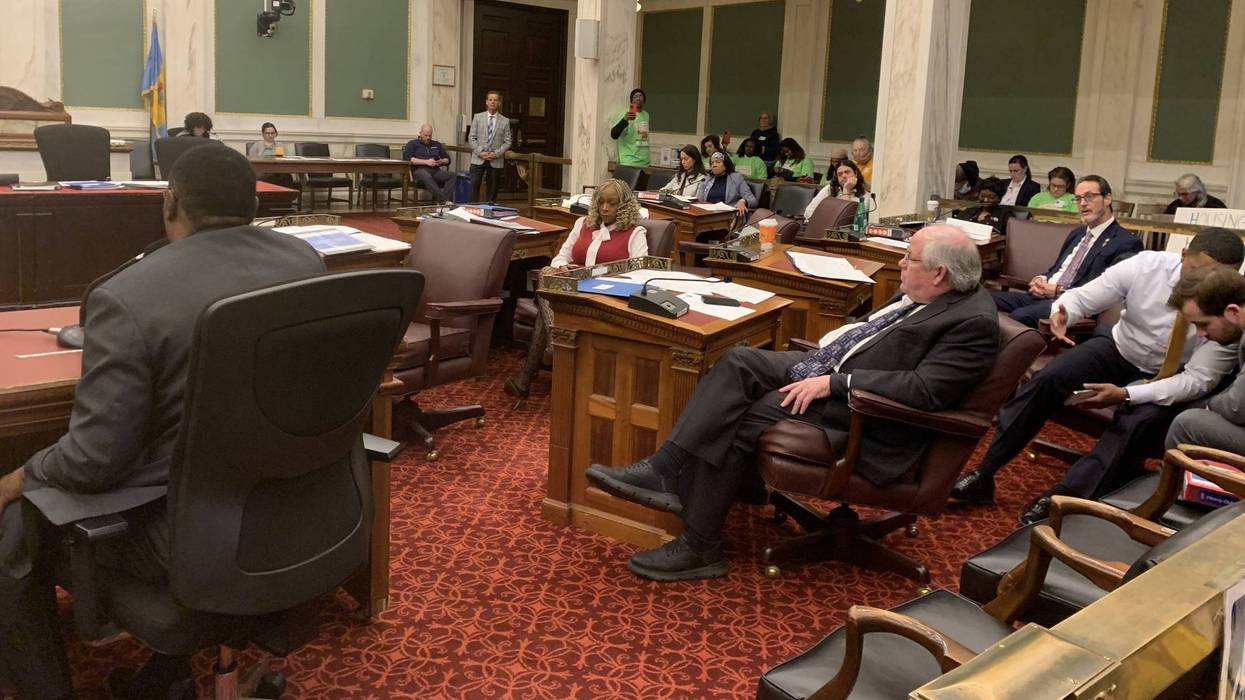

PHILADELPHIA (KYW Newsradio) — The Parker administration threatened to withdraw support for the mayor's own signature affordable housing initiative on Wednesday, during a City Council hearing on a bill to authorize the sale of bonds for the plan.
"There is one sentence in [the bill] that the Parker administration does not support," Parker's chief of staff Tiffany Thurman testified. "If this sentence is not amended, then we cannot and will not support this ordinance in its entirety."
The startling position opened a new front in the power struggle between Mayor Cherelle Parker and Council over who will be eligible for programs in the $2 billion HOME initiative to build or restore 30,000 units of affordable housing.
The mayor favors allowing moderate income Philadelphians to benefit through home repair programs and mortgage assistance. Council wants to reserve 90% of the spending for very low income residents.
In June, Council approved a bond authorization in line with the mayor's plan but last week, it approved changes to the spending ratios, creating the need for the new bond authorization bill heard by the full Council sitting as a committee on Wednesday.
The new bill contains a provision stating, "Council has the authority to establish the maximum Area Median Income (AMI) qualifications for any program or subprogram. The established AMI qualification can apply to all the funding allocated to such program or a percentage of funding allocated to such program."
Thurman asked Council to remove the provision or amend the second sentence to clarify that Council can establish AMI qualifications but for no more than 60% of the funding.
"Without one of these changes," Thurman repeated, "the Parker administration will not support this legislation."
In his own escalation of the dispute, Council President Kenyatta Johnson refused to allow Council member Anthony Phillips to introduce the requested amendments, maintaining Phillips had not circulated the amendment until almost two hours into the hearing.
"The administration just showed up," Johnson said, "and I don't think in the history of this body that I remember the administration not having a conversation with the Council president on any alternative."
He also cut off comments from Thurman and dismissed the administration officials after her testimony, rather than allow the usual question and answer period.
Council then engaged in an unusually lively debate during the hearing with Councilman Curtis Jones arguing the administration's point that moderate income residents (over 60% of AMI) should be eligible for 40% of the HOME budget.
"I believe in ALICE: Asset Limited, Income Constrained Employed. In other words, the working poor," he said. "If they have a $400 home emergency, they cannot fix it because they are not eligible for the programs we're talking about today. They just pay for everything and are eligible for very few things."
Housing chair Jaime Gauthier led the charge against the mayor's request.
"The Council, at least I hope, the Council will not be bullied into being a rubber stamp for a proposal that does not serve the needs of the most vulnerable people in our city," she said.
Council voted 13-3 to approve its version of the bill, without amendments. Jones, Phillips and Brian O'Neill dissented. Council member Mike Driscoll voted yes but said that was just to keep the process moving.
"I still hope to influence a reasonable solution which includes program support for row home Philadelphians," he said.
The mayor is not accepting the defeat lightly. She issued a statement after the vote, saying, "I will continue to lead the effort to Save Row Homes in Philadelphia. They need repairs to remain vibrant and critical investments for our homeowners.
"The whole debate over income eligibility limits is to make sure that we leave no working Philadelphian and no qualifying Philly rowhome owner excluded from these vital programs. That includes City employees too. We have a duty and a responsibility to them.
"If we don't save Philly rowhomes, we're going to become a city of used-to-be neighborhoods, blocks that used to be nice but now are showing signs of age and decline. I will not allow that to happen — not on my watch as Mayor of Philadelphia.
"I'll take this message with me wherever I go. My mission won't change!
"I will not leave any Philadelphian behind, including working Philadelphians or their neighborhoods!"
The bill now goes to the full Council but, because Thursday is the last session of the year, Council cannot vote on it until it returns from winter break on Jan. 22. Administration officials said the mayor will be appealing directly to voters in the intervening weeks, hoping they will put pressure on Council to expand income eligibility.