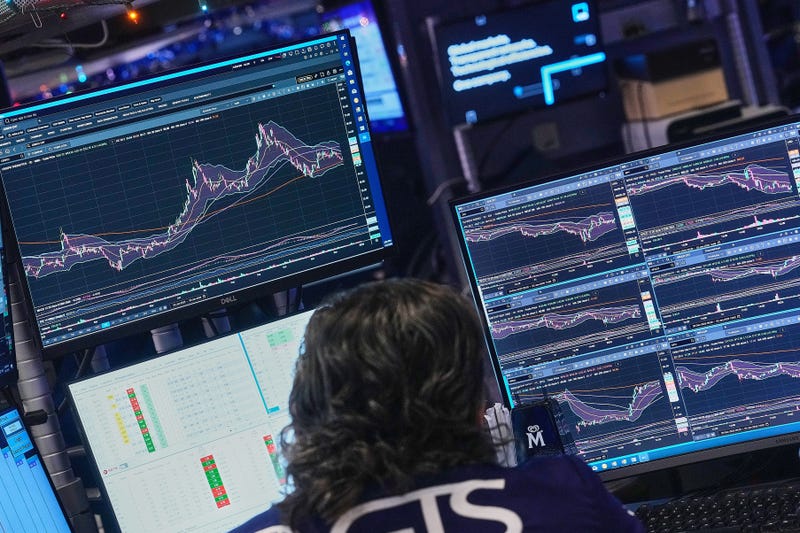
NEW YORK (AP) — Losses for several banks and Big Tech stocks pulled indexes lower on Wednesday, even though the majority of stocks on Wall Street rose.
The S&P 500 slipped 0.5% for its second straight loss after setting its all-time high. The Dow Jones Industrial Average dipped 42 points, or 0.1%, and the Nasdaq composite lost 1%.
Wells Fargo helped pull the market lower after falling 4.6%. The San Francisco-based bank reported weaker profit and revenue for the latest quarter than expected, with analysts citing lower trading fees and other miscellaneous items.
Bank of America fell 3.8% despite reporting a stronger profit than analysts expected, with some consternation about the size of its upcoming expenses. Citigroup, which is in the midst of a turnaround under Chair and CEO Jane Fraser, fell 3.3% following its own profit report.
Companies across industries are under pressure to report strong growth in profits to justify how high their stock prices have run recently. Analysts are looking for businesses across the S&P 500 to report earnings per share for the final three months of 2025 that are roughly 8% higher than a year earlier, according to FactSet.
Biogen sank 5% after the biotechnology company said it expects to take a hit to its profit for the fourth quarter of 2025 due to research and development expenses and other costs that it acquired.
The heaviest weights on the market were tech stocks, which gave back a bit of their huge gains from recent years created by the frenzy around artificial-intelligence technology. Such stellar performances caused some critics to say their stock prices had become too expensive.
Nvidia fell 1.4%, and Broadcom sank 4.2%.
Still, more stocks rose on Wall Street than fell, and the strongest forces keeping the S&P 500 from steeper losses were Exxon Mobil and other oil companies.
Exxon Mobil rose 2.9%, and Chevron climbed 2.1% as the price for a barrel of benchmark U.S. oil rose 1.4% to settle at $62.02.
Stocks of smaller companies also did better than the rest of the market, with the Russell 2000 index rising 0.7%.
All told, the S&P 500 fell 37.14 points to 6,926.60. The Dow Jones Industrial Average dipped 42.36 to 49,149.63, and the Nasdaq composite fell 238.12 to 23,471.75.
Oil prices have rallied recently after protests swept Iran, which is a member of the OPEC group that helps set crude prices. The protests could lead to disruptions in production and squeeze supplies of crude.
Brent crude, the international standard, rose 1.6% and briefly brought its gain for the year so far to nearly 10%, before prices for both it and U.S. oil fell back later in the afternoon.
In the bond market, Treasury yields sank as investors sought investments seen as safer. Several reports on the U.S. economy also came in mixed.
One said that shoppers spent more at U.S. retailers in November than economists expected. That could be an encouraging signal about the main engine of the U.S. economy.
A separate report said prices rose modestly at the U.S. wholesale level in November. It followed data on Tuesday that said inflation at the U.S. consumer level was close last month to economists’ expectations, though it remained above the Federal Reserve’s 2% target.
Taken altogether, the reports did little to change Wall Street’s expectation that the Federal Reserve will cut its main interest rate at least twice this year to shore up the job market, likely beginning around June, according to CME Group.
The yield on the 10-year Treasury fell to 4.14% from 4.18% late Tuesday.
In stock markets abroad, Japan’s Nikkei 225 rallied 1.5% to another record as expectations grew that Prime Minister Sanae Takaichi may call general elections soon.
Indexes were mixed elsewhere. Stocks rose 0.6% in Hong Kong but fell 0.3% in Shanghai after a report showed China’s trade surplus surged 20% in 2025 to a record despite President Donald Trump’s tariffs.
___
AP Business Writers Yuri Kageyama and Matt Ott contributed.