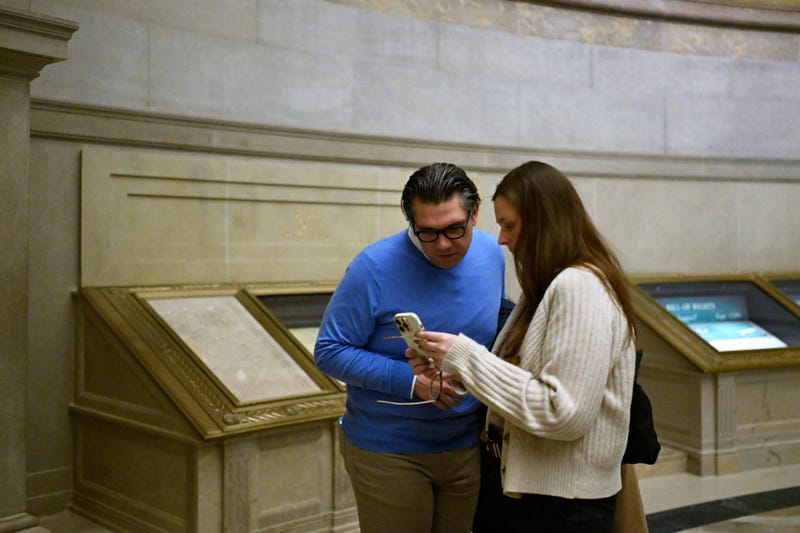
WASHINGTON (AP) — America's 250th anniversary arrives at a time of deep political divisions and, in some quarters, heightened anxiety over whether representative government in the world's oldest democracy can be sustained.
Cultural institutions, sporting events, even communities are polarized. If there is any place the bitter partisanship is set aside, even temporarily, it is in the rotunda of the National Archives. This is home to the nation's founding documents, including the one that will be commemorated this year, the Declaration of Independence.
The room is filled with a silent sense of reverence as visitors gaze down at the light brown parchment, secured under bullet-proof glass, that helped create the foundation of a government that has been a beacon of inspiration for people around the world for more than two centuries.
Its significance was not lost on those who filtered in on a recent day, braving a deep freeze in the nation's capital to ensure they would not miss this stop on their Washington tour. Even as the crowd grew, the room was filled with a sense that people knew they were in the presence of something momentous.
Their visits coincided with a national reckoning over President Donald Trump's aggressive immigration enforcement actions, which had led to the shooting deaths of two U.S. citizens on the streets of Minneapolis and grave concerns about attacks on constitutional rights. The Associated Press interviewed visitors after they had viewed the Declaration of Independence, along with the Constitution and Bill of Rights, for their thoughts on the state of America and its future as it approached its semiquincentennial moment.
They acknowledged the country's ideological divides but were reluctant to assign blame, in many cases expressing hope the nation would be able to repair itself, as it has done many times over its history. With the Rotunda's bus-sized oil on canvas paintings of the Founding Fathers as a backdrop, they gave complicated responses when asked whether America was living up to the ideals of its founding documents and where it might be headed.
Despite divides, the nation has found ways to come together
Ryan O’Neil, visiting from West Bloomfield, Michigan, said that while the country is split politically — what he called “very tribal” — he finds hope in the documents he viewed at the National Archives because they have guided the country for 250 years.
"We’ve not yet lived up to everything that we had hoped to, but we are continuing to progress and get closer to that,” he said.
The Archives has a special exhibit marking the 250th anniversary, "The American Story,” that highlights that complex history, mixing the country's astonishing accomplishments and advances with images showing its darker moments.
O'Neil, 42, said the U.S. has been in similar divisive situations throughout its history and always managed to regroup. The one constant, he said is that the country's political pendulum is always swinging.
“Despite many tests over the years, going back to its founding, throughout the last 250 years it has withstood challenges, has withstood complaints, has withstood protests," he said, "and continues to evolve to what we have today.”
How would the founders approach this moment?
Kevin Sullivan had traveled to Washington from Milwaukee with his wife to visit their children and attend the confirmation of their oldest grandson.
He acknowledged the country was in a divisive moment, but said it wasn't the only one the country had faced, and that gave him hope for the future.
“So I have some faith that we’ll put some of the uglier partisan disputes behind us," he said.
Sullivan, 69, said he supported at least a few of Trump's goals, including securing the southern border, but was conflicted about the president's approach.
He opposed Democratic threats to shut off funding for the Department of Homeland Security without drastic reforms to U.S. Immigration and Customs Enforcement and other federal law enforcement agencies, but he also said he didn't like the mass deportation policy.
His advice to lawmakers and the president would be to get away from the cameras and hold meaningful discussions to find solutions. Looking at the oil paintings with images of the founders, he said having an equivalent of today's media trying to report on the writing of the Declaration probably “would not have been a positive development for the decisions and the discussions that were going on at Independence Hall.”
The view from outside the US: ‘some confusion’
The Rev. Michael Stokes, a priest with the Church of England, was visiting friends in the Washington area. Before heading to the rotunda, he saw the Magna Carta, the English document signed in 1215 that set up a series of rights for the people and served as a model for America's system of government.
Stokes, 30, said others look at the diversity of people, religions and industry that all come together “for this one common purpose of America." It's a vision that has inspired the world, he said, but also is one that appears to be waning.
“I think this is the time in history where it’s been challenged the most with the actions of the current administration. I think that the rest of the world is looking and seeing how this thing, this Constitution, which is held with such pride, the Bill of Rights, which is held with pride, how can that also be held in tension with a popularly elected government that seems to disregard so much of it," Stokes said. "And I think the rest of the world is looking at that with some confusion.”
Life, liberty and a pursuit still in progress
Morgan Whitman, an executive assistant, was in Washington on business from Miami and was seeing the documents for the first time.
She said reading them created a mix of emotions. The ideals were lofty, she said, but “there’s also of course the feelings of hypocrisy” because Thomas Jefferson had argued for a passage opposing slavery that was not included.
“So I think we have this document that fought for independence and life, liberty, the pursuit of happiness,” she said. “My only wish was that it was for everybody at the time.”
Whitman, 25, said she is grateful for being granted rights that many others around the world do not have, but also said she is afraid some of those are under threat. She cited the killing by federal agents of Veterans Affairs ICU nurse Alex Pretti in Minneapolis.
“Take immigration out of it. These are American citizens that are being harmed now," she said. “That’s unacceptable.”
The spirit of 1776. Is it alive today?
Jerry Curl was visiting the capital with his wife, Bobbi, from their home in Diamond, Illinois. A Trump supporter, he said the president's second term has so far "lived up to my beliefs.”
But he also said he has stepped away from news coverage recently because it is too negative. When asked about the administration's immigration enforcement, he wanted to see more discussions where people could share their views and do so respectfully.
He said trying to understand one another is crucial to maintaining American democracy.
”We owe it to our future generations that we never meet to uphold this,” he said of the founding documents.
Curl, 62, said the signers of the Declaration undoubtedly disagreed and had different beliefs, but they were able to find common ground as they took the first step to creating a new nation. He wonders whether the same spirit is alive today.
“Where we can now find common grounds to keep this one great nation on track is hard for me to fathom,” he said.
___
Associated Press video journalist River Zhang in Washington contributed to this report.