
Mike Rizzo talks Nationals top draft pick Seaver King's 'off-the-chart analytics' with Junkies
The Washington Nationals selected a player in each of the 20 rounds of the 2024 MLB Draft healed over three days this week, adding headlined by infielder Seaver King with the No. 10 overall selection.
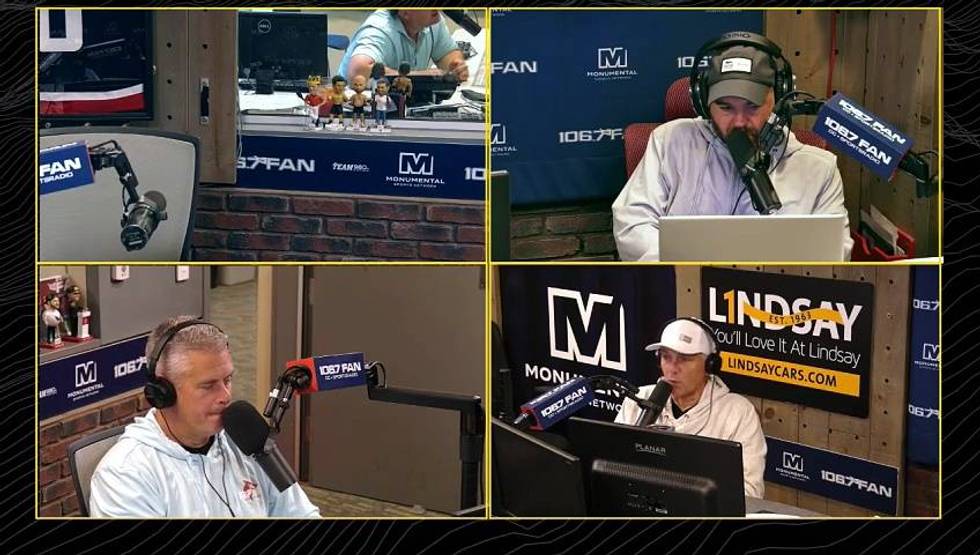
"He's got some off-the-chart analytics, he's got some great skills, he's a shortstop that is a plus-plus runner," general manager Mike Rizzo said during his weekly appearance Wednesday with 106.7 The Fan's The Sports Junkies, which is presented exclusively by our partners at MainStreet Bank — Cheer Local. Bank Local. Put Our Team in Your Office. Member FDIC. Equal Housing Lender. On the 20-80 scale, Rizzo added that King is probably a 75 runner.
"We think this kid is just scratching the surface," the GM told the Jukies. "Our player development analytics hitting guys, they love him. And our strength and conditioning guys say he's athletic off the charts. We like this pick and we thnk this guy's gonna be a shortstop of the future and a guy that is going to play in a prominent role in where we're going in the next couple of years."
King's path to the first round wasn't always clear-cut as before transferring to Wake Forest, King began his collegiate career at Division II Wingate University.
"Out of high school, it's mostly a physicality thing where the guys have some skills and have a love for the game, but just physically aren't ready to compete at LSU and that type of thing at the time," Rizzo said. "There's a lot of small school success stories, Josiah Gray is one of them... big leaguers are all shapes and sizes, they're come from all parts of the country and all types of schools."
After King grew into himself, Rizzo said, the infielder's "epiphany" that MLB could be possible came after his sophomore year at Wingate when he played in the Cape Cod League.
"Notoriously one of the great prospect leagues in the summertime," he said, adding, "it's the top college players in the country that are gonna be drafted in the following year, they play with a wooden bat which is kind of a separator for evaluation with a lot of guys. And [King] went off and had a terrific Cape Cod League with the wooden bat.
"I know for our side it put him on the map for us. And I think, speaking to him after we drafted him, I think the same thing was thought by him. 'Wow, I'm competing at the highest level, in the biggest and best collegiate wood bat league and I'm as good as these guys.' So I think that is really when he started to think that he could play in the big leagues."
In 16 cames with Harwich on the Cape as a 20-year-old, he had 25 hits in 59 at-bats (.424) with four doubles and a home run for a .542 slugging percentage and 1.021 OPS.
At Wake Forest, King did play out of his natural position of shortstop for most of the year and still had a terrific season at the plate where he batted .308 (78 hits in 253 at-bats) over 60 games for the Demon Deacons with 14 doubles, three triples and 16 home runs for a .577 slugging and .954 OPS.
The Nationals drafted several shortstops – using three of their first five picks at that position – but Rizzo reiterated that this isn't like other sports where positions of need determine picks – as 23-year-old All-Star CJ Abrams is very much a central focus for the club.
"Our philosophy specifically is we're gonna draft the best player that gives us the most impactful combination of skills at each and every round," he said. "If they happen to be two catchers so be it. If they happen to be three shortstops so be it. And as they work their way through the minor league system, the positional thing kind works itself out."
Rizzo recounted a story from his time with the Arizona Diamondbacks organization when they drafted shortstop prospect Stephen Drew in the first round one year and shortstop Justin Upton the next year. When asked what they would do if they both made it to the bigs at the same time, Rizzo said, "We'll deal with that problem when we get to it."
"Having too many great shortstops and having to decide where they play in the big leagues because they were so successful is a problem I can't wait to embrace," he said.
One of those shortstops was Luke Dickerson with the 44th overall pick, who Rizzo said was "high, high" on the Nats' board and somebody who the GM thought had great power and was a real "hard-nosed" player.
"He gives you that rare combination, as a high school kid... with the power and the defense at shortstop," Rizzo said, adding, "this guy is a heckuva player to get and to put in our system."
Part of the challenge of the MLB Draft is determining fit and also, with so many different ways of looking at players, "beauty is in the eye of the beholder," Rizzo said, mentioning Dickerson was a player the Nationals were excited fell to them where he did.
"It's much less set in stone with where guys are going than any other sport," he told the Junks. "I think it's more fluid because you're comparing high school, junior college, college guys to each other to draft. We identify guys and put them on the board and identify what we think they are. Often times early in the draft, other teams have the same type of thoughts, but I think you'll see throughout the ages teams value players and see players differently. And that's the reason sometimes a high school kid like Mike Trout will last into the 20th-something pick rather than go where he's supposed to go which would be at the top of the draft."
While the draft room gets all the glory, Rizzo outlined the great deal of work that the scouts and crosscheckers (both regional and national) go into in determining which players they have their eye on.
"We come in about two weeks before the draft after they've had their regional meetings and area meetings and then we sit down with the laborious task of separating each and every guy and putting them on the board in a way that we think will impact the Nationals most greatly," the GM said. "It's really a painstaking process. You're seeing hundreds of hundreds of hour of video on players and having interviews with them and having meetings with people who know them, going as far back as high school principals and baseball coaches and all that stuff to get the proper makeup on the players.
"It is a long, laborious process that kinda comes to fruition at 7 o'clock on Sunday. The bell rings and then you start and it really is an exciting time and really an exhausting time."
Rizzo said that after the long stretch, the front office is getting Wednesday off to recharge as they feel good about the work of the draft.
"These are exhausting days for the scouting staff and the front office, but once it's ended and you feel good about what you guys did, you really feel accomplished and feel good," Rizzo said. "Hats off to Danny Haas (VP of amateur scouting) and Brad (Ciolek, senior director of amateur scouting) and Reed Dunn (assistant director and national crosschecker for amateur scouting) for doing such a great job in the draft room. Over the last couple of months, it culminated in three days of taking some really good, exciting players for the Nats."