




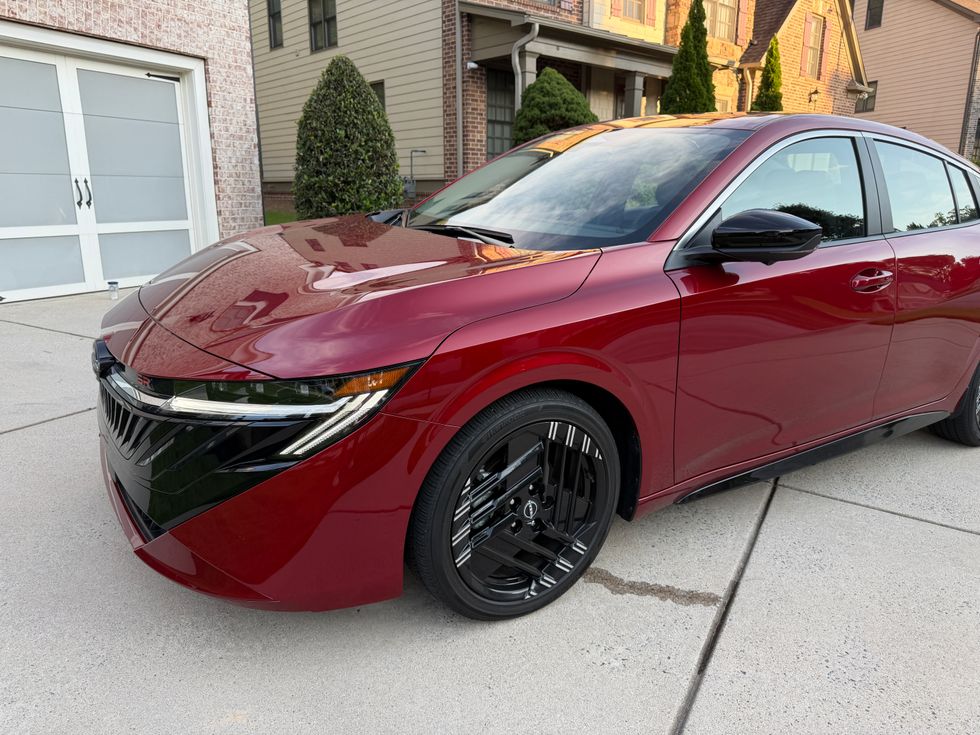
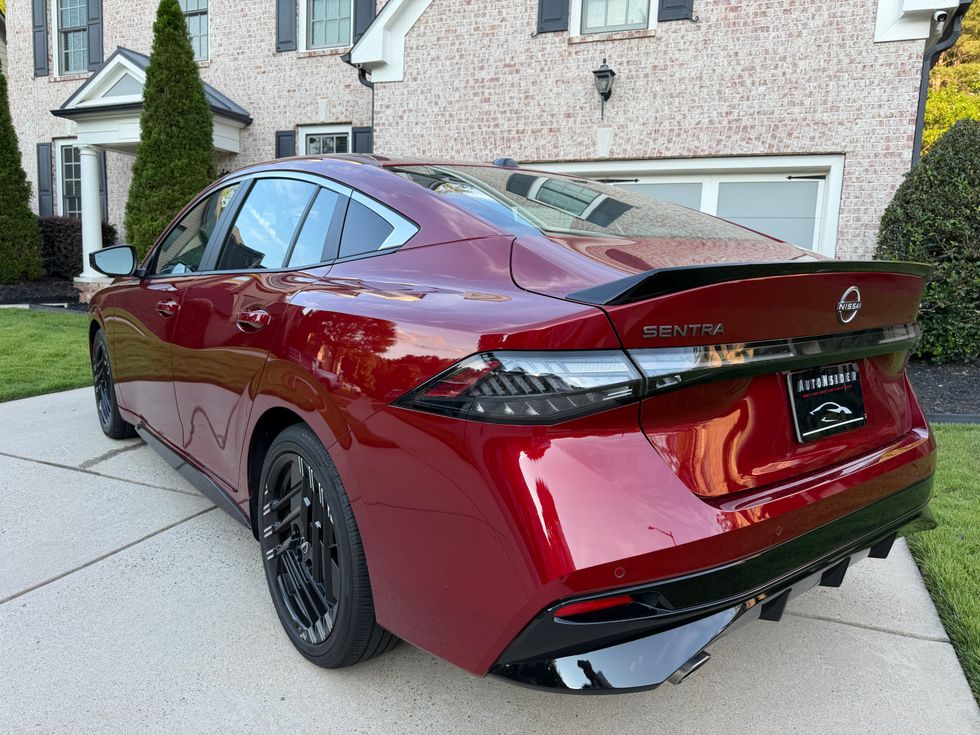
The 2026 Nissan Sentra SR makes a strong first impression. It looks low, wide, and athletic, with 18-inch wheels, dark exterior accents, and a rear wing that makes the compact sedan appear ready for substantially more performance than it actually delivers.
The Sentra also feels larger than I expected. The cabin offers useful passenger space, the trunk is practical, and the dashboard presents most functions in a way that drivers can understand without studying the owner’s manual.
 Daryl Killian
 Daryl Killian
After spending time with it, I believe this is a good daily driver.
The central problem is not the vehicle itself. It is the price of this particular configuration.
My Sentra SR carried a window-sticker total of $30,295. At that price, buyers must compare it with compact hybrids that offer better acceleration, substantially better fuel economy, and, depending on the trim, similar comfort and technology.
That comparison makes the Sentra much more difficult to recommend.
Pricing
The 2026 Sentra SR has a base MSRP of $25,000. My test vehicle added a $650 All Weather Package, a $2,300 Premium Package, a $650 power moonroof, and $450 Scarlet Ember premium paint. The destination charge was $1,245.
The final price was $30,295.
The All Weather Package includes dual-zone automatic climate control, heated front seats, a heated steering wheel, and heated exterior mirrors.
The Premium Package adds sport leatherette seating, a six-way power driver’s seat with four-way lumbar adjustment, an eight-speaker Bose audio system, Nissan’s Around View Monitor, ProPILOT Assist, additional parking technology, and rear automatic braking.
Those are desirable features. The question is whether they belong on a Sentra once the final price approaches that of a Civic Hybrid or Corolla Hybrid.
Why the Sentra Matters
The 2026 Sentra is an all-new model, which is encouraging for buyers who still prefer sedans over crossovers. Nissan gave it a more substantial design, upgraded technology, and an interior that feels more mature than many shoppers may expect from a compact car.
At 183.3 inches long, the Sentra is not a midsize sedan, but it is large enough to blur some of the traditional boundaries between compact and midsize cars. It has 34.8 inches of rear legroom and a 14.3-cubic-foot trunk.
That does not mean the Sentra replaced the Altima. Nissan still lists a 2026 Altima, and the Altima remains 192.9 inches long with 35.2 inches of rear legroom and a 15.4-cubic-foot trunk. I cannot confirm that Sentra’s size is related to any future decision about the Altima.
Exterior Design
The exterior is one of the Sentra SR’s strongest qualities.
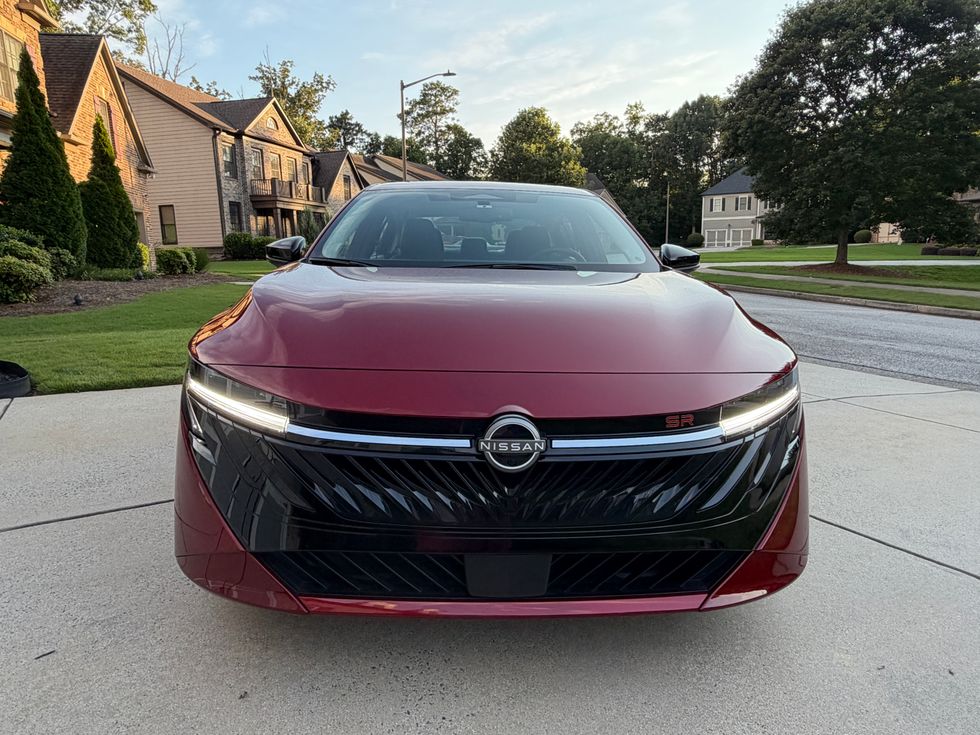
The low front end, wide grille, and sharply drawn lighting give it more presence than many compact sedans. The 18-inch wheels fit the body well, and the dark trim helps distinguish the SR from less expensive Sentra grades.
 Daryl Killian
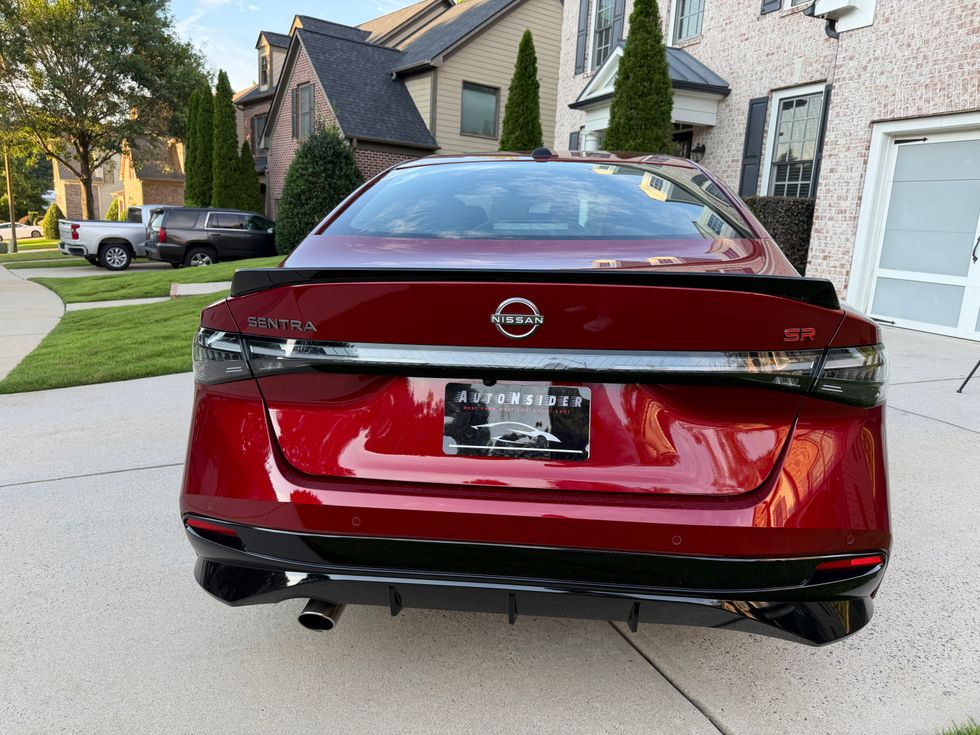
The rear spoiler is likely to divide opinion. Some buyers will appreciate how much character it adds. For me, it may be a little too aggressive for a sedan with 149 horsepower.
 Daryl Killian
The Sentra SR looks like a performance derivative, but it should be understood primarily as a sport-appearance model.
Interior Comfort
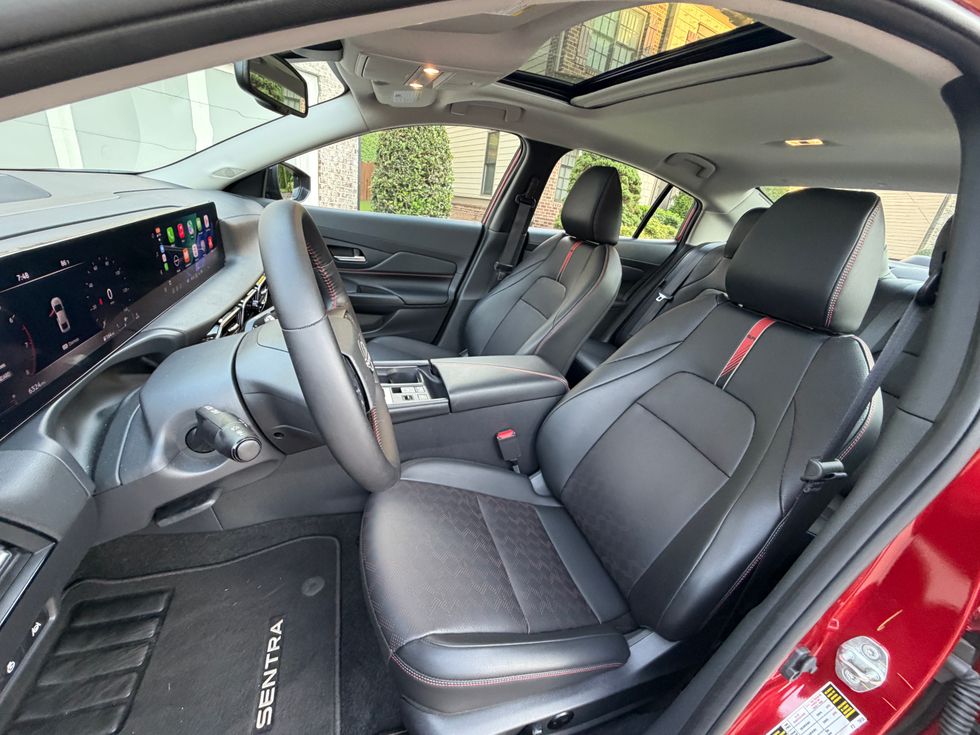
The interior feels appropriate for the vehicle’s class. The sport leatherette upholstery doesn't try to imitate a much more expensive luxury interior. Still, it looks good, appears suitable for regular use, and adds visual interest through its contrasting details.
 Daryl Killian
The power driver’s seat and lumbar adjustment make it easier to find a comfortable driving position. The cabin is also wide enough that front occupants do not feel unnecessarily confined.
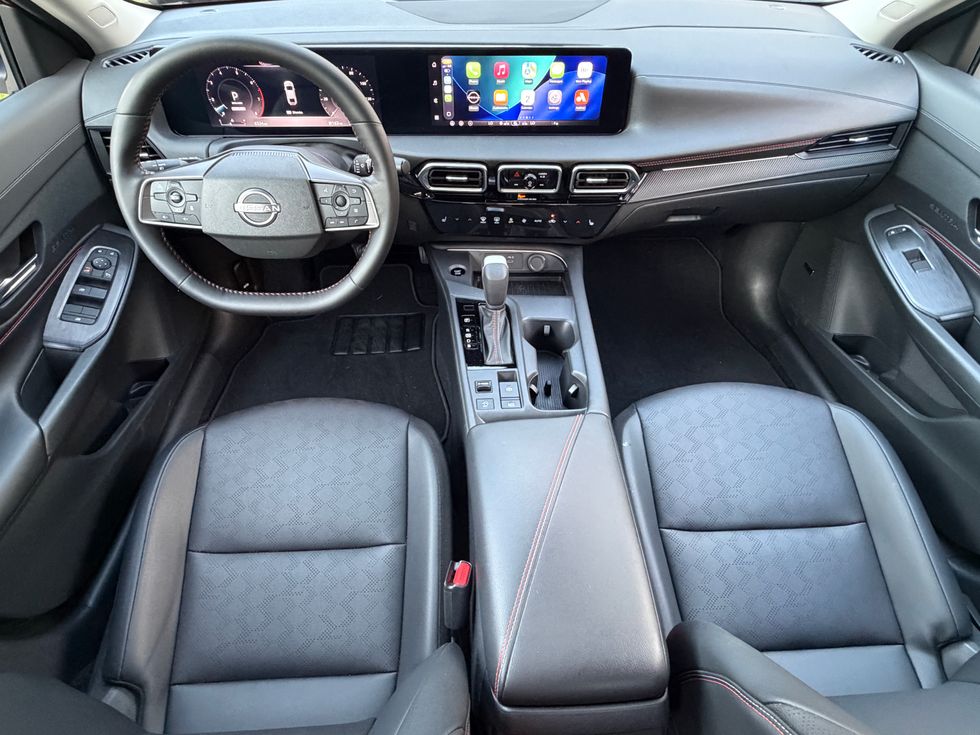
My biggest interior compliment concerns usability. Most of the controls are self-explanatory. Basic climate, audio, and vehicle functions do not require an extended search through several layers of menus.
 Daryl Killian
That may sound like a small detail, but it becomes more valuable every time you drive the vehicle.
Real-World Passenger Space
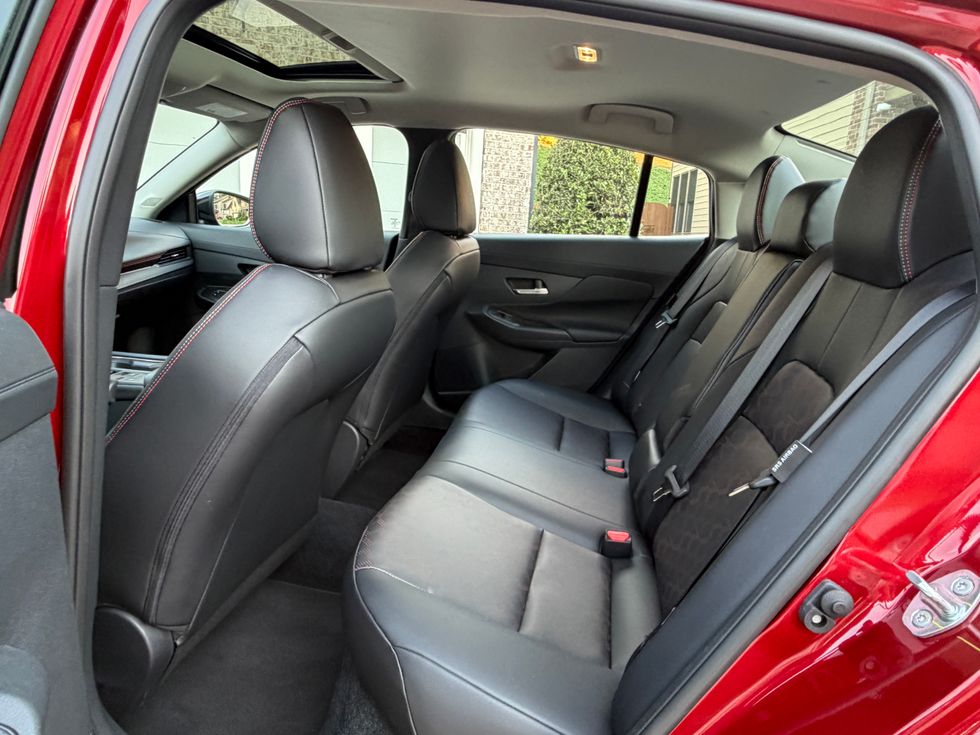
The moonroof-equipped Sentra provides 37.5 inches of front headroom and 36.7 inches in the rear. Rear legroom is 34.8 inches, while shoulder room measures 56.2 inches in front and 54.6 inches in the rear. Total passenger volume is 94.3 cubic feet with the moonroof.
 Daryl Killian
Those dimensions suggest a cabin that should work well for average-height adults during normal commuting and shorter trips. Actual rear-seat comfort will still depend on the front-seat position, passenger proportions, and how upright each occupant prefers to sit.
I did not document a formal sit-behind-yourself test, so I will not identify a specific passenger height as a guaranteed fit.
Technology and Usability
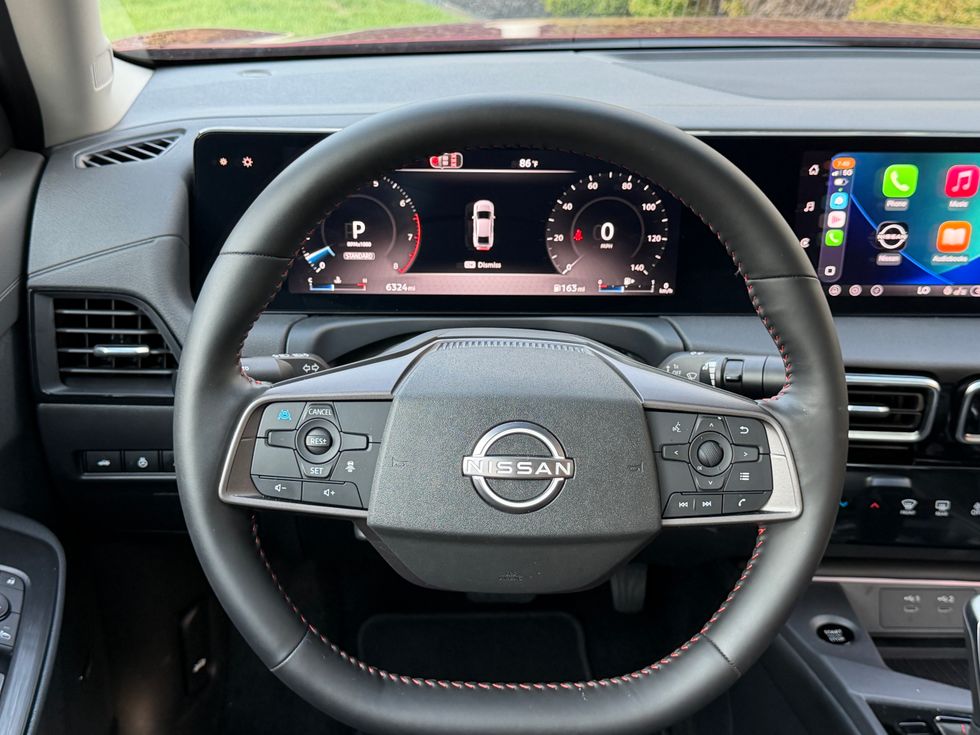
The SR includes a 12.3-inch digital instrument display and a 12.3-inch infotainment system. Wireless Apple CarPlay and wireless Android Auto are also available, along with a wireless phone charger and three USB-C ports.
 Daryl Killian
The twin-display layout gives the Sentra a modern appearance without making basic operation unnecessarily complicated.
The Bose audio system is included in the Premium Package. It is a useful upgrade for buyers who spend considerable time in the vehicle, but it is also part of the package that pushes the Sentra beyond its strongest value range.
Safety
The Sentra includes automatic emergency braking with pedestrian and cyclist detection, forward-collision warning, blind-spot warning and intervention, rear cross-traffic alert, lane-departure warning and prevention, high-beam assist and a rearview monitor.
The Premium Package adds ProPILOT Assist, an Around View Monitor, rear parking sensors and rear automatic braking.
That is a meaningful collection of active-safety and driver-assistance equipment.
However, the window sticker for this vehicle states that federal five-star crash-test ratings were not yet available. Buyers should not confuse an extensive safety-equipment list with an independently verified crash-test result.
Biggest Surprise
The biggest surprise was how substantial the Sentra felt from inside.
The exterior dimensions, rear-seat room, and dashboard presentation make it feel like more than a basic economy sedan. It doesn't fully match the width or highway presence of a midsize car, but it offers enough usable space that some buyers may no longer feel compelled to move up a class.
Powertrain and Driving Impressions
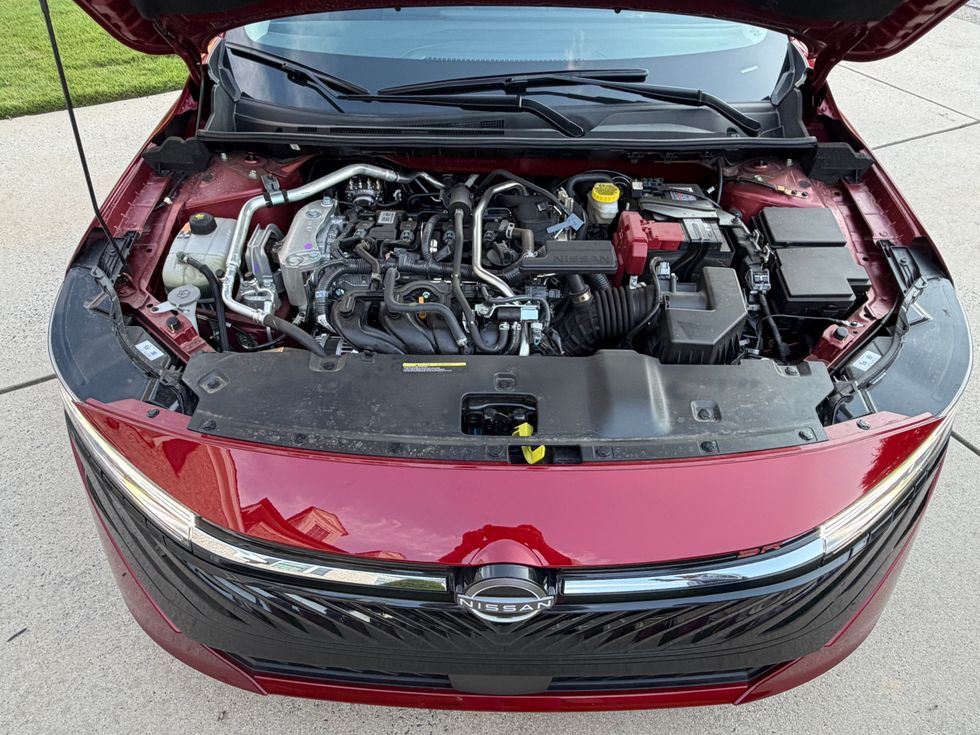
The Sentra uses a 2.0-liter four-cylinder engine producing 149 horsepower and 146 pound-feet of torque. Power is sent to the front wheels through Nissan’s Xtronic continuously variable transmission.
 Daryl Killian
This is where the driving experience fails to match the styling.
The Sentra is adequate around town, and it works well enough as an everyday commuter. The engine can handle ordinary traffic, errands, and highway travel.
It never feels genuinely sporty.
The latest CVT feels better than previous Nissan transmissions I have experienced. The artificial shifts are more convincing, and the relationship between engine speed and vehicle acceleration feels less disconnected.
It is still not a transmission I particularly enjoy.
The simulated gear changes cannot fully disguise the underlying CVT behavior, especially when the driver asks for stronger acceleration. Buyers should test the Sentra during a highway merge rather than limiting the demonstration drive to slow streets around the dealership.
Fuel Economy
The Sentra SR is rated at 29 mpg city, 36 mpg highway, and 32 mpg combined. That is respectable for a conventional gasoline compact sedan.
The difficulty comes from the competition.
The Honda Civic Sport Hybrid produces 200 total system horsepower and is rated at 50 mpg city, 47 mpg highway, and 49 combined. Its current base MSRP is $29,395 before a $1,195 destination charge.
Toyota lists the Corolla Hybrid XLE at a current base MSRP of $29,340. It is rated at 53 mpg city and 46 mpg highway, with a combined figure of approximately 50 mpg. Destination and regional charges are additional.
Using the Sentra window sticker’s assumptions of 15,000 annual miles and gasoline costing $3.30 per gallon, the Sentra’s estimated fuel cost is approximately $1,547 per year.
The same calculation produces approximately $1,010 for the Civic Hybrid and $990 for the Corolla Hybrid.
That represents an estimated annual difference of approximately $540 to $560. Over five years, the difference could reach approximately $2,700 to $2,800 if fuel prices, mileage, and EPA performance remain constant.
Some buyers may still prefer a gasoline-only vehicle. That is a legitimate purchasing preference.
I cannot confirm a universal statement that hybrids require more routine maintenance. Each vehicle has its own service schedule, warranty, and potential repair considerations. Buyers should compare those model-specific details instead of assuming every hybrid will automatically be more expensive to maintain.
Dealer Secret
The Sentra SR’s value depends heavily on how it is equipped.
The styling, 18-inch wheels, dual displays, and basic driving experience are available much closer to the $25,000 base price. Adding the Premium Package, moonroof, premium paint, and additional comfort features changes its competitive set.
At $25,000 to approximately $28,000, the Sentra can be compared with other gasoline compact sedans.
At $30,295, it must be compared with hybrids.
Buyers should negotiate from the total selling price and out-the-door amount, not from a monthly payment. A longer loan term can make a more expensive vehicle appear affordable without improving its actual value.
Buyer Alert
The SR badge and exterior treatment do not indicate a performance upgrade comparable to what some competitors offer.
The engine remains rated at 149 horsepower, and the transmission remains a CVT. Buyers should not assume the spoiler, sport trim, and 18-inch wheels come with significantly stronger acceleration.
A highway merge should be part of the test drive.
Cargo and Family Practicality
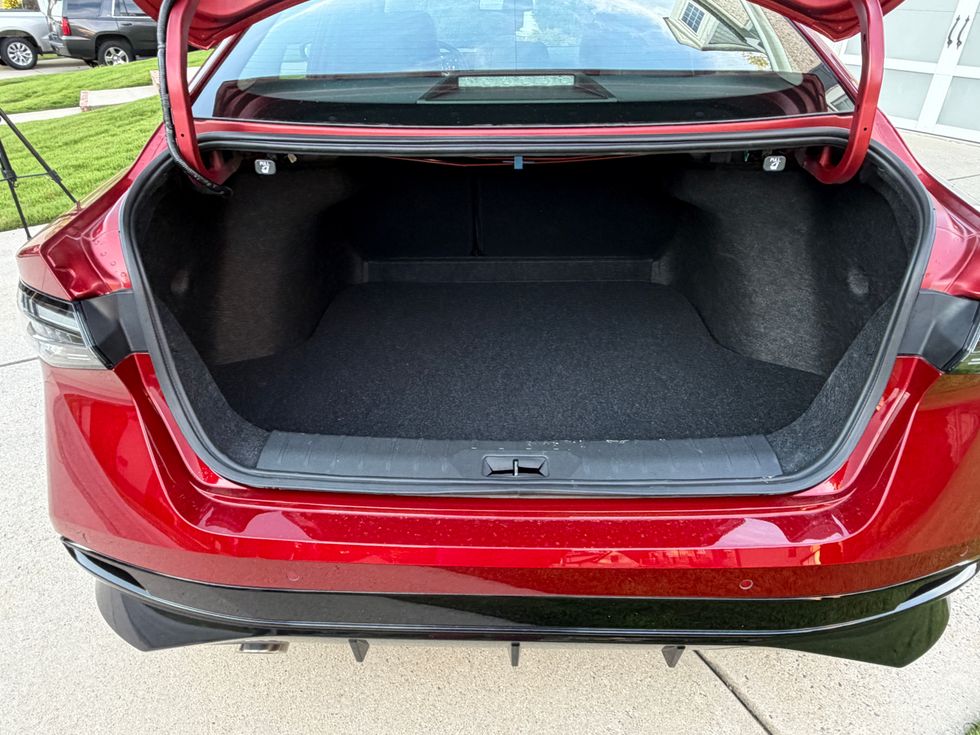
The Sentra has 14.3 cubic feet of trunk space and 60/40-split folding rear seatbacks. Nissan also designed the trunk with a wide opening to improve access.
 Daryl Killian
That should be sufficient for ordinary grocery trips, work equipment, or several pieces of carry-on luggage. I did not conduct a standardized loading test, so an exact luggage count is an estimate rather than a verified result.
The rear-seat space makes the Sentra practical for a small family, a new driver, a commuter who occasionally carries adults, or an owner who wants sedan efficiency without an extremely small cabin.
Competitor Comparison
The Honda Civic Sport Hybrid is the Sentra’s strongest competitor.
Its price is only slightly higher than this Sentra after destination, yet it offers 200 horsepower, substantially better fuel economy, and a more responsive powertrain.
The Toyota Corolla Hybrid XLE is another strong alternative. It has less horsepower than the Civic, but its fuel economy is dramatically better than the Sentra’s, and its price remains in the same general range.
For buyers who do not want a hybrid, the gasoline Corolla produces 169 horsepower and is rated at up to 35 mpg combined. It therefore offers more advertised horsepower and slightly better fuel economy than the Sentra SR.
The Sentra counters with attractive styling, a surprisingly roomy interior, intuitive controls, and generous safety technology.
Would I Spend My Money?
Here is where I would spend my money.
I would not purchase this particular Sentra SR at $30,295.
I would choose the Honda Civic Sport Hybrid because it provides better performance and much better fuel economy for only a modest increase in initial price.
If maximum fuel economy mattered more than acceleration, I would also consider the Toyota Corolla Hybrid XLE.
If I specifically wanted a Sentra, I would choose the SR with the All Weather Package and skip the Premium Package and moonroof. That configuration would retain the appearance and everyday practicality while keeping the price closer to the Sentra’s strongest value position.
AutoNsider Decision
- Buy it if: You want a roomy, straightforward gasoline compact sedan with attractive styling, intuitive controls, and a strong collection of driver-assistance technology.
- Skip it if: You expect performance that matches the SR’s exterior or you prioritize maximum fuel economy.
- The version I would choose: Sentra SR with the All Weather Package and limited additional options.
- Strongest alternative: Honda Civic Sport Hybrid.
- Recommendation: Recommended with conditions.
The 2026 Sentra is a good daily driver. The tested configuration costs too much to compare with better-performing, more efficient hybrids.
One for the Road: A sporty design may attract you to a vehicle, but the total price and powertrain
should determine whether it deserves your money.
AutoNsider Buyer’s Guide
| Vehicle tested | 2026 Nissan Sentra SR |
| Exterior color | Scarlet Ember Tintcoat |
| Interior | Sport leatherette interior |
| Engine | 2.0-liter four-cylinder |
| Electrified system | None |
| Transmission | Xtronic continuously variable transmission |
| Drivetrain | Front-wheel drive |
| Horsepower | 149 hp |
| Torque | 146 lb-ft |
| EPA fuel economy | 29 city, 36 highway, 32 combined |
| Fuel-tank capacity | 12.41 gallons |
| Front legroom | 44.0 inches |
| Rear legroom | 34.8 inches |
| Front headroom with moonroof | 37.5 inches |
| Rear headroom | 36.7 inches |
| Passenger volume with moonroof | 94.3 cubic feet |
| Passenger-space interpretation | Suitable for average-height adults, but rear comfort depends on front-seat position and passenger proportions |
| Cargo capacity | 14.3 cubic feet |
| Cargo interpretation | Suitable for routine groceries, work equipment, or several travel bags; no standardized luggage test was completed |
| Towing capacity | Not relevant to the intended use of this compact sedan |
| Basic warranty | 3 years or 36,000 miles |
| Powertrain warranty | 5 years or 60,000 miles |
| Corrosion perforation | 5 years, unlimited mileage |
| Roadside assistance | 3 years or 36,000 miles |
| Base price | $25,000 |
| All Weather Package | $650 |
| Premium Package | $2,300 |
| Power moonroof | $650 |
| Premium paint | $450 |
| Destination charge | $1,245 |
| Price as tested | $30,295 |
| Best buyer | A shopper who wants a spacious, easy-to-use gasoline sedan with strong safety equipment and sporty styling |
| Consider something else if | Performance or maximum fuel economy is a priority |
| Recommended Sentra configuration | SR with All Weather Package and limited additional options |
| Strongest competitor | Honda Civic Sport Hybrid |
Nissan’s current 2026 Sentra materials support warranty, dimensions, and capacity figures.
AutoNsider Buying Scorecard
| Exterior Design | 8.5/10 | Attractive, substantial, and distinctive, although the rear wing may be excessive for the available performance |
| Interior Comfort | 8.0/10 | Comfortable seating, useful lumbar adjustment, and more cabin room than expected |
| Technology | 8.5/10 | Dual 12.3-inch displays, wireless smartphone integration, and straightforward controls |
| Powertrain | 6.5/10 | Adequate output and improved CVT behavior, but performance does not match the styling |
| Ride and Handling | 7.5/10 | Well suited to normal daily use, but the SR is not a true performance model |
| Fuel Economy | 7.0/10 | Good for a gasoline sedan, but weak against similarly priced hybrids |
| Family Practicality | 8.0/10 | Useful rear-seat space, a 14.3-cubic-foot trunk and folding seatbacks |
| Value | 6.5/10 | Competitive near the base SR price, difficult to justify at $30,295 |
| Daily Driver Score | 8.0/10 | Easy controls, good space, and strong safety technology make it pleasant to use every day |
Overall AutoNsider Score: 7.6 out of 10
Verdict: A good compact sedan in a configuration that moves too far beyond its strongest value position.