


Iranian media claimed Friday that a US pilot or pilots had ejected over southwestern Iran, and urged Iranians in the area to help hunt them down. U.S. Central Command, the Pentagon and White House didn’t immediately respond to requests for comment.
The television channel in Iran’s Kohkilouyeh and Boyer-Ahmad province initially urged viewers who see Americans to “shoot them as soon as you see them.” Then it changed the instructions, saying police want Iranians to hand over any downed American pilots alive to security agencies to “receive a precious prize.”
A major explosion from an airstrike struck Iran’s capital, Tehran, around the same time Friday afternoon. It wasn’t clear what had been hit. Earlier Friday, Iranian missiles set alight a refinery and damaged a desalination plant in Kuwait.
The war now entering its sixth week is destabilizing economies around the world as Iran responds to the U.S. and Israeli attacks by targeting the Gulf region's energy infrastructure and tightening its grip on oil and natural gas shipments through the Strait of Hormuz. U.S. President Donald Trump said U.S. forces will keep hitting Iran “very hard” in the next two or three weeks.
Here is the latest:
Iranian state TV affiliate claims US pilot ejected over southwestern Iran
U.S. Central Command, the Pentagon and White House didn’t immediately respond to requests for comment.
The television channel in Iran’s Kohkilouyeh and Boyer-Ahmad province initially urged viewers who see Americans to “shoot them as soon as you see them.”
It then changed the instructions, based on a police statement, asking for the public to hand over any downed American pilots alive to security agencies to “receive a precious prize.” The anchor asked the public to cooperate with local authorities in the hunt.
This province is about 500 kilometers (310 miles) southwest of Iran’s capital, Tehran. Its provincial capital is Yasuj. It is an intensely rural, mountainous area of Iran, home to around 600,000 people.
The Iranian channel showed metal debris in the back of a pickup truck while making the announcement. Iranian state media then shared images online of what appeared to be American aircraft flying over the area, including helicopters, planes and drones.
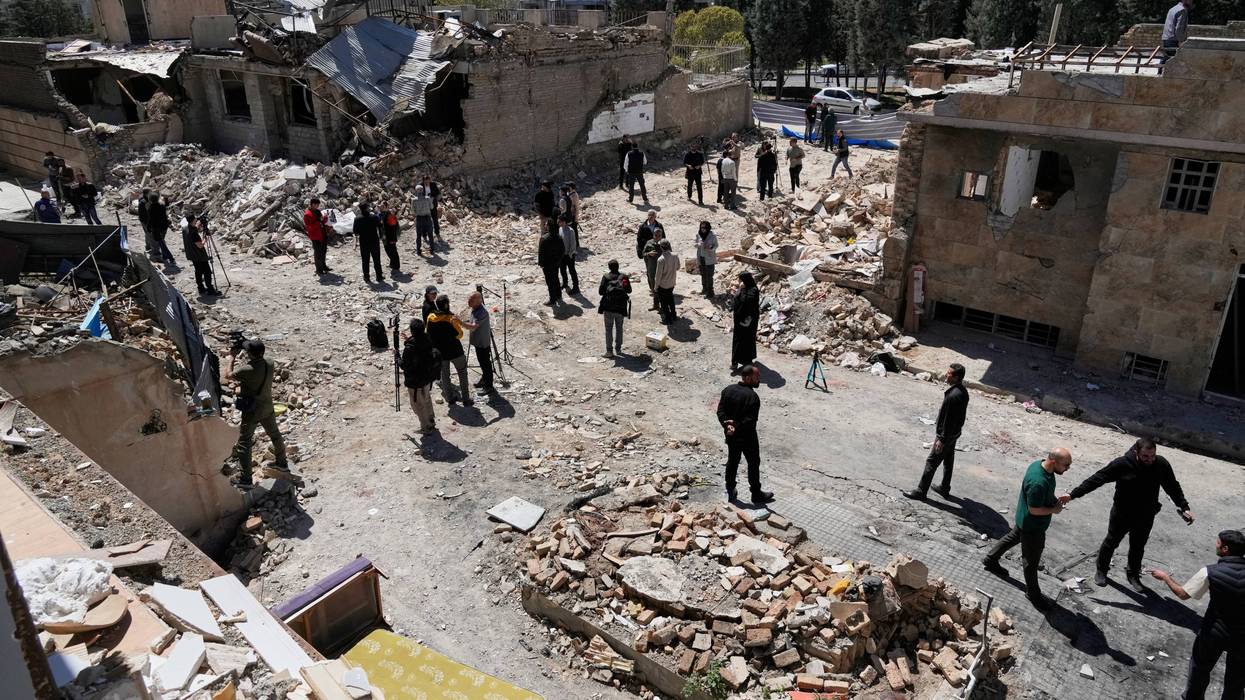
A major explosion from an airstrike struck Iran’s capital, Tehran, around the same time Friday afternoon. It wasn’t clear what had been hit.
At least 12 people were injured by missile shrapnel in UAE
Shrapnel from a missile interception in Abu Dhabi’s Ajban area on Friday left at least 12 people hurt. Officials said seven of those injured were from Nepal and five from India.
Churches in the UAE also announced they will be closed over Easter Sunday due to orders from the government as the war continued.
Israel says it will occupy new positions inside Lebanon in coming days
Israel’s military said Friday it will soon be able to say it has established new defensive lines in order to prevent direct fire on communities in northern Israel.
Army spokesman Nadav Shoshani said Israel will establish control and defense for its communities coming under “immediate fire” posing an “imminent threat.” Shoshani said Israel has killed at least 1,000 Hezbollah militants since the start of the operation.
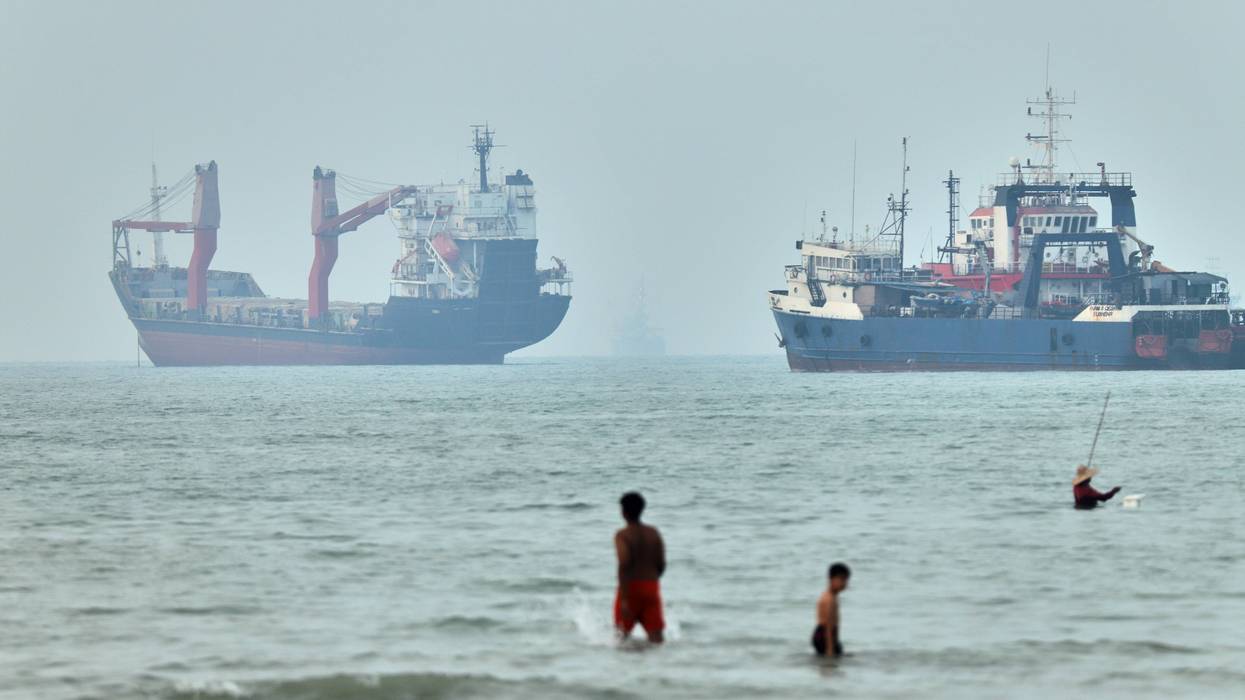
French-linked container ship transits Strait of Hormuz
The CMA CGM Kribi, sailing under a Malta flag and operated by French shipping company CMA CGM, became possibly the first vessel with links to France to pass through the strait since Iran effectively closed it, according to the MarineTraffic website.
The ship departed waters off Dubai on Thursday and arrived Friday off Muscat, Oman, MarineTraffic data showed. CMA CGM, the world’s third-largest container shipping company, declined to comment when contacted by AP.
Traffic through the strait has dropped by about 90% since the start of the Iran war. Only about 150 vessels, including tankers and container ships, have transited the strait since March 1, according to data firm Lloyd’s List Intelligence. Most were linked to Iran and countries including China, India and Pakistan.
Iran’s civilian casualties are mostly from strikes on state-linked sites, monitor says
Civilian casualties in Iran were clustered around strikes on government-linked sites “rather than indiscriminate bombardment” of urban areas, according to Armed Conflict Location and Event Data, the U.S-based group known as ACLED.
Iran reported at least 1,973 people were killed since the start of the war. The deadliest attack was on Feb. 28 on a school near a Revolutionary Guard base in southern Iran, killing over 160 civilians, most of them children.
ACLED said most of the recorded incidents resulting in civilian casualties happened after strikes on security or military sites in densely populated areas. It documented under 100 such attacks.
Targeted assassinations of government and security officials were the second most documented cause of civilian casualties. ACLED said it documented nearly 50 strikes on specific floors or using heavy ammunitions that destroyed entire buildings. In nearly 40 incidents documented by ACLED, strikes on civilian sites repurposed by security forces, such as sports complexes where they sheltered as their bases come under attack, led to civilian casualties.
British prime minister condemns drone attacks on Kuwait oil refinery
Kuwait blamed Iran for the drone attacks that sparked fires at its Mina al-Ahmadi refinery Friday. There were no injuries reported.
British Prime Minister Keir Starmer reiterated the U.K.’s support for Kuwait in his call with Crown Prince Sheikh Sabah Khalid Al Sabah, his office said.
Britain’s defense minister said this week that it was deploying an air defense system to Kuwait as part of efforts to protect its interests in the region.
Ireland’s defense minister cancels trip to Lebanon
Helen McEntee had been due to meet with Irish troops serving in the United Nations Interim Force in Lebanon after her visit Wednesday to Kyiv, Ukraine. But she said the Irish military warned that it was too dangerous after three Indonesian peacekeepers were killed this week in southern Lebanon, where Israel is fighting Hezbollah.
Abu Dhabi shuts gas field over reported debris from interception
Authorities in the United Arab Emirates shut down Habshan gas facilities Friday after a reported interception of a missile rained down debris and started a fire.
Ukraine says it’s willing to support efforts to reopen the Strait of Hormuz
President Volodymyr Zelenskyy said Ukraine could contribute to protecting maritime routes if invited, citing experience gained from keeping Black Sea shipping lanes open under sustained Russian attack.
“If we are invited, we will help,” Zelenskyy said, without elaborating. “The strait must be unblocked.”
Kyiv’s offer comes as it deepens cooperation with Gulf countries such as Qatar, Saudi Arabia and the United Arab Emirates, shifting toward a long-term role as a security partner. Ukrainian teams have already been deployed to the region to advise on air defense, infrastructure protection and maritime security.
Amnesty warns Iran is recruiting children as young as 12
Amnesty International is warning Iran that its recruitment of children as young as 12 for the Revolutionary Guard’s all-volunteer Basij force amounts to a war crime. The Guard has put out the call recently as the Basij finds its checkpoints under attack during the war with the United States and Israel.
Amnesty also said that eyewitnesses and its own analysis of video footage “show child soldiers having been deployed” to checkpoints and patrols, some armed with weapons including Kalashnikov-style assaults rifles.
“As U.S. and Israeli strikes hit thousands of (Guard) sites, including Basij facilities, across the country, including through drone attacks targeting security patrols and checkpoints, the deployment of child soldiers alongside (Guard) personnel or in their facilities puts them at grave risk of death and injury,” Erika Guevara-Rosas of Amnesty International said.
Kuwait says attack damaged a desalination plant
The attack came after an oil refinery was hit by drones Friday morning.
Kuwait said without elaborating that the attack on the desalination plant caused “material damage to some of the plant’s components.”
Desalination provides the majority of the water for the Gulf Arab states and Iran, drawing the salty waters of the Persian Gulf into drinking water for the desert region. About 90% of drinking water in Kuwait comes from desalination.
Desalination plants have become a major target in the war, with Iran initially accusing the U.S. and Israel of striking one before beginning to target them in the Gulf Arab states. Those states view attacks on desalination plants as a threat to their very livelihoods.
Zarif suggests low enrichment, regional nuclear facility for a deal
Iran’s former top diplomat suggested Tehran could down-blend its highly enriched uranium in a deal to end the war.
Mohammad Javad Zarif suggested Iran could enrich uranium below 3.67%, the level set by the 2015 nuclear deal U.S. President Donald Trump pulled America out of in 2018.
However, Trump has maintained Iran must have no enrichment.
Zarif also suggested the inclusion of China and Russia in any deal to do a single uranium enrichment site for all of the region, where Iran “would transfer all its enriched material and equipment to that space.”
That is a proposal suggested in previous rounds of talks.
Zarif also suggests Washington and Tehran could “explore dispatching diplomats to serve in their respective interest sections, restoring consular services and removing travel restrictions on each other’s citizens.”
The U.S. and Iran have not had diplomatic relations since 1980, when President Jimmy Carter severed ties over the hostage crisis.
Former Iran top diplomat suggests terms to end war
Iran’s former top diplomat offered terms Friday to see a ceasefire in the war with the United States and Israel.
Mohammad Javad Zarif, who helped reach the 2015 nuclear deal with world powers, made the proposal in Foreign Affairs magazine in a piece published Friday.
While Zarif has no official position now in Iran’s theocracy, he helped get reformist President Masoud Pezeshkian elected.
He also would not have been able to publish such a piece without at least running the positions past senior members of the country’s theocracy.
While insisting Iran “is clearly winning” the war, Zarif wrote that Tehran “should offer to place limits on its nuclear program and to reopen the Strait of Hormuz in exchange for an end to all sanctions — a deal Washington wouldn’t take before but might accept now.”
It remains unclear how U.S. President Donald Trump would respond to such a pitch, particularly as Zarif referred to Trump’s close friend Steve Witkoff and his son-in-law Jared Kushner as “completely illiterate on both geopolitics and nuclear technicalities.”
Human remains found on Thai ship
A team searching a Thai ship that was struck near the Strait of Hormuz on March 11 has found human remains onboard, the Thai Foreign Ministry said Friday.
The Mayuree Naree was hit by a projectile just north of Oman. Three of its crew members were declared missing.
The search team was hired by the ship’s owner, Precious Shipping Co. The company and the ministry did not say when the ship was searched or its current location. A previous search of the vessel was disclosed March 30.
The ministry said the team has not been able to immediately verify the identity of the remains, which were found in a damaged area of the ship.
Former CIA director warns strait could become ‘we break it, you own it’
Former CIA director Bill Burns is warning the crisis over Iran’s chokehold on the Strait of Hormuz could become a case of “we break it, you own it” for America’s allies.
Burns, a former State Department diplomat, made the observation in a podcast by Foreign Affairs magazine.
He noted U.S. President Donald Trump could try a ground operation to take Iran’s Kharg Island, its main oil terminal, or territory along the strait, but both carry significant risks.
“Then there’s the third option, which is effectively declaring victory and the inversion of the old Colin Powell Pottery Barn rule, which was ‘we break it, we own it,’” Burns said, referencing a comment attributed to former U.S. Secretary of State Colin Powell before the 2003 U.S.-led invasion of Iraq.
“Instead, it would be, ‘we break it, you own it, and it’s over to you guys,’ whether it’s European allies or Gulf Arabs or anybody else to ensure safe passage through the Strait of Hormuz.”
Former CIA director calls Iran campaign ‘a war of choice’
Former CIA Director Bill Burns has described the U.S.-Israeli war launched against Iran as “a war of choice” that may have only further empowered the most hard-line elements within its theocracy.
Burns, a former State Department diplomat, made the observation in a podcast by Foreign Affairs magazine.
“This is a regime that is inept at many things like managing its economy, but it is designed to preserve itself and designed to repress its own people and designed to withstand even the decapitation of its senior leadership,” said Burns, who secretly negotiated with the Iranians ahead of the 2015 nuclear deal with world powers during the Obama administration.
Burns also disagreed with U.S. President Donald Trump’s assessment that there had been a “regime change” in the airstrike campaign killing top leaders, including Supreme Leader Ayatollah Ali Khamenei.
“In some ways, it’s certainly a much weaker regime, but it’s also one that’s even nastier and more radical and, you know, less open,” he said.
He added that Iran’s theocracy thought “victory is survival.”
“I’ve believed for a long time that this is a regime that’s on a kind of one-way street to its eventual collapse, but I worry that, you know, in this war, what we’ve done rather than accelerate that moment of collapse is slow it down a little bit,” Burns said.
French and South Korean presidents agree to help reopen strait
French President Emmanuel Macron and South Korean President Lee Jae Myung agreed Friday to work together to help reopen the Strait of Hormuz and ease global economic uncertainties caused by the war in the Middle East.
In a televised briefing after their meeting in Seoul, Macron underscored the need for France and South Korea to cooperate to help reopen the strait and de-escalate Middle East animosities.
Lee said the two affirmed “their resolves to cooperate to secure the safe shipping route in the Strait of Hormuz.”
The two leaders did not elaborate on how they would help reopen the strait and took no questions.
Macron was making his first visit to South Korea since taking office in 2017.
Kuwait says Mina al-Ahmadi oil refinery hit by Iranian drones
Iranian drones struck Kuwait’s Mina al-Ahmadi oil refinery Friday, sparking fires at the facility.
The state-run Kuwait Petroleum Corp. issued a statement on the attack and said firefighters were working to control the blazes .
There were no injuries reported, the company said.
Kuwait has blamed Iran, as well as Iranian-backed Shiite militias in Iraq, for drone attacks targeting the small, oil-rich nation on the northern edge of the Persian Gulf.
Kuwait operates three oil refineries. Mina al-Ahmadi has come under attack at least three times in the war so far.
Refineries are key to Kuwait’s oil production because without them, oil wells would have to be shut down for lack of a destination for the oil.
Restarting refineries is extremely time consuming for safety reasons and those wells would remain largely inactive until refineries are back on line.