


Buffalo, N.Y. (WBEN) - "I think it is important that we take what we have here in the T.R. Site, and we take pride in it. This is not just America's legacy, either. This is Buffalo's legacy."
As the United States celebrates 250 years of independence in 2026, WBEN is taking a look back on Buffalo and Western New York's role in the history of the country.
The year was 1901, and the City of Buffalo was hosting the Pan-American Exposition, a celebration of connecting North and South America, while showcasing everything from harnessing electrical power from Niagara Falls to the X-ray, to soap on a rope.
In early September of 1901, a little more than four months into the Pan-American Exposition, U.S. President William McKinley made the trip to Buffalo to celebrate America with the rest of the country when he was approached by anarchist Leon Czolgosz and shot at point-blank range.
After being shot twice in the abdomen, the initial prognosis for the president was good, and they thought he was going to survive and make a comeback. However, the president's condition eventually took a turn for the worse due to gangrene, and he eventually died in the early morning hours of Sept. 14, 1901 at the Milburn House, which was on the property that is now Canisius High School.
Vice president Theodore Roosevelt, who was in the Adirondack Mountains at the time, was located and rushed down the mountainside, where he then boards a train in North Creek, N.Y. and rushed back to Buffalo, where he takes residence at his friend's mansion, Ansley Wilcox, at 641 Delaware Avenue for two-and-a-half days.
"He takes the Presidential Oath of Office in the family library at about 3:30 p.m. that afternoon, so 13 hours later after McKinley has died, T.R. [Theodore Roosevelt] is already taking the oath of office here in Buffalo. And this house served as the nation's executive mansion for two-and-a-half days," said Spencer Morgan, executive director of the Theodore Roosevelt Inaugural National Historic Site. "The eyes of the world were on the columns here at Delaware Avenue, waiting to see the new young president. This is significant. We are one of four cities in the country that has hosted an inauguration outside of D.C. We are one of the only cities that has witnessed a presidential assassination, and we are one of the only cities that has seen the death of a president because of an assassination, as well as a presidential inauguration taking place as a result of that assassination. We have to remember that. That is a significant piece of American history."
Roosevelt and Wilcox shared an interesting personal relationship that started over a period of mourning, and it blossomed into a long-term friendship.
"T.R., of course, had suffered the loss of his first wife after the birth of his eldest daughter some years prior. Mr. Wilcox had suffered something similar," Morgan explained. "He married Cornelia Rumsey, who gave birth to his eldest daughter, and then Cornelia sadly passed away. He would go on to court her sister, Mary Grace, and it was the event of their marriage that the house was purchased. We believe these two men, who met around this time, who shared this similar grief and tragedy in their personal lives, was a foundation block for them to develop a lifelong correspondence and a lifelong friendship, which 20 years later would ultimately dictate that T.R. be a guest here in this house, and why this house served as the executive mansion as it did in 1901."
Before it ever became the Wilcox Mansion, though, the site was home to the Poinsett Barracks, with the main structure originally constructed as the officers' quarters.
"In the 1830s, there was some unrest in Canada, and at the time, we did not have as great a relationship with our Northern brethren as we do now," Morgan noted. "A lot of people also remembered the burning of Buffalo in 1813 as part of the War of 1812, and there was some unease of our positioning along our Canadian neighbors. So they requested funding be set aside for a federal site to be constructed here in Buffalo, and that funding did come through. So in the 1830s, funding was set aside for the construction of the Poinsett Barracks, and the footprint was between Allen Street and North Street, and between Delaware Avenue and Main Street. It was a massive barracks."
During its time as a barracks, President Martin Van Buren was in person to dedicate the fort, while one of the officers in residence - Dr. Robert Woods, the post-surgeon - his wife was Anna Taylor Woods, daughter of future President Zachary Taylor and sister-in-law to the future Confederate President Jefferson Davis.
After its life as the officer quarters for Buffalo Barracks, the structure was purchased and converted into a private home by Joseph Masten, who was a local politician and an early Buffalo mayor. It then changed hands a few times throughout the next 60 years or so, until finally it was purchased by Dexter Rumsey, one of the wealthiest men in not just Buffalo, but rather the entire country. It was the marriage of his daughter, Mary Grace, to Wilcox that saw them take residence, and eventually brought the tie to Roosevelt.
From the Wilcox Mansion on Sept. 14, 1901, not only does Roosevelt take the oath of office as the 26th President of the United States, it's where he issues his first presidential proclamation, ushering a period of mourning for the late president.
But it's also here he sends a letter to Booker T. Washington, one of the major race relations figures in the Southern states during the time.
"As vice president, [Roosevelt] was supposed to visit Tuskegee Institute and pay his respects to Booker T. Washington, a character who had influenced a great deal of T.R.'s views on race. He knew now as president, he could not make that trip to Alabama. So instead, he invites Booker T. Washington to dine at the White House. That letter is sent to Booker T. Washington from Buffalo on Sept. 14, 1901, it is signed on the executive mansion letterhead - although it would have come from 641 Delaware here in Buffalo," Morgan noted. "That dinner did take place about a month later, on Oct. 16, 1901, the first time an African American was invited through the front doors of the White House to dine with a sitting president and first lady. This is a significant point in history. Some historians actually point to that dinner as the launch of the Civil Rights Movement in the 20th century."
In the years after the Wilcox family passes away, the mansion eventually changes hands and, at one point, nearly becomes another lost Buffalo relic to time.
"A Spanish-American War Veterans Committee attempted to purchase the house in the 1930s to turn it into a memorial and a museum for T.R., that was unsuccessful. It then became a restaurant, and then in the 1960s when this house became available again, when it was on the, let's call it, the 'endangered species' list, the people of Buffalo banded together - Boy Scouts, veterans, junior leaguers. They worked together to save this house, and this became the first building in Erie County added to the National Register of Historic Places in 1966," Morgan said. "And it was a fight to get it on that list. It took three passes of Congress, it took a march up Delaware Avenue with picketers who were crying 'Save the Wilcox Mansion.' And it took a letter-writing campaign that inundated the Secretary of the Interior's Office with requests to save this building because of the McKinley assassination, because Theodore Roosevelt - who was one of our most popular presidents in history - took his initial oath of office here as the youngest president in the country's history. It is that kind of charisma, that Buffalo grit is why this house is still standing."
Today, the site is Buffalo's only National Park site, and is a full unit of the National Park Service.
"We are one of the only units in the entire country that is not staffed by federal employees. We actually receive a little less than one-third of our funding through the National Park Service," Morgan said. "While the building itself belongs to the American people through the NPS, it is our local foundation - the Theodore Roosevelt Inaugural Site Foundation - that raises more than two-thirds of our operating every year through earned revenue like ticket sales and rentals and grants, to philanthropic gifts and individual giving and memberships that support this site. So we are a unique example of a public and private partnership that benefits not only the American people, but their wallets too. We can have heritage in Americana, and it doesn't have to cost a fortune. And it can be locally driven, and it can be a partnership."
More than 30,000 visitors from across the nation, as well as the globe are estimated to walk through the doors of the Theodore Roosevelt Inaugural National Historic Site.
Morgan feels the Wilcox Mansion at 641 Delaware Avenue is the birthplace of the modern presidency in the U.S.
"Theodore Roosevelt is president, he expanded presidential powers for the purpose of reform. He was a Republican, but he was a progressive at that time. And he really believed in the power of people, and he believed in the power of America. He did believe we were the greatest nation in the world. I would argue, and I think history can point to this, that everything we are experiencing now in today's current political and social climate is a direct result of the events of 1901," he said.
"With T.R.'s expansion of executive presidential powers, with his cousin and nephews continued expansion of those powers during FDR administration during the Great Depression and World War II, all the way up to [Barack] Obama, [Joe] Biden and even President [Donald] Trump and their expansion of presidential powers, this is a direct result of Theodore Roosevelt and his presidency in 1901. This is a direct result of what happened during the Gilded Age when the separation of the wealthiest and the poorest was at its peak."
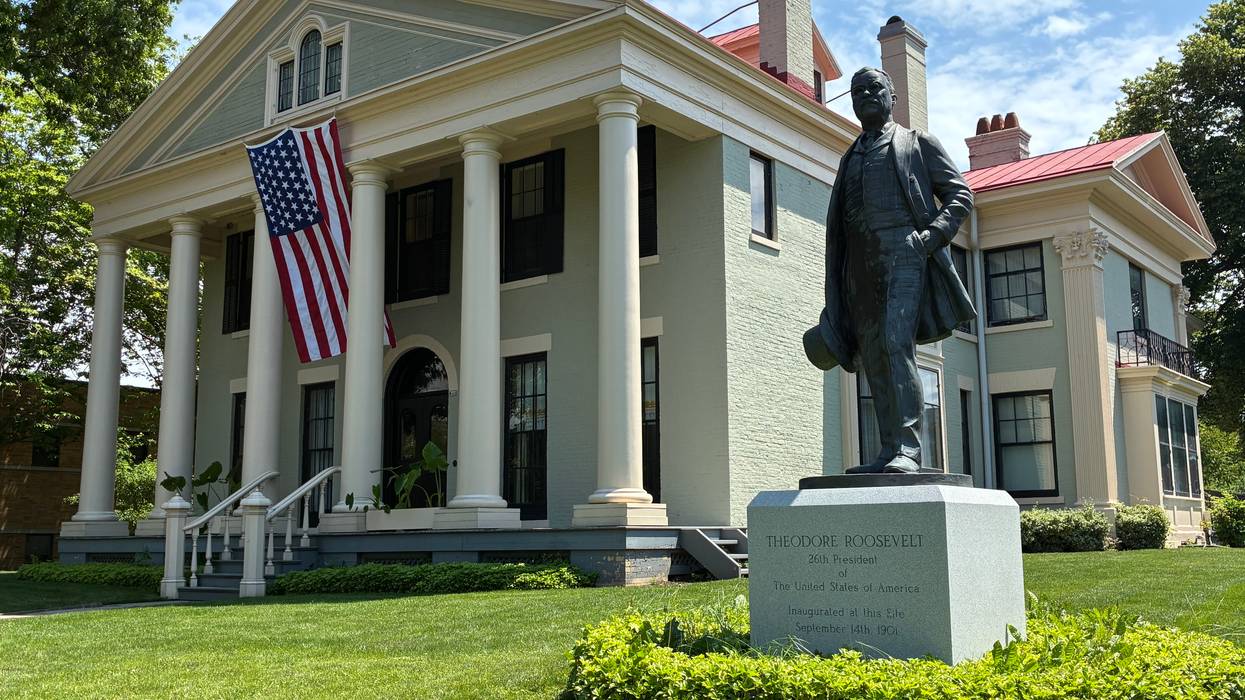
If you stop by the front of 641 Delaware, there is a 45-star flag hanging from the colonnade, which replicates the flag that was hanging at the house during Roosevelt's time at the mansion. Coming up this August, black mourning cloth will be hung on the colonnade to look as the house did on Sept. 14, 1901, the day McKinley died and the day Roosevelt took the oath of office in Buffalo.
"It's also our way of commemorating America 250. It's hard to celebrate America, but then also commemorate this whole event that's based around a presidential assassination. So we have to take pause and take that into consideration," Morgan acknowledged.
The site hosts a number of tours throughout the summer, with one tour running every half hour. It is open 10 a.m.-to-5 p.m. every day of the week, including Saturdays and Sundays.
The National Historic Site will also be hosting a couple of notable exhibits in the coming months to not only celebrate America 250, but also commemorate the 125th anniversary of the McKinley assassination.
"Later on this summer, something very special is happening. We're actually opening the gallery space for a temporary exhibit called '12 Days in Buffalo'. That will be a deeper examination of the events that occurred here in September of 1901," Morgan said. "Everything from what happened next, to how did they care for the president medically speaking, to who was in the room when President Roosevelt took the oath of office in this little library at 641 Delaware. That's going to be a great exhibit. It'll open to the public on Aug. 1, and it'll be open until the first weekend in October."
Then on Sept. 14, the city will mark the anniversary of McKinley's death and Roosevelt's inauguration with a public civic event at the McKinley Monument in North Buffalo. More details are forthcoming.
"Later that afternoon, Joe Wiegand - America's foremost reprisor of Theodore Roosevelt - will be arriving in Downtown Buffalo via Amtrak with the Adirondack Club in tow as Theodore Roosevelt. He will make his way here to the house at 641 Delaware, where he will be giving a reenactment of the Presidential Oath of Office in the library. We hope to have that live streamed as well, so you can catch that live," Morgan added.
A complete list of events and exhibitions available for the public this summer are available at the site's website, TRSite.org. You can also call the site at 716-884-0095 for more information.