


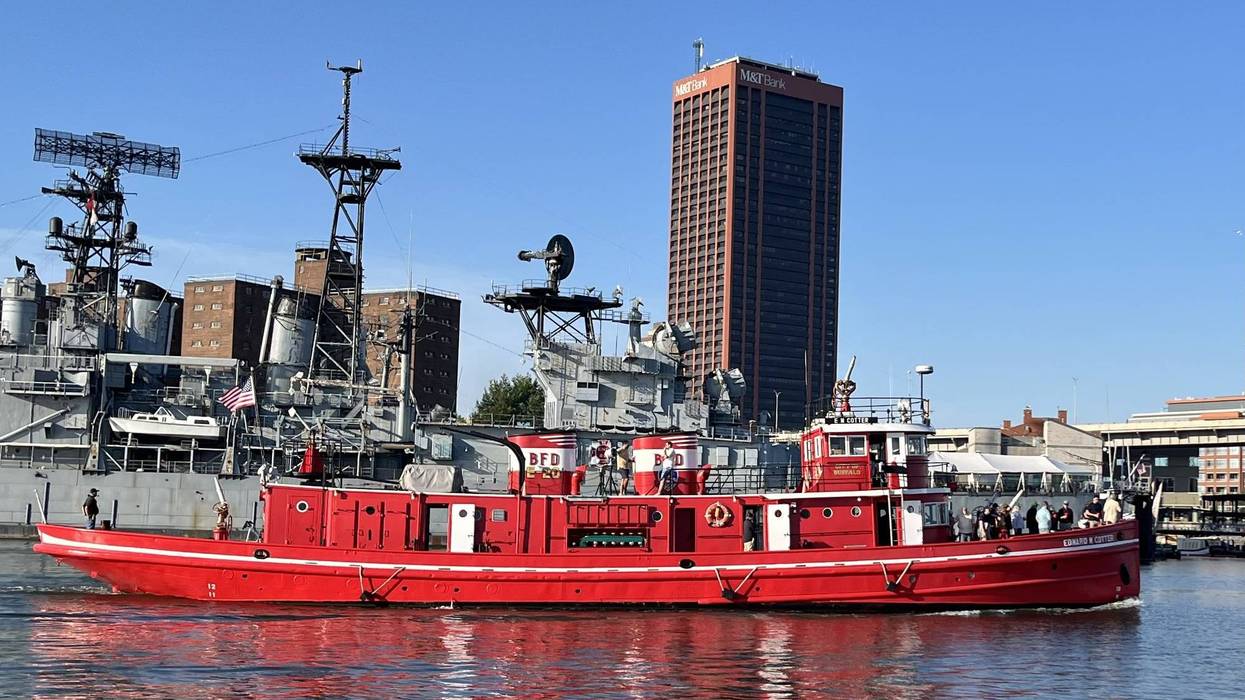

Buffalo, N.Y. (WBEN) - Over the last 125 years, the Edward M. Cotter fireboat has been a valued resource for the City of Buffalo as not just a firefighting water vessel, but also an ice breaker during the winter months and... a bridge coolant?
Due to the extreme heat in Western New York last week, the Michigan Street bridge became inaccessible due to the metal on the drawbridge expanding, causing it to become stuck in the upright position. That's when the E.M. Cotter fireboat was called on to spray water on the bridge to help cool it down.
Despite efforts from the crew aboard the Cotter, the city kept the drawbridge closed.
"Unfortunately, after putting about 3 million gallons of water onto the bridge, it didn't really work out," said E.M. Cotter Cpt. Michael Kick in an interview with WBEN. "Later in the night, they were able to get the bridge to raise, but then it got stuck again. So they're looking at some possible mechanical issues with it, in addition to the fact that I think the heat had a lot to do with causing the initial part of the problem."
To his knowledge, and with speaking with other retired captains of the Cotter, Cpt. Kick says something like this has never happened in the fireboat's history before.
"This is kind of a one-of," Cpt. Kick said. "But like a lot of things, when things go sideways and you're not really sure what to do, people call the fire department. We can usually figure it out and try to see what we can do to make the situation better. It was worth the effort. In theory, I think it would have worked, but that's why there may be some other mechanical issues besides the fact that the bridge may have expanded because of the heat."
Not only is the Cotter an icebreaker and a fireboat, but it's a huge public relations tool for Buffalo with its history and abilities on the city's waters.
"We were out last weekend bringing in the Seneca Chief, escorted them in with a water display, and things of that nature. We're good for that kind of stuff," Cpt. Kick noted. "But the capabilities of the boat, if there's a fire somewhere along the shore that we couldn't reach with our monitors on the boat, we have the capability of supplying an endless supply of water to ground companies, to fire engines and ladder trucks through five inch hoses. And we have the ability to pump five of those at one time, and the average fire engine in the City of Buffalo can do one. So if there's a warehouse type building or a major fire that's within reach of hoses from the water, we'd be able to supply them with an endless supply of water. That's one of the big things."
With the Cotter still being a vital asset for the City of Buffalo after 125 years and counting, Cpt. Kick feels it's a testament with how previous captains and crews over the years, as well as the engineers and mechanics that have worked on the upkeep to keep the boat still doing what it's doing, as well as it's doing it today.
"The city has done its part to, as best as it can and during certain financial times - it gets harder to do things that need to be done - the boat has been well taken care of. The crews that have always worked the boat have taken a lot of pride in it, there's a lot of personal elbow grease and time and effort that people put into it to make sure that it's operational and mission ready," Cpt. Kick said.
While the Cotter continues to serve the city to this day, Cpt. Kick says there are efforts being made to keep the historic fireboat in service for years to come.
"In 2016, the E.M. Cotter Conservancy was formed, and the conservancy is a 501-3c tax deductible donation-type organization who their mission is to work at preserving the history, the maintenance and the upkeep of the boat, and filling in financially where sometimes the city can't," he said. "We just had a great donation by Jon Rivera, and we've had some other politicians that are going to be sending some money our way."
Recently, a full survey was completed of the vessel with the same firm that's working with the USS Croaker and USS The Sullivans, and Cpt. Kick said they were surprised at the condition of the boat being as good as it is. He did acknowledge, though, there were some shortcomings.
"One of the things is we've been having some transmission issues, and while we did do some repairs to it over the winter, it was more of a band aid. So the recommendations now are we replace the two propulsion engines and the two transmissions, because we can't get any parts for the transmissions. They're obsolete, and they were kind of one-offs when they were put in in 1953, so the power train is almost 75 years old," Cpt. Kick explained. "So the best thing we can do is replace them so if something does happen, we'll have parts readily available and it'll be more fuel efficient, and operationally it'll keep the boat going for many years in the future."
The E.M. Cotter Conservancy is in the midst of fundraising efforts at this time.
"We're hoping to come up with about $3 million for repairs through various grants and foundations and donations," Cpt. Kick said. "Donations can be made through information garnered from the E.M. Cotter Conservancy webpage at EMCotterConservancy.org. We've got a Facebook page, there's information on there, and we're trying to keep the boat out in the public eye, we're out as much as we can."
The Conservancy is also offering tours of the fireboat on Mondays, Tuesdays and Wednesdays from 12 p.m.-to-7 p.m., with doors being open to anyone.
"It's free, but we would welcome any donation anybody wants to throw our way while they're there to help offset some of the other costs," Cpt. Kick added. "That's one way that you know people can help us. And if there's any groups out there or foundations that are looking for a good cause to help out, I can't think of a better one than the E.M. Cotter fire boat."
The historic fireboat attempted to help cool down the Michigan Street bridge during last week's extreme heat
The historic fireboat attempted to help cool down the Michigan Street bridge during last week's extreme heat