


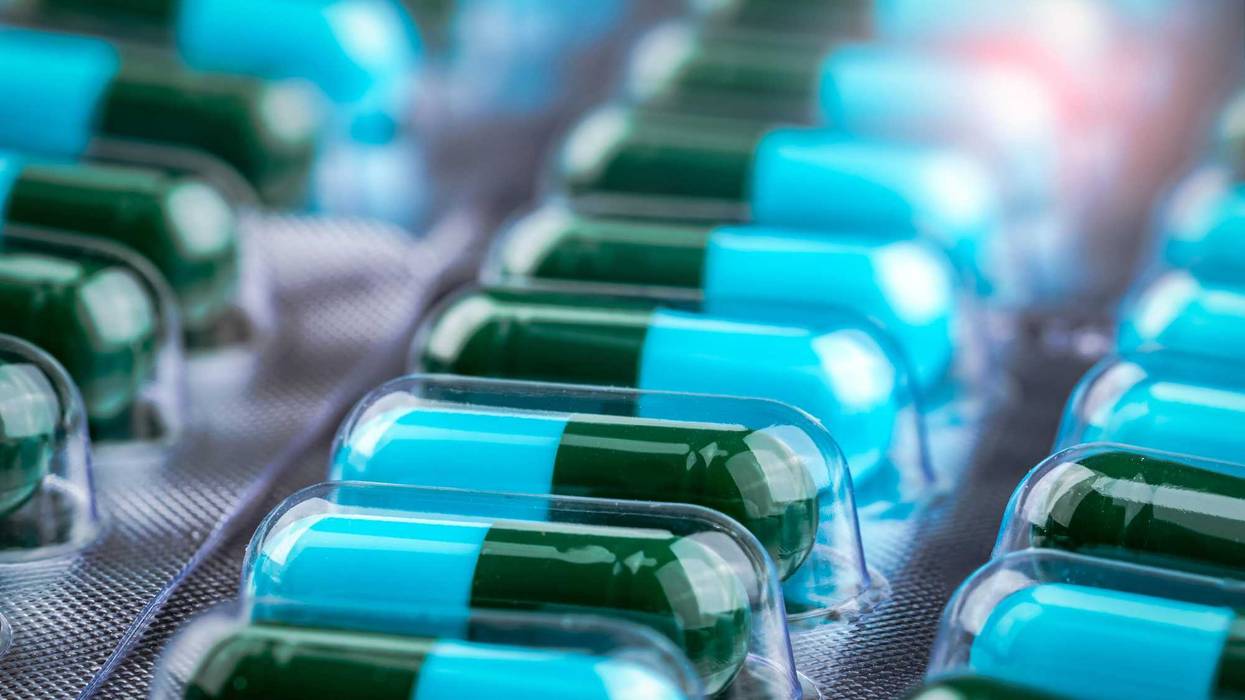

Buffalo, N.Y. (WBEN) - There is some growing concern nationally of a shortage of amoxicillin, as some pharmaceutical companies that supply amoxicillin are reporting some constraints when it comes to the antibiotic.
Companies like Hikma Pharmaceuticals and Teva Pharmaceuticals have a number of amoxicillin products that are considered in short supply, with the most predominant form being oral powder for suspension. While some of the reasonings are not made clear for the shortage in supply, there has been an indication of some back orders being a problem in the coming weeks.
As some parts of the nation are dealing with the potential shortage of amoxicillin, how are local pharmacies looking in Western New York dealing with the matter?
For some, the problem lies with ordering amoxicillin, especially in the powder for suspension, or liquid form of the antibiotic.
"We've had a problem ordering amoxicillin suspensions in the powder form for probably the last six months," said Don Arthur, owner and pharmacist with Brighton Eggert Pharmacy. "In our space, independent community pharmacies, we buy our generic medications from primary wholesalers and generic distributors. This particular one, KeySource, sells to over 6,000 independent pharmacies. So I reached out to them, and they're saying it's a manufacturing issue. It's going to be a problem for sometime in the future but the manufacturers just cannot keep up with the demand of amoxicillin."
While the demand for amoxicillin powder for suspension is creating some problems for some local pharmacies, Arthur potentially sees the issue affecting the availability of amoxicillin capsules, as well.
"As we get into what we traditionally call 'cough/cold season', it's going to be an issue now for the amoxicillin 500 milligram capsules, and it's going to be an issue for the tablets," Arthur said. "It's also going to be an issue for a newer version of Augmentin, which is a combination product of Augmentin and clavulanic acid, which is kind of a new-and-improved version. So the amoxicillin ingredient in that Augmentin product is going to be in short supply too."
Whenever any form of prescription medication is unavailable to Arthur and Brighton Eggert Pharmacy, he makes the effort to reach out to his manufacturing distributors to try and get some background information to better understand the problem, and whether if it's a short-term or long-term issue. However, the reasonings for supply issues for Arthur have so far been unclear.
"This amoxicillin is a very old antibiotic, it's one of our original antibiotics. Not quite as old as penicillin, but amoxicillin has been around for a very long time. Very inexpensive antibiotic, very effective. I asked if it's a COVID-related issue, and really the information I got back was vague," Arthur said. "They told me that absolutely, it's on the manufacturers end, it appears to be some issues that they feel may be related to labor on the manufacturing side. Most of the amoxicillin manufactured for use in the United States is not even manufactured in the United States. It's manufactured offshore in countries like India. So the best information that I was able to get was that it is a manufacturing issue, and it's tied to some of the issues that we're all having related to the supply of labor."
The good news is within the broad spectrum of antibiotics, physicians and pharmacists have other options available to them to help people when they need medication to fight off certain issues.
However, if there is someone in need, specifically, of amoxicillin with it being in short order, and if it is a child or an elderly person in need of the liquid form of the antibiotic, it is difficult for the ability to prescribe a smaller dosage of the amoxicillin that's already in a large adult capsule.
"If the physician wants the patient to be on amoxicillin and the patient unfortunately has difficulty getting that, then it's going to have to go back to the physician, and there are other antibiotic medications and classes that, hopefully, they can select for the patient to address whatever their needs are," Arthur said.
Over the nearly 40 years he has been in practice in Western New York, Arthur says the practice of prescribing and issuing antibiotics has changed quite a bit. During the cough and cold season back in the mid-1980s, pharmacies would purchase cases-and-cases of amoxicillin suspension, because it was often when a child was presented with cough and cold symptoms, physicians would select an antibiotic like amoxicillin to fight the symptoms.
In today's practice, those circumstances are certainly different.
"We know now that the overuse of antibiotics in our community is not a good thing. We know that often, the cough/cold symptoms are a virus, a seasonal virus, which the antibiotics will not be helpful for," Arthur said. "I guess it's fortunate that amoxicillin, although it's not available in large quantities right now, the demand for it over the last several years really has been quite low. It's just not really used as widely in a pediatrics practice as it was years ago."
While amoxicillin shortages may be taking a hold at the national and local level, there is some belief that the shortages may be more sporadic than anything, and some communities locally are not seeing the same effects with certain shortages than others.
In conversations with several colleagues at the retail and community pharmacy levels, former Executive Director of the Pharmacists' Association of Western New York, Dennis Galluzzo has discovered the shortages may appear to be more isolated for specific pharmacies in regions or communities that have an increased demand at a particular time.
"I think if one pharmacy may have it, the other pharmacy may be stressed. You may have an area or a community that's stressed because people panic, they ask their doctors for medication because they're worried that they might have this respiratory syncytial virus, and so therefore, the pharmacies get increased demand because the families are putting increased demand on physicians in the area," said Galluzzo. "That might be just a very local thing, and one pharmacy or one chain may go out of it, because they don't have a diverse supply chain. But right at this point in time, I think they're increasing enough of it, and of course, the FDA, I think, is also addressing the fact that they're getting these manufacturers to increase their production. I don't think this is going to be a problem."
As Galluzzo points out, shortages have slowly increased over the last few years due to the increase of demand. While several companies and manufacturers that distribute amoxicillin to pharmacies across the country and the world, if there is the increase in demand to take care of some scares in the industry, companies may say they have to limit their orders to meet the obligations they already have.
"Let's take this RSV, this syncytial virus that has caused some scares for families in the area, this puts an increased demand on the system. Even though it's a virus and we don't use amoxicillin for treating it, you get increased demand by families and put pressure on doctors to supply a medication, like an antibiotic like amoxicillin, 'Oh, this worked before, doctor. We need to have it, let's have it now.' And doctors give in," Galluzzo said. "What happens is you get maybe an isolated area, or you get a bunch of people in the community that insist on having amoxicillin given to their child, because it's not a very expensive medication, it never has been, so therefore, they put it out and causes somewhat of a supply problem."
When looking at the broader spectrum, amoxicillin is not the only form of medication that has been in short supply nationally and internationally. Liquid Tylenol has been in short supply North of the border in Canada, while other medication like Adderall has also been considered, in some cases, to be in short supply.
A number of factors could play into the impact of supply chain issues for pharmaceuticals across the globe. On top of the localized demand, as previously mentioned, there is also a decrease in the workforce and a decrease in trucks moving out the product that may be creating a problem with both production and distribution.
However, one of the problems with antibiotics like amoxicillin is they might be the first-line choice for some people, which is something pharmacists like Galluzzo and Arthur don't like to see happen.
"You have an increased demand, and then people, if they can't get amoxicillin, what's going to happen? They're going to give a higher priced medication or antibiotic, and what this causes in the community [is] bacterial resistance, so we get more resistance as we use more antibiotics," Galluzzo explained. "That's why you get doctors trying to calm people down and say, 'Look, this is probably a virus. We don't need to give you this antibiotic right now. Let's treat it this way, let's do this, let's do that.' But people put increased demands on antibiotics all the time. I've seen it in my own pharmacy, people coming up and calling, 'Doctor, I need an antibiotic. I had this problem last year, it's the same problem. I want the antibiotic.' And this causes drug resistance, and now we've gotta find more drugs, more antibiotics that are high-powered to actually eliminate some of these infections."