


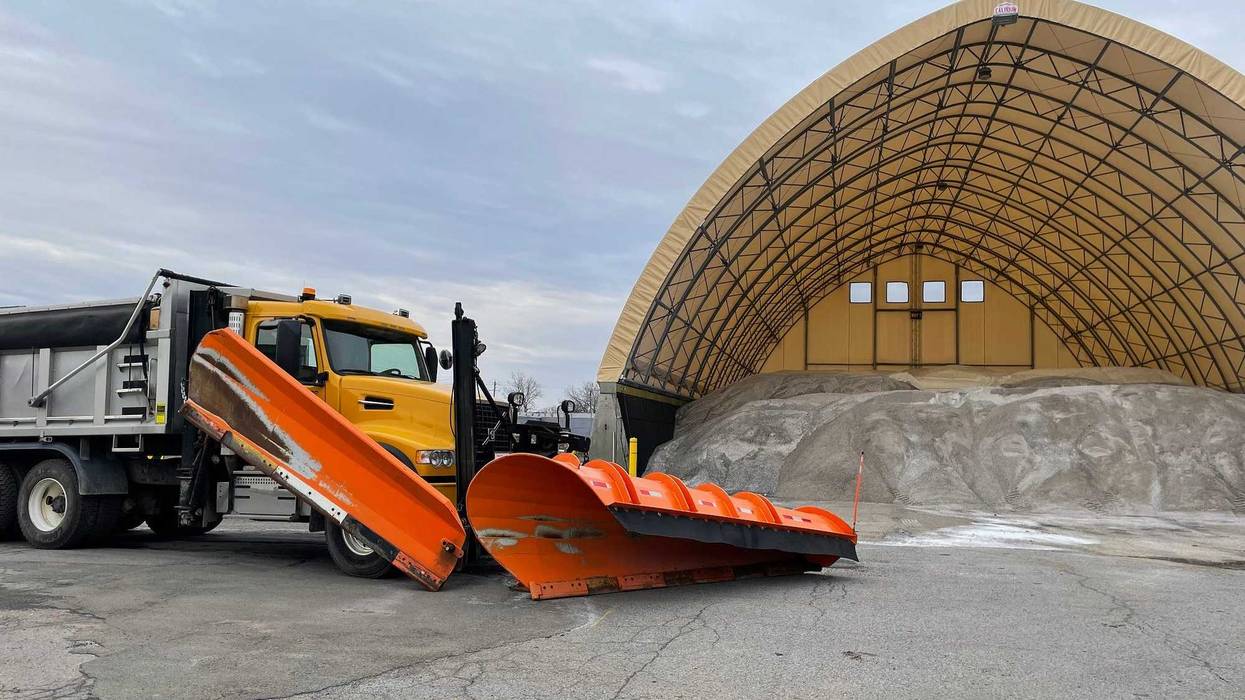

Buffalo, N.Y. (WBEN) - New York State Department of Environmental Conservation (DEC) is encouraging New Yorkers to reduce the overuse of rock salt when possible with its "Don't Be Salty" campaign.
Although applying rock salt on roadways, parking lots, and sidewalks helps to ensure the safety of those traveling by vehicle or foot, the State DEC says overuse of rock salt can be costly for consumers, degrade infrastructure, contaminate runoff that enters streams and waterbodies, and impact drinking water.
"Just one teaspoon of rock salt can actually pollute up to five gallons of water," said DEC commissioner Amanda Lefton. "We know that the individual choices we make can have a really big impact.
"Not only is rock salt obviously an issue for water - going into our waterways, we see runoff, we see other challenges - but it also really impacts habitats. So not only does it impact habitat and water, but also it's a tasty treat, which can actually result in other unintended consequences, like increased road kill and other challenges.
In addition to increasing public awareness, DEC coordinates with colleagues at the New York State Department of Transportation (NYSDOT) and the New York State Department of Health to ensure New York's salt reduction priorities are incorporated and considered within agency programs. State agencies collaborate to align the work of programs and coordinate outreach and mitigation efforts.
In August 2025, NYSDOT announced a statewide expansion of its road salt management pilot program for the 2025-26 snow and ice season. NYSDOT takes the issue of road salt management very seriously, and for more than a decade has been a national leader in the effort to reduce the use of salt while still maintaining a safe and reliable transportation system.
"We think it's a great campaign by the DEC to really try to bring awareness to the general public, municipalities, everybody about the environmental concerns involved with using road salt," said NYSDOT spokesperson Ryan Whalen in an interview with WBEN.
These efforts include, but are not limited to, enhanced training for snowplow operators, direct liquid applications in place of road salt, continuous evaluation of innovative equipment, and utilization of best management practices for reducing road salt.
As a result, the statewide average application rate for granular salt was reduced to 172 pounds per-lane-mile during the 2024-25 snow and ice season, down from the seven-year statewide average application rate of 194 pounds per-lane-mile.
"That is an opportunity to really reduce the amount of salt we use by having that sort of saline mix in the trucks, and that's something that has expanded over the years, and expanded again this year, including in Western New York," Whalen added. "We just added Route 240 to the pilot program, we've also had a salt management pilot program. This is something that we are always considering, and we're happy that DEC is working on getting the awareness up."
At the local level, while officials like Clarence Highway Superintendent Jamie Dussing would love nothing more than to reduce the overall amount of salt that they use, it has to be a group effort between the state, county and town in reducing the amounts of rock salt.
"People have gotten used to driving on black roads, and it's really hard to initiate major changes due to lawsuits and things like that. There's quite a bit of liability when you're not putting salt down, or trying to reduce the overall amount that you put down. So there can be problems with it," said Dussing with WBEN.
While Clarence has been using brine, as well as another additive to the brine mix to enhance the melting capabilities, it can be a challenge to properly clear roads of snow and ice with the road miles Dussing and his crews have to cover.
"It certainly is an environmental concern, but you're never going to see salt usage completely go away. There's simply no other alternative that is as effective as straight salt," Dussing said. "In other areas, where they don't have enclosed storm sewers, they can use sand and grit, like you see up in some of the areas with hills in the Adirondacks. We really can't use that in the Northtowns because of our storm sewer systems."
DEC encourages all New Yorkers to use these "Don't Be Salty" best practices to save money, reduce rock salt pollution, and stay safe:
Use Rock Salt Sparingly
- Shovel first, if possible, to clear snow and ice before applying rock salt. The less snow and ice there is to melt, the less rock salt is needed
- Apply rock salt strategically. A 12-ounce cup full of rock salt is enough to treat 250 square feet, a 20-foot single car driveway, or approximately 10 standard sidewalk squares
- Apply rock salt only where it is needed most, such as walkways, driveways, and steps
- Use a spreader to evenly distribute salt. Avoid piling it in one area, as this can lead to more salt runoff.
Monitor Weather Conditions
- Rock salt loses effectiveness below 15°F. Sand can be used for traction on ice during a cold snap (and can be swept up in the spring for reusing) or switch to a deicer made for colder temperatures.
- If a snow or ice storm is predicted, consider pre-treating surfaces with rock salt to prevent ice from forming.
Consider Using Alternative Products
- Consider making your own brine solution at home by combining 3.5 cups of rock salt per gallon of hot tap water and stirring until all salt is dissolved. Let any gravel settle to the bottom. Pour the brine into a regular garden sprayer and spray in a zig-zag pattern over desired area. Save extra brine to use later.
- Use products from the GreenNY specifications listed on the OGS website.