



East Aurora, N.Y. (WBEN) - The winter season is underway in Western New York, and snow removal always seems to be a talking point for many local municipalities to start the season.
In the Town of Aurora, they're working with a new solution in their snow removal arsenal that is yielding some positive results: Brine.
"It's salt mixed with water, but it is a very high tech substance, and that's the reason why it's not so simple as just dumping salt and water and shaking it up and going. It really has to be kept to a certain part salt, part water to achieve the proper meltability. That's why it's real important that either you do it with your own brine plant or with this," said Aurora Highway Supervisor Dave Gunner in an interview with WBEN.
While brine has been around for some time, Gunner says much of it for a while wasn't a clean brine, with some having different chemicals mixed into it as the result of fracking.
"We never used brine before, but what happened is last year, with the Buy American Salt Act, it really screwed up the supply chain. I think everybody remembers the salt shortage we had last year. Even though that's been now paused by the governor, it has caused for a drastic rise in the cost of salt," Gunner explained. "The salt from last year jumped approximately from $35 a ton to $53 a ton."
Gunner admits he didn't know the company with the brine factory, Texas Brine, even existed until the highway department was approached during last year's salt shortage.
"It's out in the Town of Wyoming, just North of Warsaw, and it's actually been there since the late '80s. And it gets the brine directly out of the same salt vein that we get our salt from the mine. And it never sold to the municipals," Gunner noted. It is specifically a one-foot underground line that goes all the way to Niagara Falls, and it supplies the Olin chemical company with salt brine year-round, 24 hours a day, 365 days a year. So they had this epiphany, I guess, they heard about the salt shortage. They came around and said, 'Hey, we never have sold it straight to the municipals before, but this might be a good little side business for us, because we're doing it anyway.' And the price they quoted us was very, very reasonable, and that's where we started to really look at this."
Over the years, Gunner looked into the idea of an in-house brine plant, which would've cost the town about $100,000.
"And you can make [the brine] right with rock salt, but the cost of that investment and the final cost of the mixture, the average is about $.25 a gallon. So picture that: $100,000 to buy the plant, and then even still, by the time you load into the hopper the salt to turn it into brine, it was about $.25 a gallon, which is fairly cheap," Gunner explained. "This factory that came to us is selling it to us for $.08 a gallon. So it really is a great deal."
Because the Town of Aurora has plenty of hills and curves in the roadways, Gunner says it's essential to have sand in the mixtures to have a grit for stopping ability. However, a sand/salt mix just doesn't do enough to get the roadways to a point where it can melt the snow quick enough.
That's where the application of brine can help.
"When I say heat up, in our lingo, that's melting them better. It's always a balancing act between the cost and the product, and then the actual melting ability and how effective it is," Gunner said. "So when we looked at this cost, we can now continue to run our sand/salt mixture, which saves us a lot of money, and it's necessary for the hills. But we're also now, what we can say is, heating up that road for a very, very cheap cost compared to a straight salt. So it's a great opportunity for us just to add to what we already currently were doing."
Mike Ingelfinger, working crew chief within the Aurora Highway Department, notes the brine used is 100% saturation, just like the road salt would be, but it's a more controllable option to remove snow from the roadways.
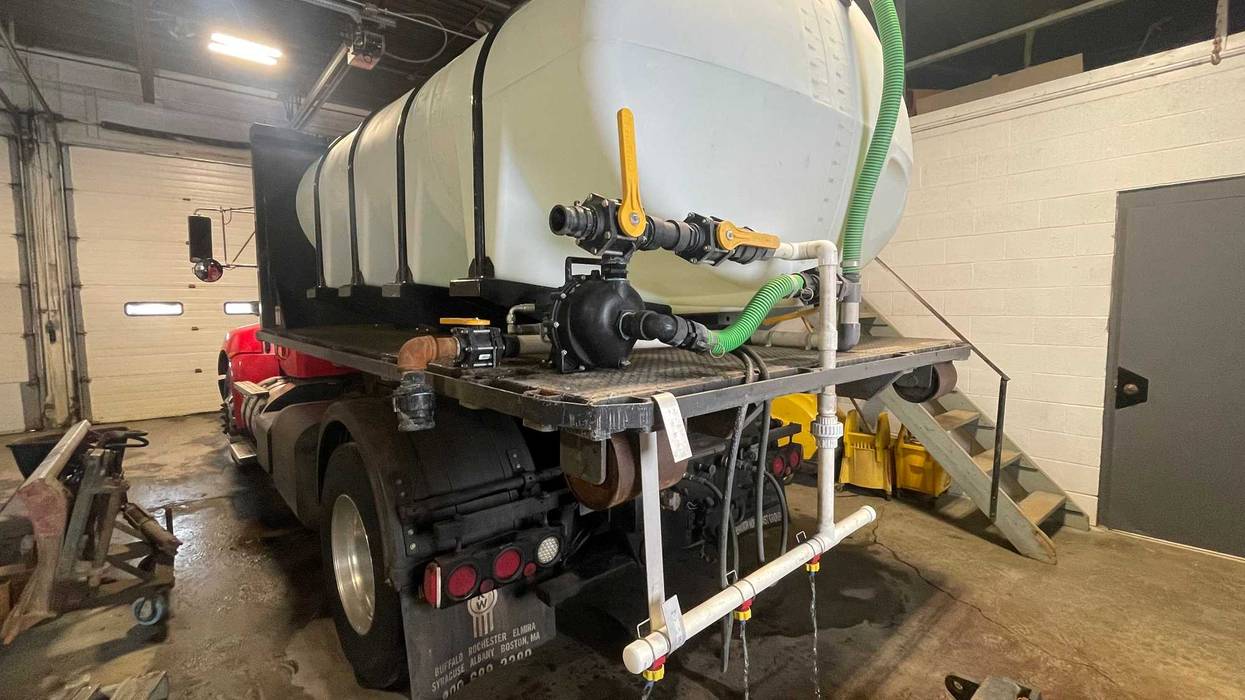
"How much we put down, where we put it down and when. And all of our roads, or the bulk of them, all have a crown to them, so they all pitch to the outside edge. I have multiple spray heads on the bar that we put it towards the middle of the road, make sure the center is out, and as the gravity takes it, pulls it to the outside and it brines, basically, the entire surface as we're going down. And it's a lot less expensive," said Ingelfinger with WBEN.
Because Aurora is not a huge town, the resources may not be entirely be available, so often the highway department will utilize what its got. It also helps to have some background in plumbing in order to help utilize the brine option as much as possible.
"We took our flatbed that we really don't use much, and I found a brine tank we can outfit it with. So we kept it low, kept it fitted for the truck size. And then I used to do plumbing and heating for myself, I have a plumbing background. I plumbed in a pump, put in a spray bar, I did some research, got some of the information. And the pump we set up, it actually runs off the truck, because the truck's already got a system on there for the salter," Ingelfinger explained.
How does the brine process work for crews in Aurora?
"We go out with our regular plow route, and then as [a driver's] halfway through that route, the brine truck leaves. So it's literally going through what has just already been peeled and salted and treated already. So you already have brining going on," Gunner detailed. "So because you've got mix in it and that snow holding the warmth through it, you should get a good natural brine without a flash over. And I think it'll still be effective even into the cold."
Where Ingelfinger feels the brine might be the best solution is it helps work the remaining snow up and get it melting faster.
"I can come right in behind them. If they scrape off the snow, get the bulk of it off, because it always leaves some, I can immediately turn that into mush, and then it'll just run right into the outside edge. It seems to be working pretty good for us," Ingelfinger said.
Another spot brine seems to be a benefit for local highway crews is in areas where the snow packs down due to heavier traffic patterns.
"If you've got hard pack, when it snows really hard right at rush hour and you can't fight traffic and you're trying to get out there, they pack it down and turn it into, what we call, a hard pack. I can take these and change the nozzle tips to them, and then I can actually use them and just spray stream straight down and try to get into that hard pack to break it up quicker," Ingelfinger said. "When that type of application comes, we can switch a little bit. It's just pop them out, put them on. I've got three to do, and we're right back, and we hopefully can break up that hard pack a little bit quicker."
With temperatures set to reach single digits later this week, and more cold spells likely to come later in the winter, Gunner feels there's a couple of different things the town can do with the brine.
"You can use it as a pre-treat item. Say tonight we have a storm coming in, well, for a pre-treat, you better really know your temperature. If it's too cold, you could cause a flash freeze. So I think that we'll keep an eye on our street temperature - it's not the air temperature, you've got to check with a thermometer on the road. If it gets down below, say, 5 [degrees], I think we definitely wouldn't do it as a pre-treat at all. But I think that it probably still will be pretty effective in very cold on the rest of the time."
While the brine solution being used now may still be a bit tougher on the underside of cars, it is safer for the environment.
"When you throw loose salt down, it has, what happens is called, 'spatter', because it's dropping off the back of a truck. You're not actually applying it to the surface. You're hoping that so much of it stays into the roadway. Then you get the spatter in the traction of the cars. When you have a salt-only environment, which most highways and thruways and everything do, most of it ends up into the groundwater," Gunner said. "Even now, over in the Adirondacks, there's what's called the Lake George Project, and it's been going on for a few years where actually salt is banned, and only brine is allowed to be used. So I think that's something that the education needs to get out there, because people right away, 'Oh my goodness, we're going to rot our car, we're going to kill the environment.'
"They're all corrosive. We're not going to lie, we're in Buffalo. But the brine is less corrosive than straight rock salt, and it's quite a bit less corrosive. I mean, it's not as a scientific thing. It's about how it's placed."
Both Ingelfinger and Gunner believe more-and-more municipalities will soon start utilizing brine more as an option for snow removal.
"I know the state is all over this for the environmental reasons. But honestly, for that cost, the salt is so expensive, and people can't afford the taxes. They want the good services, but nobody wants the real high taxes. So something's got to give," Gunner added. "I think it should be a permanent thing to us, it's tried and true. It's just that we never could afford it in the past, like the outfit, the equipment. Now that we've found a way that we can do it for very fair price, we can afford to do this now."
The Town of Aurora joins the Town of Tonawanda as a local municipality that utilizes a brine to help with snow removal.