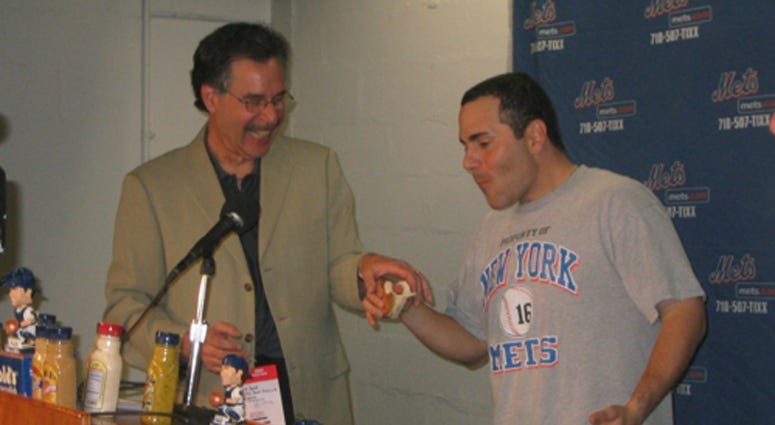

“My mother said, ‘Enough of this (blank),’ you have to go and do your homework," said Gold, 71, laughing.
Using a reel-to-reel tape recorder his grandmother gave him, Gold taped the first Mets spring training radio broadcast in 1962, featuring pre-game host Howard Cosell. He published Mets Maze with a typewriter, stencil and mimeograph machine at the Brooklyn office of Gold’s Horseradish, founded in 1932 by Marc’s grandfather, Hyman, and later run by his father, Morris and uncles.
For generations, Gold’s Horseradish has given foods that extra kick, just as Mets Maze provided Gold that first season.
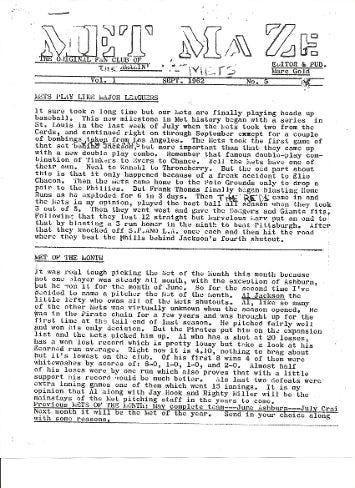
“I was a Met fan and I wanted to express my thoughts and feelings on the Mets in those years,” said Gold, a Canarsie, Brooklyn native. “They were my whole life.” While those ’62 Mets often have been called lovable losers, Gold says there was little to love about their all-time futility record of 40-120. “It was terrible to lose,” Gold said. “It was horrendous.”
Still, Gold recorded other Mets firsts like their inaugural regular season game, home opener and matchup against the Dodgers. On 8mm film he captured the 1963 home opener at the Polo Grounds, played on Passover, bringing matzo to the stadium.
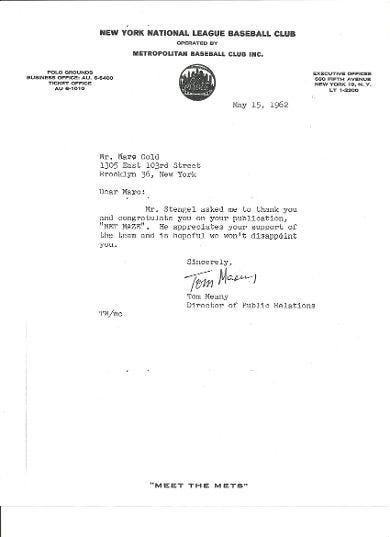
Costing 45 cents, Mets Maze reached 120 fan club members, Gold says, though only about half paid their dues – no gefilte fish for them! The newsletter attracted attention from Mets manager Casey Stengel, who expressed his thanks in a letter Marc received from the team’s public relations director, Tom Meany. “Mr. Stengel asked me to thank you and congratulate you on your publication, Mets Maze,” it read. “He appreciates your support of the team and is hopeful we won’t disappoint you.”
While he now realizes that letter’s historical value, “We didn’t like Casey Stengel,” Gold said of Met followers. “We thought he was worse than Mickey Callaway, believe it or not. The mistakes that he made.” Indeed, before a 1963 home game, Gold made paper signs reading, “Stengel Must Go” for disgruntled fans, with instructions to chant that after the national anthem.
His Mets passion continued as Gold entered the family business, where by 1996 Gold’s held 70 percent of America’s horseradish market, according to Crain’s New York Business. Working with his father from 1970 until he died in 2005, Gold, his brother and cousins took the company to another level, carrying on dad’s marketing spirit. Gold’s headquarters moved to Hempstead, Long Island in 1994. That baseball season, the company had just bought Baker’s Mustard, served at Shea Stadium, which became Gold’s Deli Mustard.
That year the Mets contacted Gold about becoming an advertiser, inviting him to their executive offices. “I put on my Bar Mitzvah suit,” Gold joked. “I thought it was a great vehicle for us to promote this new item that we were going to start.” Gold’s began with ads in the Mets program, and in 2002 they were offered sponsorship of bobblehead doll giveaway days.
Mets bobbleheads, Gold realized, could give the company’s advertising that extra horseradish-like kick.
“We need (Mike) Piazza,” Gold told the Mets. “It’s the only way we’re going to do it, or else we’re out.” Well, not exactly. Gold’s Mets heart was overpowering his business head. “I was blustering,” Gold said. “There was no way I was going to just be out. You think I’m going to give this up? I’ll take the money out of my pocket. I’ll ask my father for the money, or my mother for the money.”
Starting with Piazza, Gold annually picked an expected Mets star player to be the subject of Bobblehead Day, but each failed miserably, resulting in the Curse Of The Bobblehead.
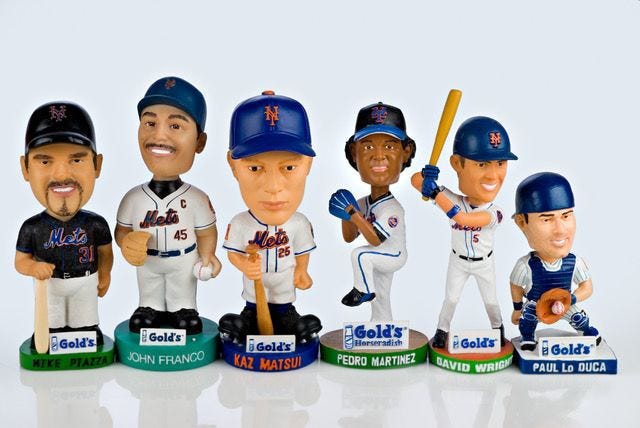
David Wright (2006) and Johan Santana (2008) eventually had injury-shortened Mets careers. “Then they started doing the non-active players, so that broke the curse,” Gold said of Keith Hernandez (2012) and Doc Gooden (2013). Not for long, though. Curtis Granderson (2014) was a free agent failure that year. At least Gold’s bobbleheads went out swinging with Jacob deGrom (2015).
Regardless, the bobbleheads were successful. “I would send the dolls to all the buyers and they’d love it,” Gold said. Each bobblehead prominently displayed the Gold’s brand. “It just reinforced the name,” Gold said. “This is something my father started all those years ago with advertising and promoting.”
In 2015, Gold’s was being sold to LaSalle Capital, triggering a dark period for Gold. “I’m going through the selling of the business, and the turmoil, and the trouble, and the stress,” Gold recalled. “It was terrible. It was the worst time of my life.” By August 1, 2015 the sale was complete.
“And do you know what happened, what the Mets did that moment?” Gold asked. “They got (Yoenis) Cespedes.” The slugger’s late season, offensive tear led those Mets to the World Series. “It was just so wonderful,” Gold said. “It provided me with such a distraction. It was a mental health savior.”