

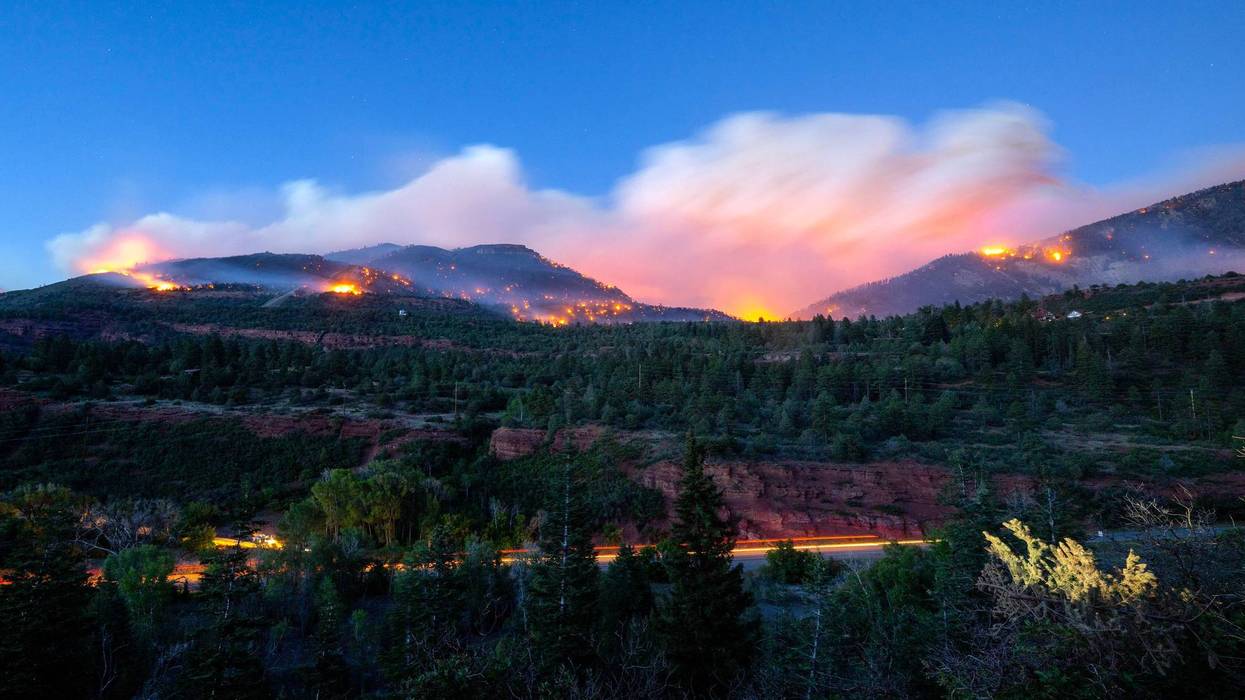
Drought, high heat, and wildfires caused havoc across the U.S. and Canada this week. There are many in the U.S. who don't want to hear it, but the data is telling a clear story: rising global temperatures from climate change means more fire.
So far this year, more than 5,740 square miles of the United States has burned from wildfires, which is 31% more than the average of the previous 10 years on this date, according to the National Interagency Fire Center. The amount of U.S. land burned each year in the 2020s — averaged out over a decade — is now more than twice what it was 30 years ago.
"The scientific term for our weather is bonkers," University of St. Thomas climate scientist Dr. John Abraham told WCCO's Laura Oakes earlier this week.
That comes after numerous fires deep in the Boundary Waters Canoe Area Wilderness, and dozens if not hundreds of wildfires torched extremely remote areas of Canada pushing smoke and hazardous breathing conditions across the Upper Midwest, the Great Lakes, and the Northeast.
Every day was another Air Quality Alert, and there were times this week when Minneapolis, Detroit, Toronto, New York City, Boston and other major North American cities had the worst air on the planet. Parts of Northeast Minnesota had air that was over three times above the highest Air Quality Index reading.
"I mean, it's not just something that's hitting Minnesota or the U.S. It's actually affecting us all around the world, and Europe is just one other example," says Abraham. "Weather is becoming more wild and more severe as the Earth warms, and what that means is it's going from one extreme to the other more rapidly. And more viciously."
Europe saw a record high amount of land burned in 2025, Canada has had several record or near-record fire years in the 2020s and the Arctic recently has had unprecedented levels of burning.
“Wildfires are becoming more frequent and intense because of climate change, and when a fire happens, you have smoke,” said Colleen Reid, a University of Colorado geographic health professor.
Most of the biggest particles in wildfire smoke fall close to where a blaze is burning, while the smallest particles — the ones that scientists say do the most damage — travel the farthest. In a typical wildfire, the nasty particles that harm human health are about the size of one micron, Reid said.
Abraham says hot weather, dry weather, even forest fires aren't new or unusual. But he says those incidents are becoming more extreme, powered by warming in the oceans and atmosphere.
"For example, we are having more hot, dry spells followed by wet, rainy spells followed by more hot and dry spells," says Abraham. "And so we're going from one extreme to the other like a seesaw, and it is causing a lot of problems. Both in our state but elsewhere around the world."
It's also being affected by a developing, an already historically strong El Nino. That is nature’s heat-releasing thermostat that spikes global temperatures, and is heading to a level we perhaps have never experienced, according to the U.S. National Oceanic and Atmospheric Administration.
In its monthly update earlier in July, NOAA said this year’s El Nino, a natural warming of the equatorial Pacific that alters weather patterns across the globe, has an 81% chance of becoming “very strong” — the top category available — by fall. It should rank among the most intense El Ninos since the weather agency started tracking them in 1950.
El Nino is a natural occurrence. It's a normal part of the ocean's cycles. What is not normal, is how far above average it is this year. Pacific waters off the coast of South America are already running 5-10 above normal, numbers that in meteorological circles are almost unheard of.
Being that it is only mid-July, there is still a lot of warming still to come, and it's likely this will be the strongest El Nino in 175 years of measuring ocean temps.
Abraham says climate worries go beyond just fires, storms, heat, floods or whatever else comes our way.
"If you look at the what climate change costs us in the U.S., it's about $100 to $150 billion a year," he says. "With a B. We are paying that every year because of increased storms, heat waves, droughts, and flooding. These are real costs. They're real dollars. We're not just talking about polar bears and penguins. We're talking about our pocketbook issues."
He does add, however, there is work being done to combat change, and there's plenty we can still do to overcome climate challenges.
"In the past it was a badge of moral fortitude to use solar panels and wind power," Abraham said. "But now, it's a marker of fiscal responsibility and conservatism. We have reached a tipping point where we can power our homes, our cars, and our places of work more cheaply with clean energy than with dirty fuel."
Abraham says making a difference will involve a sustained approach of reducing emissions, and while he says it may take decades, we'll be able to bend the curve of climate change.
"So, if we really want to make a difference, we have to have a sustained approach of reducing our pollution emission, and over time," Abraham adds. "This is going to be years and decades. We can bend the curve of climate change. But for anyone looking for a panacea that we can fix this by tomorrow or even by next year, such a panacea just doesn't exist. It's going to take a long term effort."
Seth Borenstein, Associated Press science writer, contributed to this story.
"Weather is becoming more wild and more severe as the Earth warms," says St. Thomas climate scientist Dr. John Abraham
"Weather is becoming more wild and more severe as the Earth warms," says St. Thomas climate scientist Dr. John Abraham