


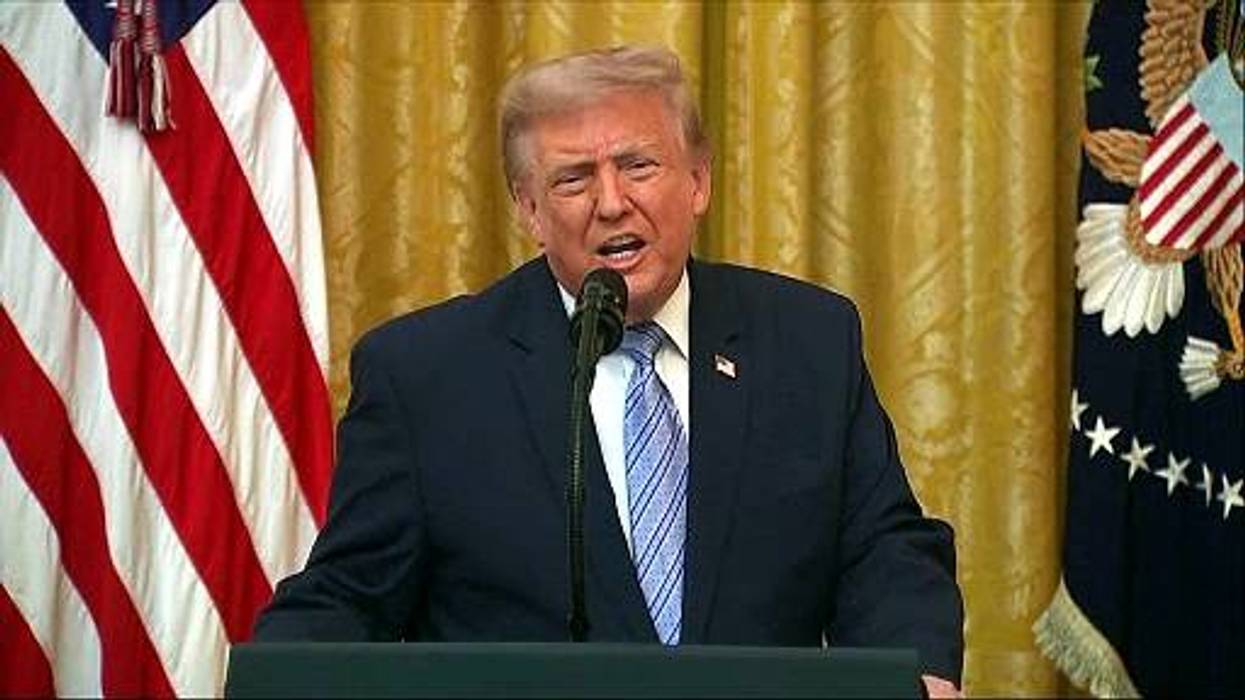

Last week, President Donald Trump released a trove of documents during a primetime address to the nation that allies had hyped as a smoking gun that would prove his long-debunked allegations of mass voter fraud.
Speaking from the White House on Thursday night, he described shocking revelations, like Chinese meddling to undermine his failed candidacy in 2020 and a cover-up by the “deep state.” He claimed, “Americans were blatantly lied to about the security of our election infrastructure.”
Is this really a bombshell? An analysis by the Associated Press found no such confirmation in the collection of newly declassified reports, investigation files, intelligence analysis and assorted correspondence. Many pages are so heavily redacted that their findings are unclear. Others outline vulnerabilities and assessments that have been well-documented for years. There’s no evidence that China or any other foreign entity manipulated the vote in 2020 or any other year.
Monday, WCCO's Adam and Jordana turned to Minnesota Secretary of State Steve Simon to analyze the claims made by the president, and detail what we know, and what is being done about allegations of fraud.
Here’s a look at what some of the claims and documents say, and what Simon said about them:
Noncitizens may or may not be more common on voter rolls
In his remarks, Trump touted the release of a new Department of Homeland Security investigation, based on state voter rolls and public records, that he said had identified approximately 278,000 noncitizens registered to vote in federal elections.
The report said the agency uncovered more than a quarter of a million noncitizens illegally registered to vote in California, Pennsylvania, New Jersey and Nevada, based on public records, which are often erroneous or incomplete. Another 28,000 noncitizens, it claimed, were found on voter rolls in 25 states using the new Systematic Alien Verification for Entitlements system.
There is no allegation, however, that any of those people actually voted, which would be a crime.
That data has also not been verified. Reports have found that the SAVE database is plagued with errors, including outdated information that has often classified naturalized citizens as noncitizens. Indeed, a federal judge has barred the database from being used over fears that voters will be wrongly purged from voter rolls.
"What he's talking about is a proof of citizenship, documentary proof of citizenship requirement where you'd have to show papers, to demonstrate they're a U.S. citizen," explained Simon. "Which, look, I mean, it's perfectly fine for people who have passports or naturalization papers or something like that. But for 69 million American women who have a different last name now than the one they were born with, that would mean they'd have to produce when they register to vote, both a birth certificate and a marriage record, both."
Studies have found noncitizen voting to be extremely rare. Noncitizens are also allowed to vote in some local elections, and could be on the rolls for that reason.
"And what's troubling about that is the experience that Kansas had a few years ago," Simon continues. "They passed a similar bill on the state level. They had an election under that law, and when they had that election under that law, 31,000 eligible Kansans eligible like me and you, born, raised, voting for years and decades, 31,000 were kicked off and shut out. Now, we're twice the size roughly of Kansas. So the question I ask myself is, is it worth the possibility of kicking out tens of thousands of eligible Minnesota voters like me and you, to catch a couple or a few handfuls of people? I think the answer to that is no, in my judgment."
Documents detail Russia’s election efforts
Trump has spent years criticizing the intelligence community’s assessment that Russia meddled in the 2016 election to help him win. But the documents shed new light on the country’s ongoing efforts.
One declassified document from 2020 portrays Russia as the country that has tried the most to penetrate American election systems — but in an effort to defeat Joe Biden. It notes how Russia worked to amplify claims that Biden, while serving as vice president, engaged in inappropriate behavior involving Burisma, the Ukrainian energy firm that employed his son Hunter, a charge frequently repeated by Trump and Republicans.
"I think you put your finger on the exact distinction that's important, interference versus influence," Simon explains. "On influence, there's no question that China, Russia, Iran, North Korea are seeking to influence our elections in the sense that they're populating social media with bots, and they're trying to shift American public opinion on all sorts of issues. Maybe they're for a candidate or against a candidate. That absolutely is true. So if the president was talking about just influence operations, he's right, that does go on. But there's a big difference between that and actual interference, meaning trying to hack into our stuff, trying to change votes, or maybe successfully changing votes, and there is no evidence that any foreign power, Russia, China, anyone, has at least so far been able to change a single vote."
“Their aim is to defeat the former Vice President and ensure the President’s victory,” reads the document from the National Intelligence Council.
The document went on to state that both China and Iran wanted Trump to lose. But it included a chart documenting each country’s known efforts. Only Russia was marked as having been known to have engaged in “targeting, accessing, or manipulating election processes or election-related systems.”
Russia has continued to deny interfering in U.S. affairs.
"There's nothing in there that that backs up that a foreign power of any kind, or anyone, even a private actor, has switched votes," Simon adds. "They may have tried to engage in in certain conduct, but the defenses have held. And we know that going back to 2016, when we know of a particular country, Russia, bipartisan agreement on that, tried and failed, tried and failed, to hack into actual election infrastructure. The defense held, the systems worked."
Vulnerabilities in voting systems
The documents, Trump told the nation, included intelligence “revealing shocking vulnerabilities in our election infrastructure” that leave it vulnerable “to hacking, exploitation and foreign interference.”
One report included a list of recent breaches -- mostly by Russia — and called on state and local election officials to step up their defenses to prevent information from being used to obtain absentee ballots or alter voter rolls. Election officials acknowledge that voting machines also carry risk -- which is why they don’t rely on them alone to ensure the accuracy of the vote. Safeguards like physical security, equipment testing, paper ballot backups and post-election audits help to catch machine errors or threats.
"No, look no further than the declassified documents that the White House itself put out," Simon explains. "They say the opposite. In one particular document, it quotes some intelligence service, that part is redacted, we don't know which agency, saying 'this really isn't a thing that could happen on a widespread basis.' Could someone in a particular precinct somewhere distract the election judges for a moment and go in and touch the machine or whatever? Sure, you could say that about anyone. But any sort of mass movement that would be successful? No way."
But it is unclear what the administration is doing to facilitate their efforts. Earlier this month, Trump ousted members of a bipartisan federal election commission that distributes federal grants to states, oversees the testing of voting systems and maintains the national voter registration form, after the group resisted his efforts to require potential voters to document their U.S. citizenship before registering.
"So, even if someone suspected that someone was changing outcomes from candidate A to candidate B, we have good old fashioned paper that you can touch and feel and see," Simon said about Minnesota's paper ballots. "It's auditable. You can take it to court. You can challenge an election result, and that's why that hasn't happened and the machines themselves are tested regularly and in a public way."
Trump has also cut millions of dollars in federal funding from the U.S. Cybersecurity and Infrastructure Security Agency, known as CISA, which helped state and local election officials keep elections secure, and disbanded an FBI task force focused on investigating foreign influence operations, including those that target U.S. elections.
The documents make repeated reference to the risks posed by large databases of voter information, including registration databases and election websites that could be accessed or manipulated by foreign adversaries.
But the SAVE system, which Trump has been pushing states to adopt, has been criticized as an unlawful, centralized federal database of voter information, which could be another target.
Associated Press national political reporter Jill Colvin, and national security reporter Eric Tucker contributed to this story.
Minnesota Sec. of State Steve Simon says they are the "same old" claims not backed up by evidence
Minnesota Sec. of State Steve Simon says they are the "same old" claims not backed up by evidence