


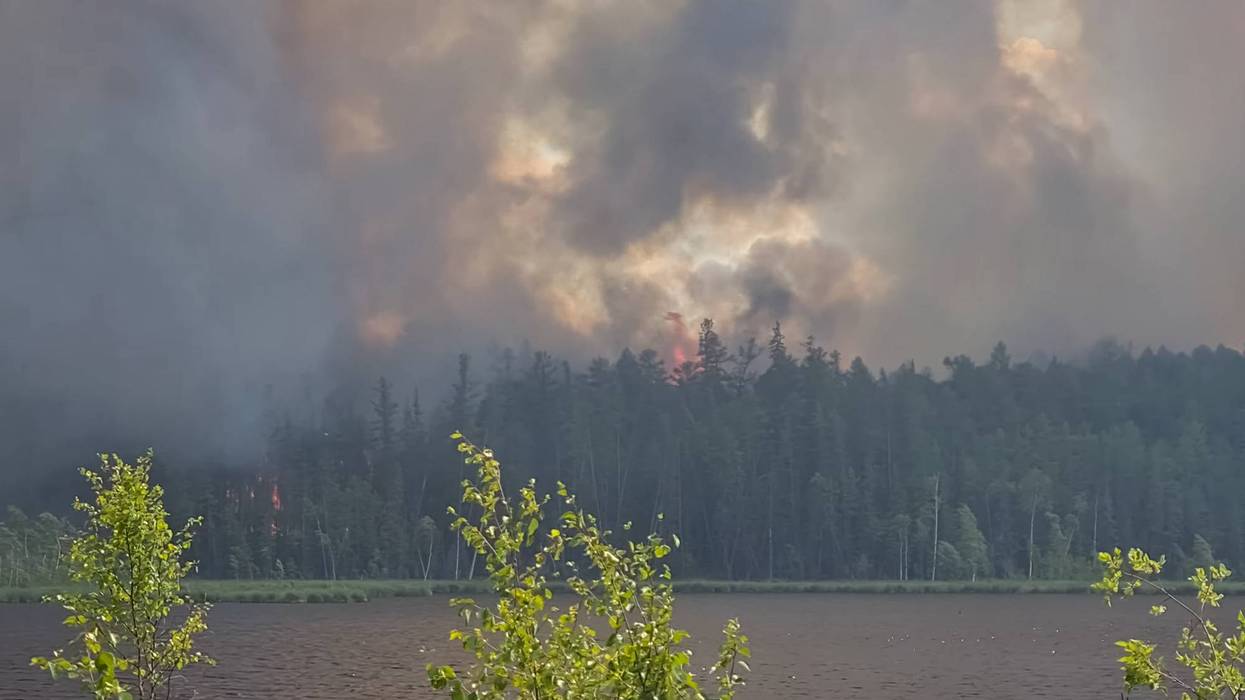
The fires in northern Minnesota continue to rage through the Boundary Waters and Superior National Forest with no end in sight. It's also having a major effect on some of the towns that surround the area, and those that depend on summer tourism.
One of the more popular summer events for the northern Minnesota town of Ely is canceled because of the ongoing wildfires in the nearby Boundary Waters Canoe Area.
Ely Mayor Heidi Omerza told Susie Jones on the WCCO Morning News that the Blueberry Arts Festival usually draws tens of thousand to the community.
"It is a very fluid situation. It rained overnight, which will give us a little bit of reprieve," Omerza said. "Which we all know, by no means is that going to do anything in the overall scheme of the wildfires going on right now."
The decision was announced at a community meeting Sunday night. Mayor Omerza says shops and restaurants in Ely remain open, but anyone trying to get into the Boundary Waters will be turned away.
Ground crews and other personnel are staying in Ely to work the fire, turning the area around the public school complex into a campground.
"It looks like there's a whole camp there," Omerza explains. "There's a lot of people that are there, tents the whole nine yards are, community college, there's a cafeteria up front. They have a whole area, and then that has also been taken over. Which is great because it's all firefighters coming from all over the United States."
The local Vermillion Community College is providing meals for the fire crews.
Wildfires are forcing the Superior National Forest to extend Boundary Waters permit cancellations through at least Friday. That is hurting local outfitters who have had to cancel all of the permits, and will lose at least two full weeks of business at the height of summer.
"Obviously, everybody wants to get back to what would be normal right now, and some people are a little more urgent about that than others," explains Dave Seaton, who owns Hungry Jack Outfitters along the Gunflint Trail. "That's very typical in situations like this. Everybody has different opinions in different situations. But we're all looking forward to the day when there's less fire and more availability for people to come up and recreate."
Seaton also notes that there really isn't any smoke in the air, at least on the Gunflint side of the BWCA. He also says most of the North Shore is open for business, and that it is slower than it normally would be in mid-July. He adds that there are numerous places outside of the BWCA where you can camp, fish, or just enjoy northern Minnesota that is outside the fire zones.
"We want to make sure that everybody's healthy, and that's really what it all comes down to, is as much as it's inconvenient and as much as it's a hardship right now, we really want everybody to be safe," Seaton told the WCCO Morning News. "We want everybody to be healthy. We want everybody to have this place be a fun place and a great memory for them."
Fires continue to rage thanks to hot, dry weather
More 71,000 acres have burned, with the Bear Trap fire having scorched nearly 35,000 acres in the Boundary Waters.
Despite the little bit of rain northern Minnesota saw, more crews from across the country are heading to the area. Phil Manuel is an incident meteorologist for the National Weather Service in Minnesota.
"The Weather dictates everything that happens," he says. "It dictated the start of these fires. It dictates how we suppress these fires and how the team reacts and manages what's on the ground out there. For the benefit of those that haven't heard this, how did we get here? We turned the spigot off. About a month ago, it didn't rain."
Jason Loomis, an incident commander with National Incident Management Organization.
"We have never seen anything like this," Loomis adds. "I'm sure some locals that have been here quite a while have seen events very similar to this, but this is unprecedented. I don't think I need to tell the locals here, 104 degree temperatures, it comes back to the weather, right? And it also comes back to the low snow impacts winter that you all experienced. I don't think I need to tell you all that that is unprecedented."
Loomis also said the conditions are more like the conditions they face in Arizona and dry, arid climates, not in northern Minnesota.
The Forest Service says smoke continues to impact air firefighting operations as well. Currently, more than 500 firefighters and support personnel are working the blazes, including members from over a dozen local and out-of-state departments.
An Air Quality Alert runs through 11:00 a.m. Monday morning for large sections of the state, including the Twin Cities, due to wildfire smoke.
"We have never seen anything like this," said Jason Loomis with the National Incident Management Organization
"We have never seen anything like this," said Jason Loomis with the National Incident Management Organization


