

Three congressional candidates, including Minnesota state Senator Matt Klein (DFL-South St. Paul), wagered on the outcome of their own elections on Kalshi, according to the prediction market, which said Wednesday that it fined and suspended the men from their platform for five years.
It is the latest high-profile case of alleged insider trading on prediction markets including Kalshi and Polymarket, which have brought bipartisan scrutiny from Congress and calls for stricter regulations of the websites where people can put money on just about anything.
Kalshi's disciplinary documents named Mark Moran, who is running as an independent in Virginia's U.S. Senate race; Ezekiel Enriquez, who ran in a Texas Republican primary for a U.S. House seat; and Klein, who is also running for a U.S. House seat in Minnesota's Second District.
Klein and Enriquez both placed bets less than $100 related to their “own candidacy,” Kalshi said. Moran said on social media that he “traded $100 on myself.”
WCCO Political Analyst Blois Olson says this is a situation that could have political fallout for candidates.
"Matt Klein's running for Congress," notes Olson. "He's in a competitive race in Congressional District 2 as a Democrat to succeed Angie Craig, against Matt Little and Kaela Berg. And these are the kinds of trip-ups, mistakes, misjudgments that can cost somebody their race."
These relatively small bets follow mammoth wagers on prediction markets earlier this year that raised eyebrows. In one case, an anonymous Polymarket user made a $400,000 profit in January on a wager that former Venezuelan President Nicolás Maduro would soon be out of office.
In March, after two U.S. senators announced legislation that threatened prediction markets, Kalshi and Polymarket highlighted new rules, including against political candidates trading on their own campaigns.
Moran refused to reach an agreement with Kalshi and was fined the most at more than $6,200, while Klein and Enriquez did reach agreements and face penalties of over $530 and $780, respectively, the company said. All were suspended from Kalshi for five years.
Some politicians said the punishments didn't go far enough. U.S. Rep. Mike Levin, a California Democrat, slammed the repercussions on social media, saying, “That’s not a punishment. That’s a parking ticket.”
The agreements are with the company, and not with the Commodity Futures Trading Commission, which regulates predication markets. The agency is chaired by Michael Selig, who is considered friendly to the burgeoning industry.
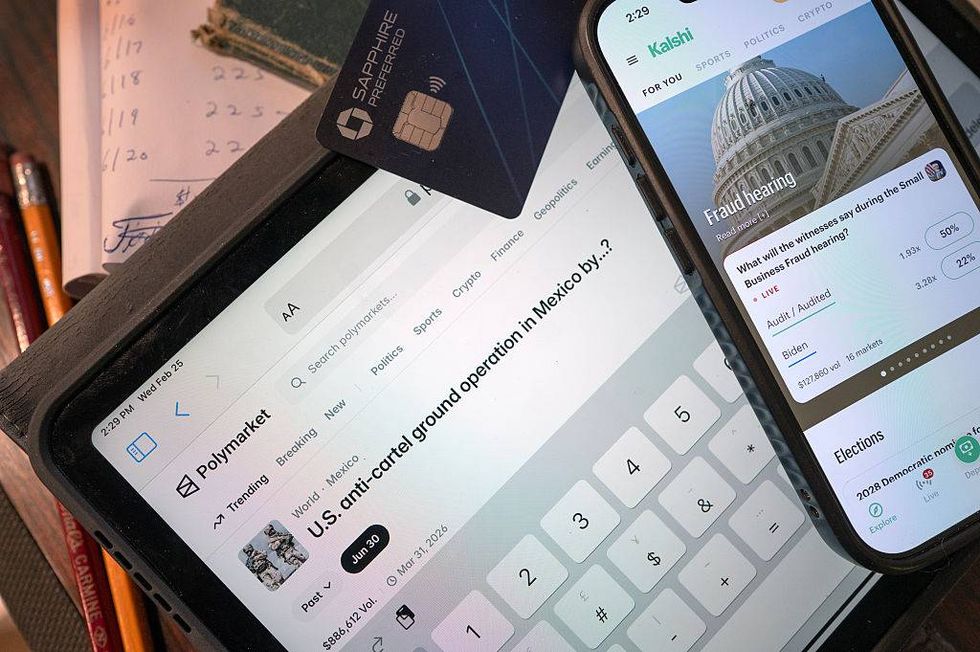
Predictions market sites are shown on electronic devices on February 25, 2026 in Chicago, Illinois. Online prediction market platforms, such as Polymarket and Kalshi, allow people to place bets on wide-ranging subjects such as sports, finance, politics and currents events.
(Photo Illustration by Scott Olson/Getty Images)
Far from denying the allegations, Moran told The Associated Press on Wednesday that he placed the bets intending to draw attention to what he said was unjust sway that platforms like Kalshi have on elections. Moran added that he'd met with the company and had asked for his name to appear on its website.
Moran said he was fined more than the other candidates because he refused to sign a settlement that would've required him to post a statement on X. He said he felt that the stunt was successful.
“When I piss people off, when I upset people, and when I captivate their attention, that’s when they have to start listening,” he said.
Klein says he first heard about the prediction app Kalshi and was curious. He put $50 down on himself to win his own political race.
In March, the company notified him that it was a violation. He paid a $539 fine and is banned from using the app for five years.
“This was a mistake and I apologize,” Klein wrote, saying that the experience made it clear that the markets need more regulation.
Klein is a cosponsor of a bill working its way through the Minnesota Legislature to ban most wagering on predictive markets, including the outcome of elections. In an interview, he said he didn’t think there was an inconsistency between his betting $50 on himself to win his primary and his sponsorship of legislation.
Klein said he spent the winter learning about predictive markets and signed onto the bill well before he learned that his bet violated Kalshi’s rules. Klein had been a proponent of legalizing sports gambling as well, something that has yet to happen in Minnesota.
"How he explains it to delegates in that race is the next thing to watch," Olson adds. "He was both on Kalshi and in most people's minds, the front-runner to win that seat as the Democrat and face likely Eric Pratt in the general election. And now that's up in the air."
Enriquez, known as Zeke, lost his House race in the beginning of March with less than two percent of the vote. Contact information for Enriquez was not immediately found to request comment.