

A federal grand jury has indicted 15 people accused of plotting violence against ICE officers in Minneapolis during Operation Metro Surge.
Federal prosecutors have unsealed these charges against the defendants allegedly linked to antifa affinity groups Action in Minnesota and the Black Hat Workers Collective, for allegedly orchestrating violent blockades, assaults, and the stalking of law enforcement during Operation Metro Surge.
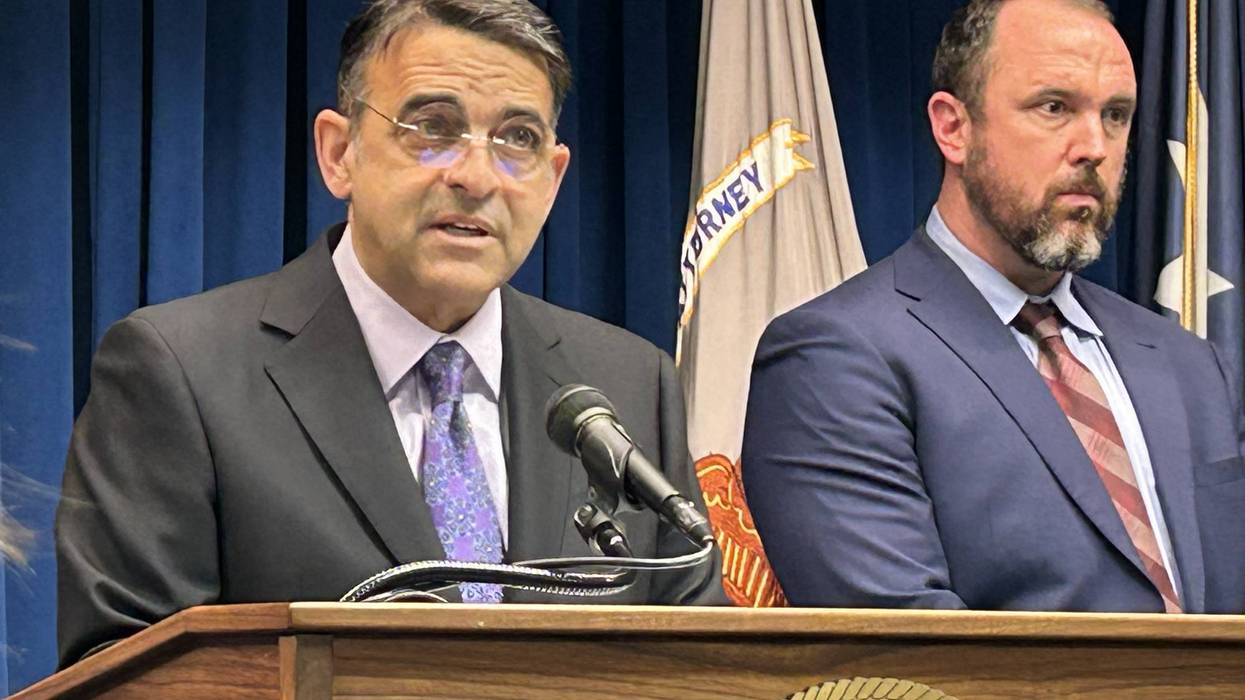
"This action is not peaceful. It's obstructive, disruptive, and unlawful," says Minnesota's U.S. Attorney Daniel Rosen. "The organization trains its members in the aggressive use of shields against law enforcement, surveillance, operational planning, ad rapid mobilization against law enforcement actions."
Rosen wouldn't say how many federal agents were injured as a result of those actions.
"All of those numbers on this will roll out in the course of the prosecution. Whether they actually caused bodily harm is not the measure of if they committed a serious federal crime," Rosen told reporters.
Authorities confirmed that 12 of the defendants have been arrested, while one was already in custody. They continue to search for two remaining fugitives.
"These defendants have been charged not for what they said, but for what they did," says Rosen. "They all joined an agreement, a conspiracy to interfere with lawful immigration enforcement operations. The conspiracy was not to interfere by their voice, but to do it by force. That's a crime and it will not be tolerated in the United States."
The charges include conspiracy to impede or injure a federal officer, solicitation to commit a crime of violence, interstate threats, interstate stalking, assault on a federal officer, and destruction of government property.
Rosen was also asked about the state of prosecution or charges filed against the federal officers who killed Renee Good and Alex Pretti during Operation Metro Surge, which Rosen didn't offer a comment on.
"Those investigations are ongoing. We're not going to get into the details," he said.
Twin Cities defense attorney Jack Rice says the prosecution in these cases could be interesting, due to the First Amendment issues people have when it comes to the evidence federal prosecutors have used in the indictments. Rice says it all adds up to a difficult case to prove in a courtroom.
"A lot of the evidence that they seem to be depending upon comes from social media. So they're actually going after these 15 people, many of whom have a lot of information that was online, and so they're using quotes in the complaints themselves," Rice explains. "This person said X, this person says Y, and that actually is powerful stuff because you can very much see what it is that these people are saying. And sometimes what these people are trying to do. Now, there is a difference, and the difference is there are some things that are protected by the First Amendment, where your ability to say things is one thing. It's the criminal aspect that's the different part of this."
Local activists are condemning that indictment calling it politically motivated
Members of the National Lawyers Guild and community organizers gathered outside the federal courthouse in Minneapolis urging community members to sign a collective pledge and opposing these charges.
"It is because we are calling out authoritarianism for what it is, political repression. We're calling out authoritarianism for what it is. It is political repression," says Luis Argueta with Unidos Minnesota.
Federal prosecutors have not revealed how many agents were injured as a result of the groups alleged planned attacks and organizers say they plan to gather again at the federal courthouse in St. Paul as the legal proceedings in the case officially get underway.
Rice also says that a jury will likely take into account the actions of ICE agents, which have already lead to the investigations in the shootings of Pretti and Good, plus another investigation of agents who lied in the non-fatal shooting of a Venezuelan man. Hennepin County has also charges pending against two federal officers.
"The problem is, ICE agents were violating the First, Fourth, Fifth, Sixth, and Fourteenth Amendments," says Rice. Almost every day they were in the (Twin) Cities. And so, for them to now turn around and argue that their rights were violated is really quite extraordinary. And if they're going to try to prosecute these kinds of cases here in Minneapolis now. That's going to be a really interesting thing, because guess what? They get a Minneapolis jury. Contemplate how that's going to play."
Former President of the National Lawyers Guild, Bruce Nestor, says it's another example of the Trump administration weaponizing the Department of Justice.
"The announcement today is not about law enforcement," says Nestor. "Even if you believe all the allegations made, this is the type of stuff that gets prosecuted as misdemeanors in state court, not as federal felonies with a coordinated propaganda show by the U.S. attorney."
Trump administration escalates attacks on "antifa"
The charges come as the Trump administration has escalated its attacks on “antifa,” an umbrella term for a diffuse movement of militant left-wing activists, which President Donald Trump has described as a domestic terror group.
Rosen said some of those arrested identified as “antifa,” while deploying a range of tactics to disrupt the immigration crackdown, such as “stalking” federal agents and using blocks of ice to slow their convoys. He declined to say whether any federal agents were injured as a result of their actions.
“Whether or not they actually, at the end of the day, cause bodily harm is not the measure of whether or not they committed a serious federal crime,” Rosen told reporters.
The charges come months after the administration's “Operation Metro Surge" brought thousands of federal agents to the Twin Cities, setting off mass protests and leading to the fatal shooting of two U.S. citizens.
During the surge, convoys of agents in unmarked SUVs traveled through neighborhoods, at times banging down doors, waiting outside schools and demanding residents produce proof of citizenship.
A sprawling network of outraged Minnesotans — primarily organized through anonymous neighborhood messaging threads — quickly formed, with ordinary citizens and activists using whistles and car horns to call attention to the masked, heavily armed agents.
At the time, border czar Tom Homan indicated that federal authorities were probing “the organization and funding of the attacks on ICE.”
“They’ll be held accountable,” he said. “Justice is coming.”
Last September, Trump signed an order classifying antifa as a domestic terror organization and directing federal agencies to “investigate, disrupt, and dismantle” its affiliates and funders.
Democrats and several First Amendment groups have raised issue with the designation. While the federal government may designate foreign terror groups, there is no formal mechanism to apply the same label to domestic groups.
Trump has long invoked the term against a range of political opponents, including peaceful protesters without anarchist-leanings.
Associated Press writer Jake Offenhartz contributed to this story.