


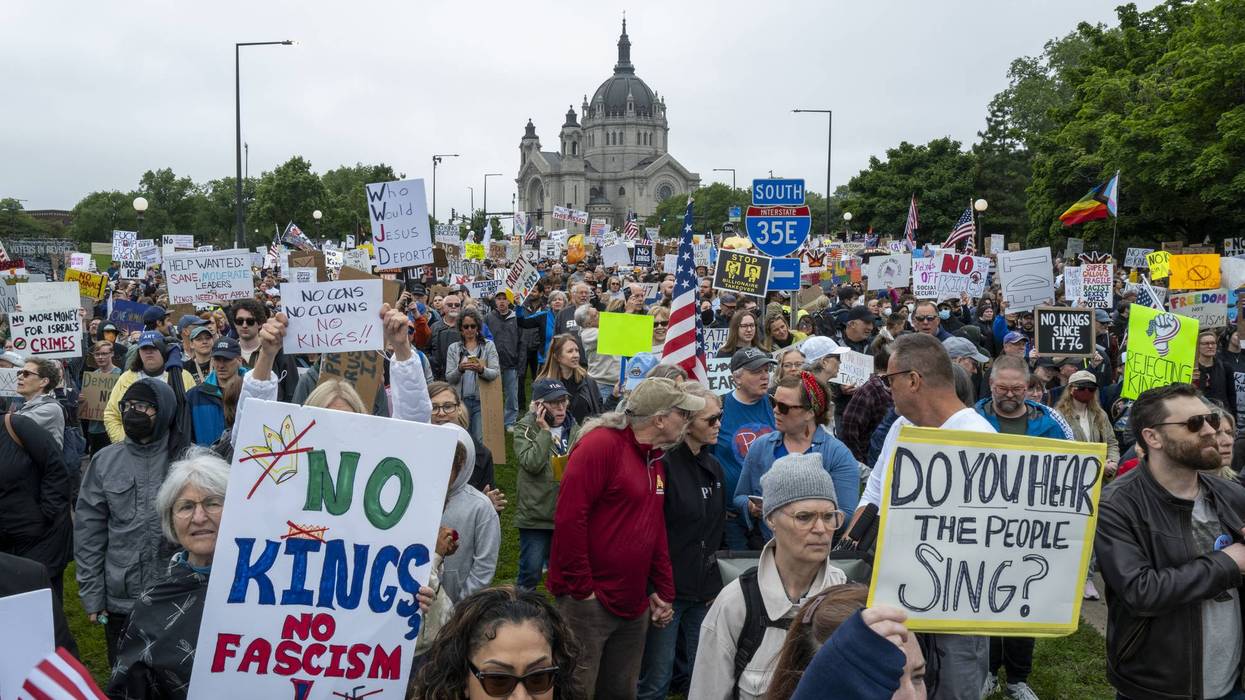
If you're heading out this weekend, whether you're attending the "No Kings Rally" or just running errands on Saturday, keep in mind so are thousands of others.
Here's what you need to know:
What is the "No Kings" rally?
For starters, these are larger gatherings, some of the largest Minnesota has ever seen if the exected numbers turn out to be accurate.
They are a series of protests, nationwide, and billed as "nonviolent demonstrations." The began in 2025, opposing the perceived authoritarian actions of the Donald Trump administration. Saturday's will be the third one.
Organizers emphasize that the country belongs to its people rather than a monarch, advocating against federal abuses, immigration raids, and executive power.
Will there be street closures?
Yes, especially in St. Paul.
According to St. Paul police, who say these are subject to change depending on circumstances, the plan is to close Wabasha Street from Harriet Island to the Capitol grounds starting at 11:45 a.m. Saturday. They say the closure will last at least one hour, possibly more depending on how big the crowd is, and how long it takes marchers to get into place at the capitol.
John Ireland Boulevard up to Marion Street and the 12th Street Bridge area around St. Paul College also is tentatively slated to be closed for the same time period. St. Paul Police reiterating this is subject to change.
Rev. Dr. Martin Luther King Jr. Boulevard, around the Capitol, will be closed throughout the main protest.
At noon on Saturday, protesters plan to march from three St. Paul locations — Western Sculpture Park, St. Paul College and Harriet Island Regional Park. They will then meet at the state capitol grounds.
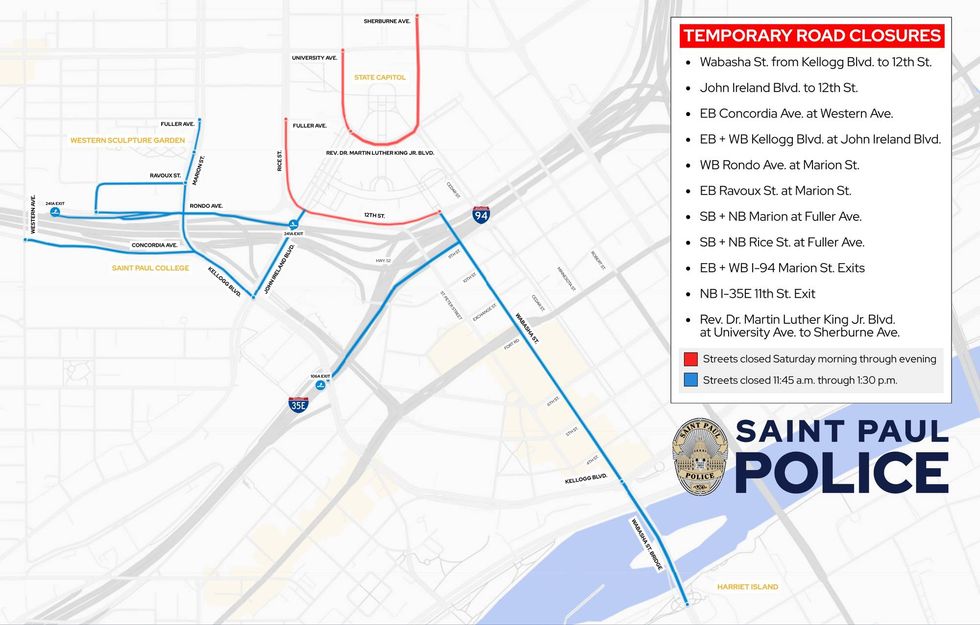
Planned street closures in St. Paul Saturday.
(City of St. Paul / St. Paul Police Department)
Metro Transit has increased capacity for protestors
Drew Kerr with Metro Transit says they're fully prepared for the event.
"We will have three car trains out on the light rail system so that there's extra capacity," Kerr explains. "We will also have more buses out on the system and of course people at points along the way for those who are looking for directions, needing help purchasing fares, those sort of things. And managing the crowds as well."
Kerr says to purchase your fare in advance and have patience as there may be delays and detours, especially with numerous street closures in St. Paul.
Kerr says with so much foot traffic, Metro Transit may be your best option.
"Transit for events like this is really a great option because we can move a lot of people in and out of places pretty efficiently and pretty effectively," he says. "We've done that many times over our history and ready to do so again on Saturday."
You can also use Metro Transit's "Alerts" website for information on buses and light rails.
What else should you expect?
Organizers say an estimated 150,000 people are expected to attend the No Kings Rally in St. Paul on Saturday. They will congregate there, after marching from different spots in the Twin Cities.
The rally in St. Paul is one of thousands planned around the country. There are also some big names associated with the rally in St. Paul, including Bruce Springsteen, Joan Baez, Jane Fonda, U.S. Senator Bernie Sanders, and many more. See the entire list here.
Some events get underway around 12:00 p.m. with the main stage speakers and performers getting underway at 2:00 p.m. at the state capitol.
The organizers are stressing their commitment to nonviolent action as well.
"We expect all participants to seek to de-escalate any potential confrontation with those who disagree with our values, and to act lawfully at these events," they say. "Weapons of any kind, including those legally permitted, CAN NOT be brought to events."
There are thousands of rallies across the world
St. Paul is expected to be the biggest in Minnesota, but it is far from the only one. There are dozens registered to participate across the state, from as far north as Baudette, International Falls and Grand Marais, to the Iowa border with Luverne, Fairmont and Albert Lea. And all spots in between.
Of course, there are many across the U.S. as well, with every major city participating.
But these rallies also stretch beyond the United States. There are protests planned across Europe, and even some in Mexico, South America, and the Caribbean.
You can see a map of registered events here.


