


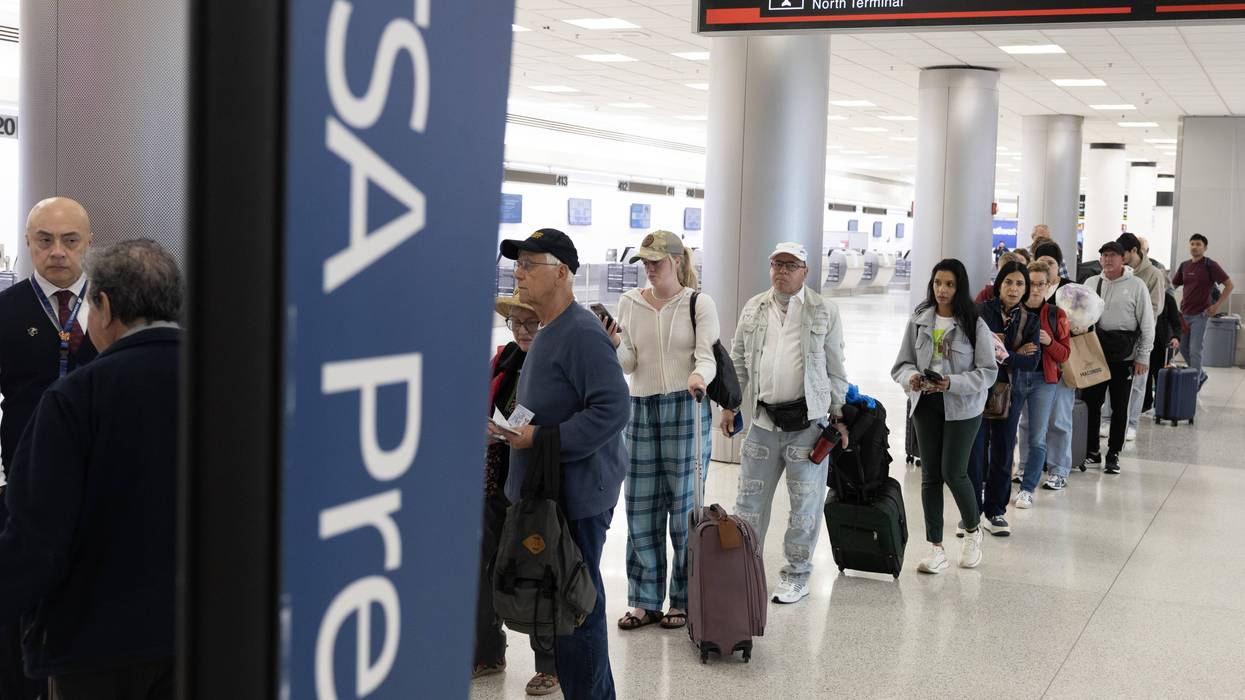

Storms have hampered air travel across the United State this week, but it is still the ongoing government shutdown that is top-of-mind for travelers as security lines have grown considerably longer at numerous airports.
Air travel was already under pressure before the storms. A partial government shutdown that began Feb. 14 has thinned staffing at some security checkpoints, and airports are crowded with spring break travelers and fans heading to March Madness.
"Last Friday was the first complete zero paycheck that TSA agents got since the start of the shutdown just over a month ago," says Thrifty Traveler Editor Kyle Potter, who spoke with WCCO's Chad Hartman on Wednesday. "And maybe more importantly, this is now the second prolonged shutdown of work without pay for more than one month, in less than four months going back to the last big shutdown in October and November of 2025. This is going to have, unless if this gets wrapped up real quick, an exacerbating effect. That is going to have effects on airport security probably for months, maybe for years. Because who in their right mind would sign up to work for $40,000 a year when you're not even guaranteed to get those paychecks."
Democrats in Congress have said Homeland Security won’t get funded until new restrictions are placed on federal immigration operations following the fatal shootings of Alex Pretti and Renee Good in Minneapolis earlier this year.
As Potter noted, this isn't the first time it has happened. It is the third shutdown in less than a year to leave TSA workers temporarily without pay. Once the government reopens, employees will have to wait for back pay.
It's also nearly impossible to know if or where long lines and TSA delays will take place - it's a regional issue, depending on who shows up to work.
"If you're an airline, the worst thing that you could do is tell people everything is fine and then they show up, and there's a two-hour wait and they miss their flight," Potter explains. "So I mean to everybody, as hard as this is, first and foremost, better safe than sorry. If I was heading to the airport here in Minneapolis, despite the fact that we haven't had significant issues like we've seen in other major hubs, I'd be there probably 2.5 hours or more before departure just because I would rather be sure."
With little progress happening in Washington between lawmakers up until now, Potter says this could be just the tip of the iceberg. He says a situation where some smaller, regional airports are forced to close, and even some larger airports have to start cutting back.
"We are so in so much worse of a position that I think all bets are off," Potter explains. "And not only do I think is it possible that smaller airports get shut down, I think it's possible that we're going to see even - not the shutdown of Minneapolis or Chicago-O'Hare, nothing like that - but we're going to see very significant disruptions far beyond what we're seeing today if this doesn't come to a close pretty quickly."
A shutdown-induced staffing shortage prompted TSA to temporarily close multiple security checkpoints at Philadelphia's airport starting Wednesday. Staff will guide travelers to alternate checkpoints, the airport said in a post on the social platform X. It recommended that passengers arrive 2.5 hours early for domestic flights and 3.5 hours early for international flights.
Outside the Atlanta airport, TSA union leaders held a news conference Monday warning that air travelers could face increasingly long wait times as the shutdown continues. Supporters held signs reading, “We want a paycheck, not a rain check.”
Many TSA workers “are coping with eviction notices, vehicle repossessions, empty refrigerators and overdrawn bank accounts,” said Aaron Barker, a local leader with the American Federation of Government Employees. Even so, he said, many officers continue reporting to work despite mounting financial strain.
Rising fuel prices start affecting airfares
Fares are already up, according to tracking done by Potter and Thrifty Traveler.
CEOs and other top officials from the nation's largest airlines have confirmed that themselves, and Thrifty Traveler reports they told investors Tuesday that they've already raised fares to cover some of those higher fuel costs.
There aren't many specifics yet, but one airline suggested they've raised many fares by 15% to 20% in the last week alone. Much of this is tied to the war in Iran, and the availability of oil across the globe driving up prices.
"I mean, safe to say, the longer that this goes on, the higher the fares are going to get for a longer period of time," Potter responds. "That sounds like a cop out, but I think that's all we can say at this point. Airlines have acted quickly, I will say. Quicker than I expected them to start to raise fares. And I think people are seeing that anecdotally in some really nasty domestic prices in particular, over the coming months. Maybe to a slightly lesser extent for some longer haul travel to Europe."
How long this goes on will really hinge on the affairs in the Middle East, and how long the Strait of Hormuz, along the Iranian coast, is closed to shipping. In mid-February, jet fuel costs were around $2.40 per gallon. It's up significantly.
"If jet fuel goes above $4 on average a gallon, which is where it's really been hovering for the last week and a half or so, I just don't know," Potter says.
Bottom line, for now at least, travelers should count on higher prices driven primarily by fuel costs.
"I mean, all of the biggest airlines in the country, United, American, Delta, and Southwest, the big four, all said basically in unison yesterday in a conference with investors that they are projecting a $400 million additional expense just in fuel as a result of these changes that we've seen in the last 18, 19 days," Potter adds.
Adding to the stress for travelers, fuel costs are starting to drive up the price of flights
Adding to the stress for travelers, fuel costs are starting to drive up the price of flights


