




DETROIT (WWJ) - Air quality indexes in Metro Detroit and in West Michigan spiked into the 100s on Thursday morning -- and an overnight weather phenomena is behind it, meteorologists say.
At 12:30 p.m. Thursday, Detroit and Dearborn both recorded air quality index (AQI) of 118 while Grand Rapids and Holland clocked in at 119 with both readings registering in the "Unhealthy for Sensitive Groups" range, according to IQ Air.
Levels of fine particulate in affected communities are elevated with IQ Air stating several communities are at PM2.5 concentration, which is 5.6 times the WHO annual air quality guideline value.
The air quality alerts pinging on phones and desktops at the end of February seems unusual to Michiganders who saw major air quality issues due to smoke from historic wildfires in Canada wildfires last summer.
While poor air quality is more common in summer, experts say it's not impossible for it to occur in winter. In fact, a weather phenomena called low-level inversion is spurring the latest air quality alert.
Steve Freithe, a meteorologist from the White Lake National Weather Service, spoke with the Detroit Free Press and explained a low-level inversion occurs when the land cools off, specifically very early in the morning, while the air a few thousand feet above the surface remains warmer than the air closer to the ground.
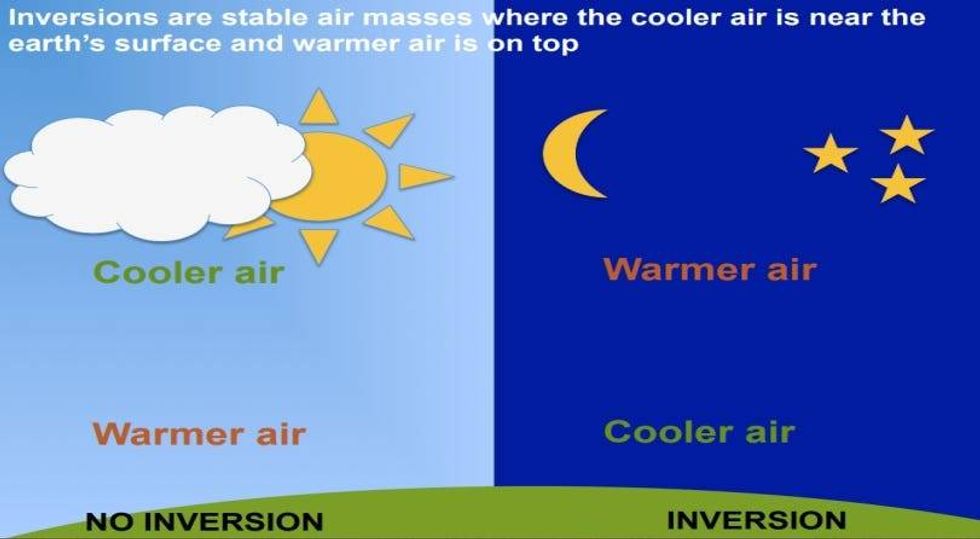 Temperature Inversion diagramNWS/NOAA/University of Missouri - https://www.weather.gov/media/lzk/inversion101.pdf
When shallow inversions happen, the wind underneath the inversion at the surface is choked cut off from the winds above- so the inversion creates a "cap" and traps air pollutants close to the ground.
"Anytime you get a strong low-level inversion with very light winds here, you're prone to have a stagnant air mass," said Freithe told the Detroit Free Press. "(Pollutants) are sort of trapped near the surface, not able to dissipate higher up."
Typically, the "cap" disappears when the sun rises and the land has heated up enough to break through the inversion, allowing the winds from high above to mix with the winds at ground level.
But the Michigan Department of Environment, Great Lakes, and Energy, said that may not be the case on Thursday.
"We are stuck between two weather systems, one to our south and one to our north with weak winds in between," meteorology specialist of the air quality division Stephanie Hengesbach told the Free Press. "This set up will remain over the state until a cold front drops in from the northwest on Friday."
Winds are finally expected to pick up with the arrival of the cold front which will disperse air pollution trapped by the inversion and return air quality to normal levels by the weekend.
Until then, experts say sensitive groups -- which include people with lung disease including asthma, heart disease, and children and older adults -- should wear a mask outdoors, avoid outside activities and close windows to prevent bad air from getting inside.