


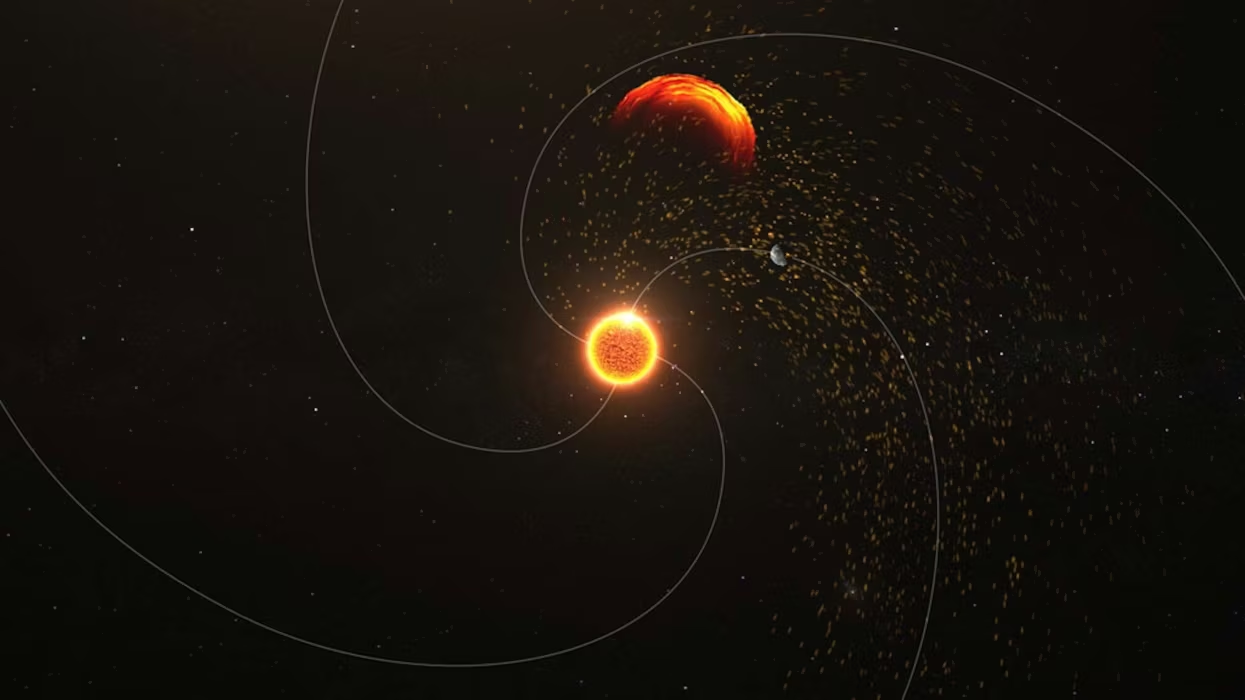

(WWJ) As the Artemis 2 mission carries American astronauts toward the moon for the first time in five decades, the University of Michigan is delivering the critical data needed to shield the crew from hazardous solar particles.
U-M, in Ann Arbor, is collaborating with NASA to provide advanced solar radiation forecasting, a "weather report" for deep space that could mean the difference between mission success and a radiation emergency.
Professor Lulu Zhao, a tenured faculty member at the University of Michigan, is leading the project to build a space weather prediction model that specifically monitors the radiation environment surrounding the spacecraft.
Speaking with WWJ Newsradio 950's Tony Ortiz, Zhao explains that the project focuses on predicting whether the space radiation in the space would be harmful in the next, for example, 24 hours.
This foresight is vital for mission control, as it helps "plan your activities in the space to avoid you being suddenly in the very high radiation environment," she said.
While people on Earth are generally shielded by a magnetic field bubble that blocks hazardous particles, lunar travelers lose that natural defense once they leave Earth's orbit.
According to Zhao, when astronauts fly to the moon, "the Earth's magnetic field would not be able to protect us anymore." This transition makes accurate environmental predictions essential for deep-space travel.
The partnership officially took flight in 2024 following a 2023 selection by NASA to build a Space Weather Center of Excellence.
Zhao notes that the team met with NASA stakeholders in late 2025, where they learned of the planned early 2026 launch for Artemis 2.
The timing, she said, provided a "good opportunity to really stress test our model and then to really show that we're able to help them".
About the Artemis 2 mission
Artemis 2 is the first crewed mission under NASA’s Artemis program, marking a historic return to lunar exploration. Launched in early 2026, the mission carries a crew of four aboard the Orion spacecraft, propelled by the Space Launch System (SLS).
The 10-day flight serves as a lunar flyby, testing life-support systems and deep-space maneuvering capabilities. This mission is the final stepping stone before Artemis 3, which aims to land humans on the lunar surface.
For Zhao and her team, the mission represents the ultimate application of their academic research.
"I feel very excited about this. And, you know, as, as a scientist, we really want to see what we are doing is actually contributing to the community," Zhao said. "And we are very excited to really push our model to be, to be used for future similar missions to help with, you know, our entire humanity."