


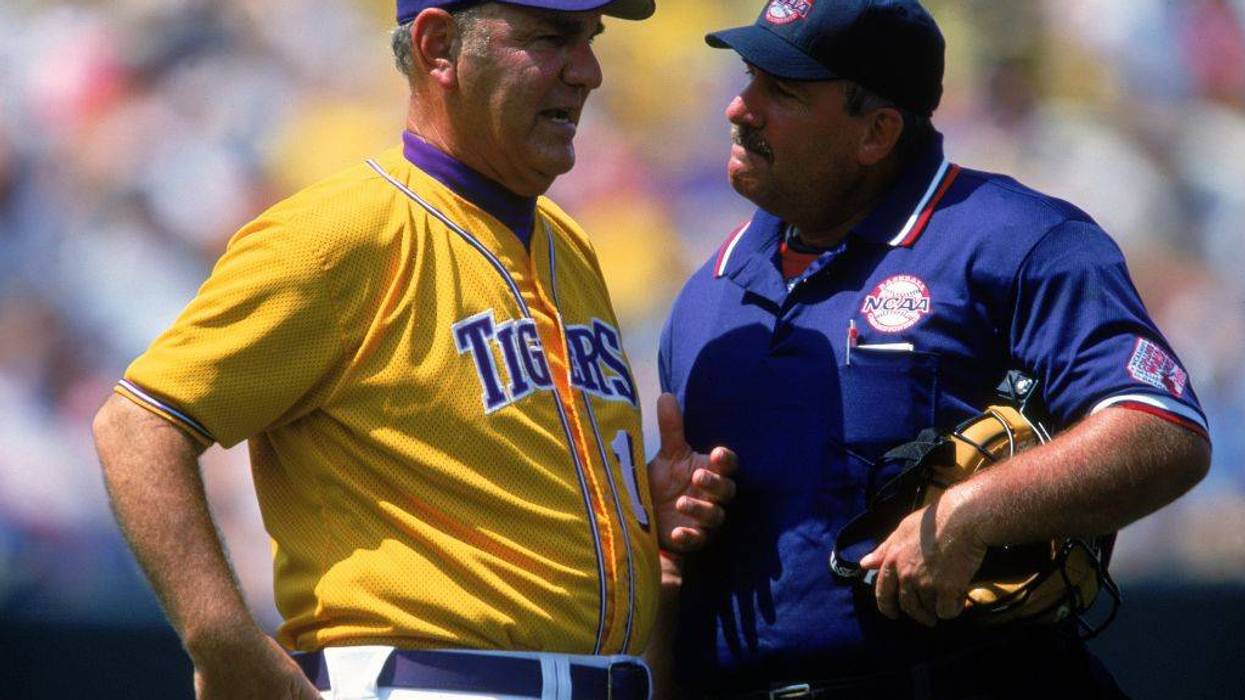

Bertman died Friday morning after being hospitalized with heart issues.
The Detroit native, who grew up in Miami, was hired by LSU in 1983 and inherited a baseball program that drew little attention. Over the next two decades, he built the Tigers into one of the most dominant programs in college baseball history.
Bertman led LSU to five national championships in 10 seasons—in 1991, 1993, 1996, 1997 and 2000—and took the Tigers to the College World Series 11 times.
“This is the greatest college baseball coach of my entire lifetime,” current LSU baseball coach Jay Johnson said. “Five national championships in a 10-year period is legendary.”
Bertman spent 18 seasons as LSU's head coach, compiling an 870-330-3 record. He was even more dominant in the NCAA Tournament, going 89-29 for a .754 winning percentage, which was the highest postseason winning percentage in NCAA history at the time.
But Bertman's impact went far beyond the numbers.
He helped create a passion for college baseball in Louisiana that remains unmatched. LSU led the nation in attendance during each of his final six seasons, as the old Alex Box Stadium became one of the most intimidating and recognizable venues in college baseball.
And for many of Bertman's former players, he was much more than a coach.
“I was one of the luckyones to have been able to learn from one of the greatest leaders,” former LSU star Warren Morris said. “I tell people today, as a player at LSU under Coach Bertman, you received more than just an education in baseball. You got an education in life.”
Bertman stepped down as LSU's baseball coach following the 2001 season and became the school's athletic director. He remained in that position until 2008.
During his tenure as athletic director, LSU continued to build one of the nation's most successful athletic departments.
The football program won national championships under Nick Saban and Les Miles. Bertman hired Miles after Saban left LSU following the 2004 season.
He also made difficult decisions, including firing his close friend Smoke Laval as baseball coach and replacing him with Paul Mainieri. Mainieri would lead LSU to the 2009 national championship and four SEC regular-season titles.
Bertman's influence extended across nearly every LSU sport.
He promoted Dennis Shaver to lead the track and field program, and Shaver went on to guide LSU to NCAA women's and men's outdoor national championships.
Bertman also hired Chuck Winstead as LSU's golf coach in 2006. Winstead led the Tigers to the 2015 national championship.
Under Bertman's watch, LSU women's basketball reached five consecutive Final Fours, while the men's basketball team reached the Final Four in 2006.
He also oversaw major improvements to LSU's athletic facilities, including the construction of new baseball and softball stadiums and renovations to Tiger Stadium and the Pete Maravich Assembly Center. The Cox Communications Academic Center for Student-Athletes was also built during his tenure.
But perhaps Bertman's most enduring legacy is a simple phrase he used to motivate his teams: “Hold the rope.”
The message was that every person on a team has a responsibility to do his or her part. If everyone holds the rope, the entire team stays together.
For generations of LSU athletes, coaches and fans, Bertman was the person who taught them how to hold it.
And now, LSU is mourning the loss of one of the most influential figures in the history of the university.
Skip Bertman didn't just build an LSU baseball dynasty. He helped change the culture of LSU athletics—and left a legacy that will last far beyond the five championship banners he brought to Baton Rouge.


