

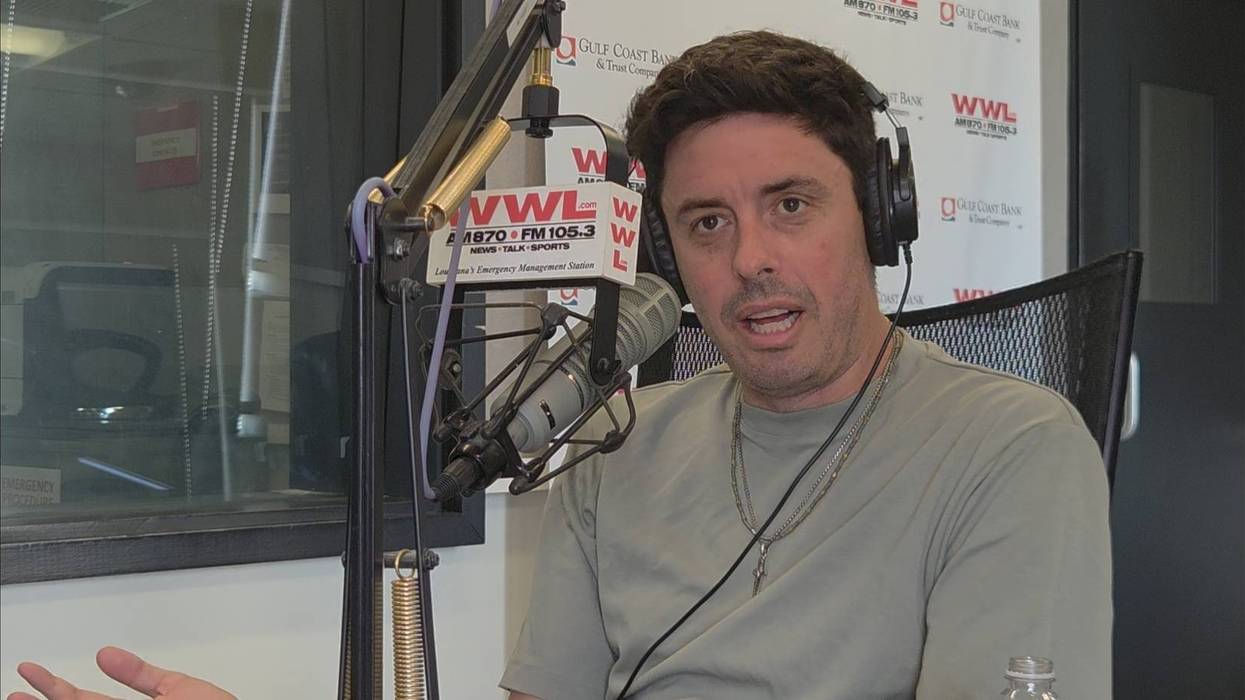

Tim Miller has spent years inside Republican politics, and now makes a living analyzing it from the outside. Sitting down with him in studio, I wanted to move quickly through a few of the biggest issues in front of Congress right now, the SAVE Act, the fight over funding the Department of Homeland Security, and the growing conflict with Iran - and figure out what’s actually real, what’s overstated, and what’s about to hit people where they live.
On the SAVE Act, I told him I had come away from a recent interview with Congressman Troy Carter less convinced that the level of Democratic opposition matched the actual threat. Universal voter ID polls well and most people say they want secure elections. So why does something like this turn into a blood feud?
Miller didn’t dismiss the concern but he didn’t fully buy into the panic either.
“I also have more of a mixed view on this one,” he said. “I think that there’s a little bit of… for good reason, a lot of folks on the left are raising alarm bells on this. Donald Trump hasn’t demonstrated that he can be trusted with running elections and doing so in a way that’s fair,” Miller said. “He lost an election in 2020 and then tried to get it overturned… and a lot of those lies about the 2020 election undergird the things in the SAVE Act.”
Where he gets more specific is on how these rules play out in real life. Mail-in voting and signature verification, in particular, stood out.
“I don’t know what my signature is,” he said. “And then you have some person looking at them and being like, ‘Do these match?’ And if they decide they don’t match, my vote doesn’t count. That’s BS.”
Tim is right. If you signed your signature today, do you feel confident it would match what you put down ten years ago? Not likely.
At the same time, he pushed back on a common assumption I hear all the time, that tighter voting rules automatically benefit Republicans.
“I think it’s a little overstated that this might hurt Democrats,” he said. “A lot of older folks tend to be more Republican. I’m not sure that, even if this was an effort to cheat, I’m not sure it would work. It might backfire.”
His bottom line was pragmatic: the concerns are real, but the politics around them are overheated, and the bill likely doesn’t have the votes anyway.
From there, we stayed on Capitol Hill and talked about the partial shutdown of the Department of Homeland Security. The Senate had just moved to fund most of DHS, including paying TSA workers, but House Republicans were already signaling resistance.
I asked him something I think a lot of people are wondering: if the House and Senate are actually disagreeing, even under unified control, is that dysfunction, or is that the system working as designed?
“Well, in theory it could be,” Miller said. “I think right now we’re seeing a Congress that can’t do anything.”
He argued the deeper issue isn’t just gridlock; it’s that Congress has slowly handed its authority to the executive branch.
“There are a bunch of issues where people in Congress say they disagree,” he said. “But they haven’t actually passed any bills to rein him in.”
And in the meantime, basic things fall through the cracks.
“Who is not for paying the TSA agents at this point?” he said. “They’re not getting paid because they’re like this ping pong ball in a legislative morass.”
That led into what may be the biggest story of all, even if it hasn’t fully landed yet: Iran.
I told him it felt like the U.S. was sliding deeper into a conflict with serious economic consequences, but politically, it didn’t seem to be breaking through. People just don’t have the energy to care - he thinks that’s about to change.
“I think it’s about to break through,” he said. “The scale of the disaster this Iran war is now inevitable.”
Right now, the impact is limited to higher gas prices. Annoying, but manageable.
“You fill up your tank one time, two times, it’s a little more expensive,” he said. “It’s like, okay, that sucks, but I can figure this out. But if it’s going on for months and you’re paying 30 more bucks a week in gas, that matters.”
And it doesn’t stop at the pump.
“What do diesel trucks haul? Your food,” he said. “A bag of carrots - it’s in a plastic bag. What’s plastic? Petroleum. It goes on a truck. What fuels the truck? Diesel. The costs add up across the board.”
By the time summer hits, he thinks people will feel it everywhere.
“People are going to look around come Fourth of July… and they’re going to go, everything is so much more expensive. Why?”
His answer is simple.
“Because he went to war in Iran when he said he didn’t want to,” Miller said. “And people are going to get really frustrated.”
After all of that, we finally got to something lighter - his life here in New Orleans. Miller didn’t have to move here. That’s what makes it interesting.
I asked him for the most “New Orleans” thing that’s happened to him so far.
“My buddy lives in the Marigny,” he said. “He walked out one morning and there was a guy sleeping underneath his house. He couldn’t figure out how to get back to his Airbnb from the French Quarter.”
But it’s not just moments like that. It’s the pace of life.
“My daughter loves the 10 days before Mardi Gras weekend,” he said. “We’re out there on a Wednesday night… she’s drenched in beads, making friends.”
I told him that’s the part of the city people don’t always understand - that it’s not just big events, it’s random Tuesday and Wednesday nights that turn into something.
He agreed.
“I’m like, your cousins in St. Louis and Denver are not doing this on a Wednesday night,” he said.
For all the work he’s doing - podcast, TV, everything else - he’s found a way to lean into that.
“The social life is not what gets cut,” he said. “Laundry gets cut. Sleep gets cut.”
Which, honestly, might be the most New Orleans answer of the whole interview.
A wide-ranging conversation on election fears, Washington paralysis, and life in New Orleans
A wide-ranging conversation on election fears, Washington paralysis, and life in New Orleans