


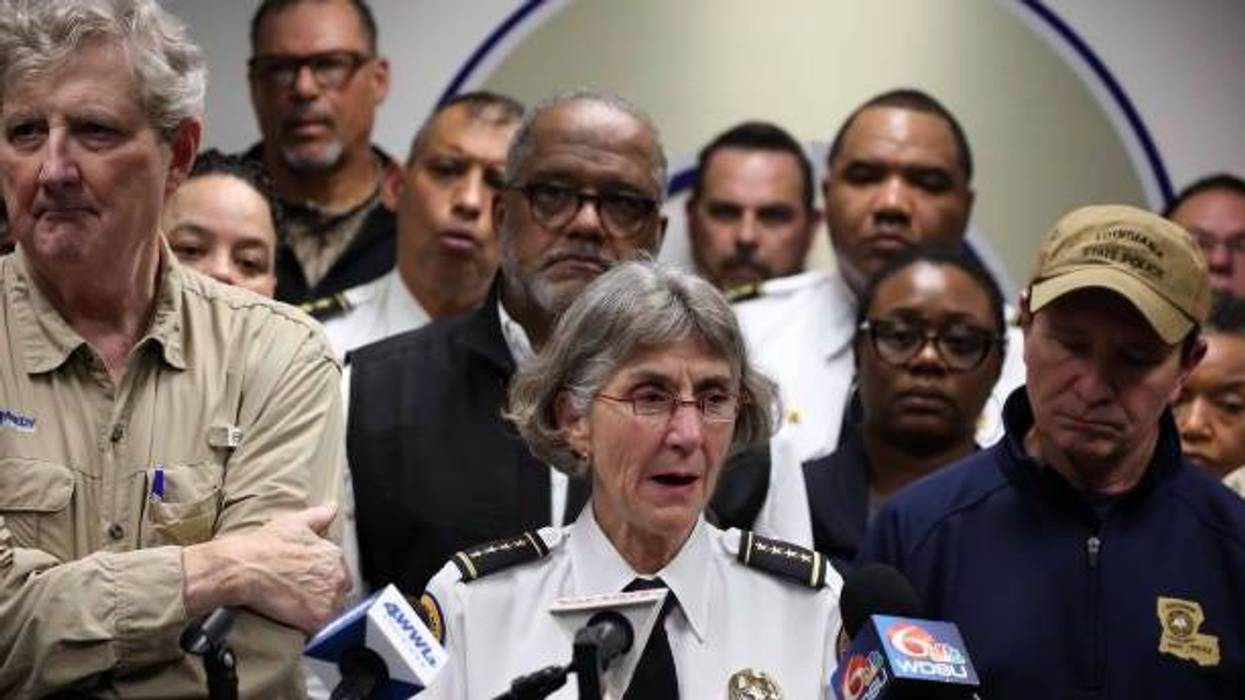

“The terrorist is dead and now the media, at least on the national scene, look to assign blame. The person they’re looking to target for some of the blame is Superintendent Anne Kirkpatrick,” said the President of the Metropolitan Crime Commission, Rafael Goyeneche in our interview Thursday.
Goyeneche staunchly disagrees and doesn't hesitate to explain why. He says, “Truth be told, I think she is one of the best things that’s happened to the City of New Orleans from a public safety perspective. Under her leadership, we’ve seen crime continue to go down. We’re seeing the morale of officers improving. We’re seeing new levels of accountability. We’re very close to substantial compliance with the consent decree. The events of what happened on January 1st are a tragedy… But everyone recognizes that what happened in New Orleans could happen anywhere… The blame assigned to Kirkpatrick is, I think, unjust and ill-informed.”
I don’t often rush to the side of the city officials. But in the case of Superintendent Anne Kirkpatrick, I couldn’t agree more with Goyeneche’s take.
As an organism, the news feeds on dramatic events—like a flame needs oxygen. And when it doesn’t get enough oxygen, it creates it.
I’m always for a free press. However, in the wake of the tragedy on January 1st, I feel the need to draw a line between local and national coverage.
The moment news began to circulate, national outlets began to spout outlandish, untrue, and distracting claims. At first, you might’ve gotten away with justifying it as a knee-jerk reaction. But since then, they’ve continued to manufacture drama where they have no business doing so.
The national media desperately wants to play the role of the executioner. They want to see heads roll just because that’s the easiest road to the largest, plumpest headlines. As William Randolph Hearst—who many consider the father of yellow journalism—once said, “Don't be afraid to make a mistake, your readers might like it.”
At this point, mainstream outlets don’t even care to hide their mistakes. They’d rather spin another misinformed story for the sole purpose of pushing their narrative.
Thankfully, locally, we’ve managed to stay more or less above the fray. Of course, there are those who blame the police chief. But even after some called for her resignation, community leaders came to her support.
Many don’t understand that police departments are highly complex, and part of a larger, city-wide network of agencies.
So, when judging a police chief, you ought to use the following framework: How have we dealt with mass casualty events in this city historically? Is it unreasonable for Kirkpatrick, who has been here only a year, to know everything, including information that resides in agencies she has zero control over?
New Orleans' bureaucracy is a nightmare to navigate. Yet, the national media went off and running with Kirkpatrick's culpability without pausing to consider the city's complex and tangled nature.
When judging someone’s job performance, you can’t base it on one event. You need to take into account their performance in the role writ large.
When it comes to the chief, there's no doubt about it. She's done a good job, and the numbers back her up.
Coincidentally, the Metropolitan Crime Commission’s year-end crime trend report is wrapping up, and the numbers undoubtedly show that Kirkpatrick has been successful in her position.
Goyeneche broke it down for my listeners, saying, “When she came here, it was her mission to make this city safer and move the department to comply with the consent decree. And she's done everything in her power and exceeded the expectations of a lot of people, including myself, in her short tenure here. But to try and blame her for what happened on January 1st is unfair to her and the people of New Orleans because the people realize how much better and safer the city is because of her leadership.”
As for the numbers themselves, Goyeneche explains, “We’re seeing homicides decline 35% from ‘23 to ‘24. The high watermark for homicides in the city was 2022, and we're down 49% this year compared to ‘22. How was it accomplished? Well—the first district, which includes the Bywater, Mid-City, and Tremé areas—showed the largest reduction, a 75% decrease in homicides. The seventh District saw its raw numbers in homicides decline from 30 in 2023 to 9 in 2024.”
Homicides aren’t the only crime that’s plummeted under Kirkpatrick’s oversight. Goyeneche read off the statistics concerning the NOPD’s rising success in solving crime, explaining that “There’s an 85% solution rate of homicides, 97% on aggressive assaults, 85% simple robberies, 94% purse snatching, 88% solve rate on armed robberies…Those numbers are huge.”
I get we’re all still wrapping our heads around the events on January 1st. But what I said on the day of the Bourbon Street terror attack still stands true: It’s not about something hyper specific like bollards. It’s about our ability to execute.
Executing requires hiring and keeping aboard people who succeed at, you guessed it, execution. Kirkpatrick has executed, met, and succeeded in her goals.
It's not that we shouldn't hold people accountable when failures occur, and it's not as if Kirkpatrick and the NOPD don't face major challenges ahead.
However, judging her on her performance so far, we should thank her for the job she's done, not chastise and rake her over the coals for doing a damn fine job at getting the NOPD back on track.


