



Today is the big day for the highly anticipated solar eclipse that will be visible in North America.
Even though cloudy weather is expected to decrease the view in Louisiana, LSU Planetary Astrophysicist Dr. Natalie Hinkel said it’s definitely worth stepping outside to see how the moon blocking the sun affects the Earth.
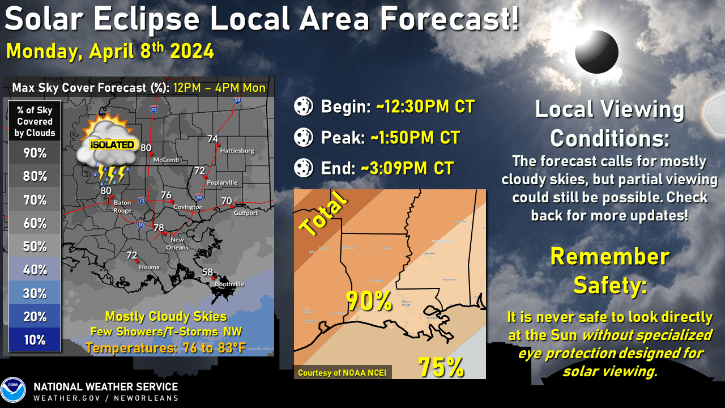
“In Louisiana, we’re only going to be getting a partial eclipse. Starts around 12:30pm and goes until about 3pm, where the actual maximum eclipse is roughly around 1:45,” said Hinkel.
The National Weather Service says the closer you are to the Texas line, the more the moon will cover the sun.
In north and west portions of the state, it will be a 90% eclipse; with about 75% of the sun blocked in coastal areas in the southeast.
“In the 2017 eclipse, I think the temperature swung down by about 10 degrees. Wind starts picking up, so there’s just a variety of things that happen on the earth,” said Hinkel.
Ophthalmologists remind you to never look directly at the eclipse, even a partial view of one without proper eclipse glasses. Doing so can cause permanent eye damage.
You can also safely view the eclipse by visiting science.nasa.gov.
Hinkel says animals even react to total solar eclipse, for example, crickets have been known to emerge because they think it’s nighttime and livestock often show signs of anxiety.
“The way the animals react is just an unreal experience, it’s one of those you kind of have to be there kind of thing,” said Hinkel.