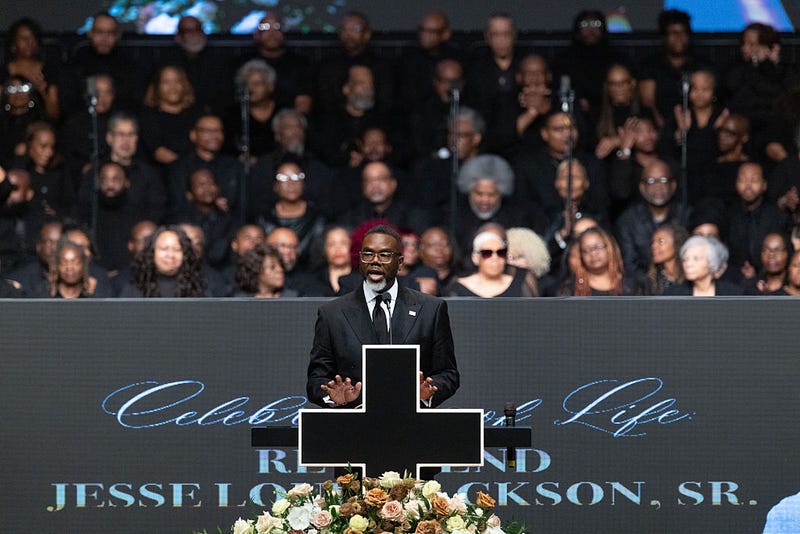

Chicago mayor Brandon Johnson's eulogy for his friend and mentor the Rev. Jesse Jackson at the House Of Hope on the Far South side last week was a stirring tribute to the civil rights icon's commitment to social justice and equity, and recalled his efforts to bring often-marginalized people into the political process through registering millions of new voters.
"We understand our assignment!" the former middle school social studies teacher exhorted as nearly the entire audience rose to its feet.
But the mayor's plan for having a living tribute to the Rev. Jackson enshrined in Chicago's municipal code is now an incomplete assignment, which in part demonstrates the challenges the mayor and progressive colleagues in city government have faced in responding to initiatives and actions from the Trump Administration.
On the day of the Rev. Jackson's public memorial March 6, Mayor Johnson called a special City Council meeting for March 11 with two items on the agenda: a resolution honoring the Rev. Jackson, and consideration of the "Rev. Jesse L. Jackson Sr. Fair Access to Democracy Ordinance." Rev. Jackson's family had been invited to the meeting, which promised heartfelt tributes from aldermen to the global civil rights figure as well as debate on the mayor's proposal intended to maintain Chicagoans' access to polling places.
Its centerpiece was the establishment of "democracy zones" outside every polling place in Chicago, where federal immigration enforcement would be banned. The mayor's team reportedly hoped that the measure would get enough support from City Council members to put it into immediate effect, which would have meant setting up zones around all 1,000+ polling places in the city for the primary just six days later.
And even as the mayor's office publicly shared few details about the proposal, he forcefully supported the concept the day before the planned meeting. "The President has made it very clear that he wants to suppress the vote of working people," the mayor told reporters in Back of the Yards on Tuesday. "We've always explored different ways in which we can protect Chicago."
But that plan apparently grew murky as the mayor's team began presenting it to Chicago aldermen, some of whom asked questions for which no answers were offered. "They had not talked to the Chicago Police Department, the Board of Elections, the State's Attorney's office or the Attorney General about the legality or the implementation," one alderman told me about those discussions. "They had no citations for state law allowing them to do this. It was wrought with unanswered problems."
Another complication arose: the participation of the Jackson family. A mayoral spokesperson told me the Rev. Jackson's loved ones were not yet emotionally ready to attend, citing the health of Jacqueline Jackson, the Reverend's widow. Concerns were also raised about a high-profile appearance by former Rep. Jesse Jackson Jr. in council chambers so close to the primary, as he seeks re-election to his former Congressional seat.
And so, with questions swirling around the mayor's marquee proposal and the attendance of the guests of honor in question, the mayor's office canceled the special meeting just before 5:00pm on Tuesday. Since doing so, the mayor has shown no interest in publicly discussing the future of the plan: he cut short his appearance at an unrelated announcement on Thursday and refused to answer reporters' questions about the issue. His team cited the mayor's need to keep to a tight schedule, which is no doubt true, though answering those questions surely would have taken about as much time as refusing to do so.
The mayor's communications director Erin Connolly told me there are no plans to have City Council consider the ordinance before the primary, and the office is taking feedback from aldermen on "tweaks" to the "democracy zones" piece, while saying there was broad agreement about other provisions banning the "doxing" of poll workers and requiring landlords to make sure tenants' mailboxes are in working order.
But while interfering with an election is a crime, it's still unclear whether the city has the authority to enjoin federal agents from carrying out their legal duties around specific areas. The alderman who expressed concerns about the "democracy zones" proposal told me "based on legal soundness, they should" abandon the proposal.
It's easy to see the mayor's vision: leaders of a progressive American city stand up to what the mayor and his supporters have described as tyranny, with a measure named for a Chicago and civil rights giant, approved while his family looked on. But if indeed honoring the legacy of the Rev. Jackson is an assignment, it's not clear when -- or whether -- the mayor intends to show his work.