

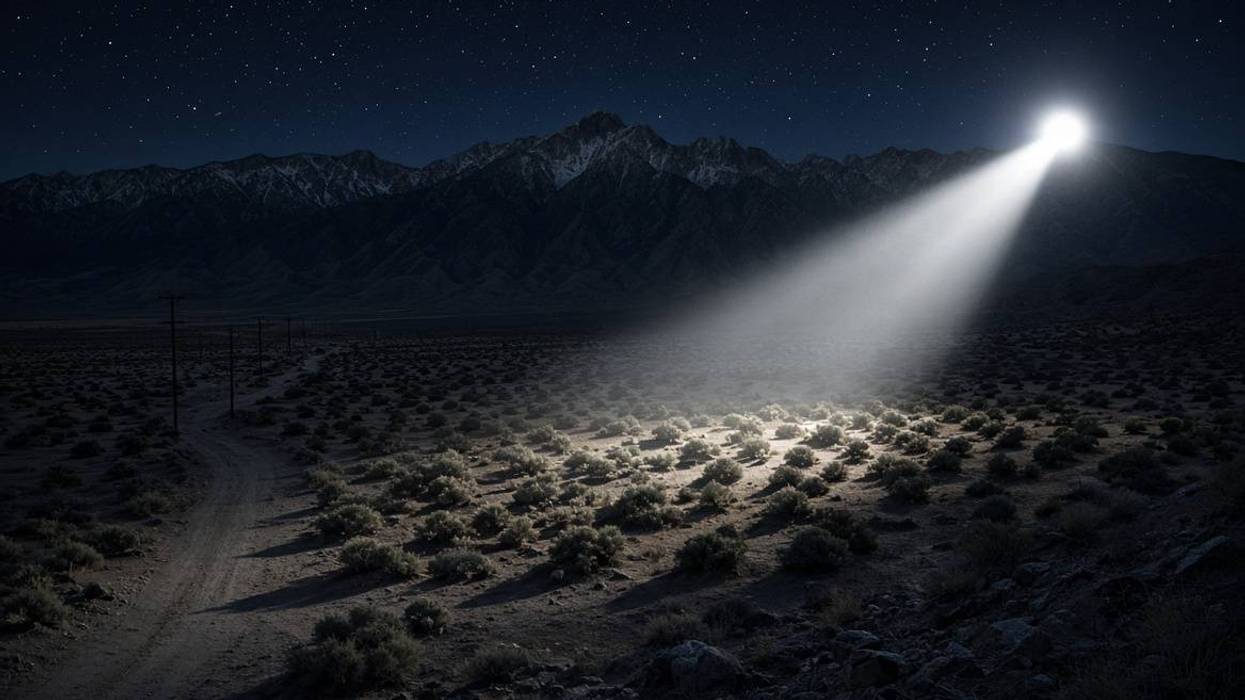

A Los Angeles startup used powerful ground-based spotlights near Lone Pine, California, on October 10 to simulate the beams it hopes to deliver one day from satellites reflecting sunlight onto Earth after dark. Reflect Orbital staged the multi-hour demonstration in a desert area along Horseshoe Meadows Road near Mount Whitney, illuminating roughly three miles of terrain at a brightness slightly higher than a full moon.
The company invited volunteer search-and-rescue teams, including the China Lake Mountain Rescue Group and Inyo County Search and Rescue, to practice grid searches, stretcher carries and equipment rigging under the artificial light. Participants first worked by headlamp in darkness, then repeated the drills under the spotlights. A company spokesperson said the test was intended as a realistic simulation for emergency responders, who are expected to be early customers. Local residents reported surprise at the sudden bright beams, which some described as blinding.
Reflect Orbital’s longer-term plan involves a network of roughly 50,000 satellites equipped with large deployable mirrors that would redirect sunlight to specific spots on the ground at night. Potential uses include aiding search-and-rescue operations, extending solar-power generation and supporting other nighttime activities. The Federal Communications Commission has approved a single demonstration satellite, Earendil-1, which would carry an approximately 18-by-18-meter steerable reflector. No satellites have launched yet, and the California event was a ground-based simulation only.
Astronomers and scientific groups have raised concerns that a large constellation of such mirrors could create significant light pollution, interfere with ground-based telescopes and alter the natural night sky. The American Astronomical Society has expressed dismay over the FCC’s approval of the test satellite, citing potential harm to optical astronomy, risks of flash-blinding and other impacts.
The FCC has stated that optical-astronomy concerns fall outside its primary authority over radio spectrum. The company has said it is engaging with astronomers and commissioning research on potential impacts.
LISTEN on the Audacy App
Tell your Smart Speaker to "PLAY 1080 KRLD"
Sign Up to receive our KRLD Insider Newsletter for more news
Follow us on Facebook | Twitter | Instagram | YouTube