

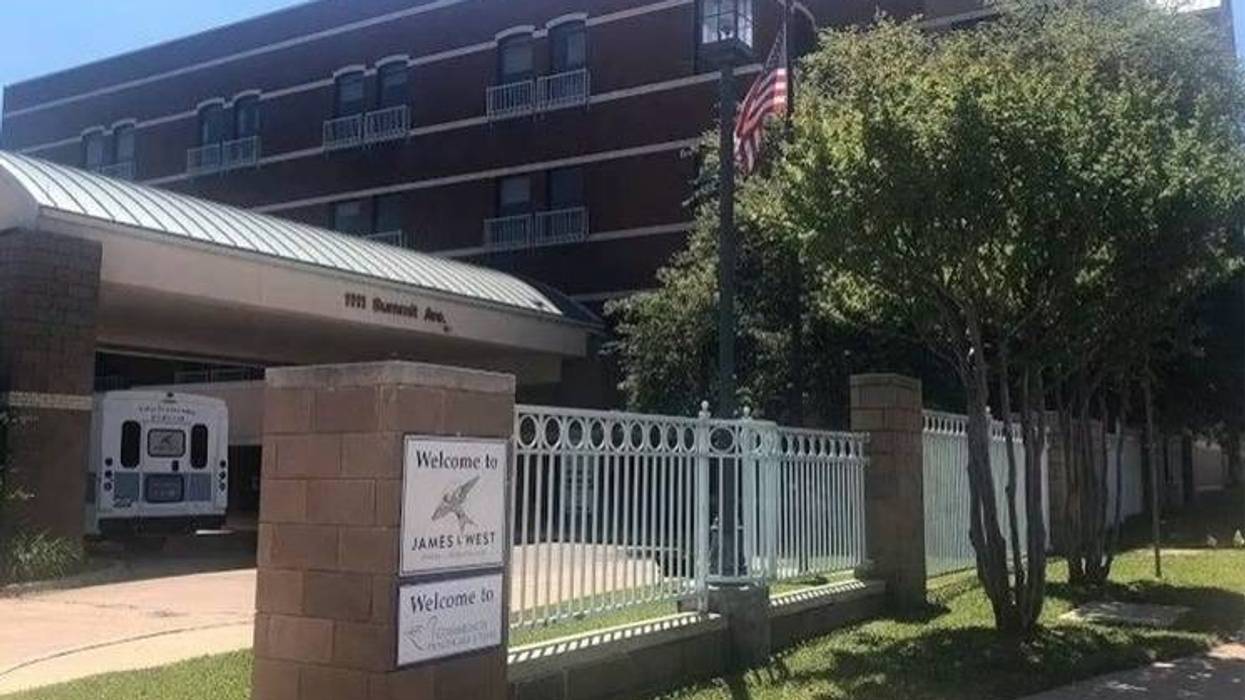

An organization in Fort Worth will host a virtual conference Monday to help people gain a better understanding of dementia. The James L. West Center is a non-profit facility that provides residential and outpatient care.
"Part of our dementia education is normalizing dementia, taking away that stigma," says Hollie Lowe, the center's director of education and family support services. "That's what we do every day. We are out in front of family caregivers and professionals and teaching about dementia. How does the disease progress? How do we accommodate the disease? The person living with dementia can't, but we can."
June is National Alzheimer's Month and Brain Health Awareness Month. The seminar Monday will start with two hours on the loss and grief caregivers might feel. Lowe says they will talk about how a spouse or child of someone with dementia may feel helpless watching personality changes in that person.
"That's what a lot of education does is allow the caregiver to get back to the relationship. Care giving is part of what we're doing, but I'm still your wife or I'm still your daughter, I'm still your son, I'm still your husband," Lowe says. "Caregivers so often become just the caregiver."
Lowe says many spouses and adult children who become caregivers die before the person with dementia, "typically from a massive stroke, a heart attack. It's the stress of care giving." She says day programs can give people a chance to focus on self-care and other parts of their lives.
"A caregiver at home, we're doing this 24/7. We don't get to clock out," she says. "We talk a lot of about asking for help. Take advantage of day programs, in-home care or come to a place like this and do respite where your loved one can stay for a week or two weeks while you go home and recharge."
The second two hours focus on education which Lowe describes as "Dementia 101." She says people can learn how to spot the difference between normal memory lapses and signs of dementia.
"'Where are my glasses, where's my phone, why did I come in this room?' That's normal, but we can step back and go, 'Ah, because I was looking for this,'" she says. "But someone with dementia, if you say, 'Go in that room and get your blue jacket,' they go in that room, see cookies and there is no more blue jacket. It's gone, and even if you were to remind them, it's gone."
The center has four support groups, and Lowe says many caregivers say the more they learn, the better their loved one feels.
"Some people never say a thing, and they're there every week because they're just listening and finding out they're not the only one going through this," she says. "It normalizes it, and they find out it's part of the disease."
Many people use the terms "dementia" and "Alzheimer's" interchangeably, but Lowe says the education segment will show the differences among different diagnoses. She says about 80% of dementia cases are Alzheimer's, but there are more than a hundred different types, and different types have different symptoms.
She says not everyone who has dementia has memory loss or may lose memories at a different rate. Lowe says people with dementia may go backward developmentally.
"Meet them where they are," she says. "If they're looking for their mom who maybe passed years ago, say, 'Tell me about your mom,' instead of 'Your mom died 20 years ago.' We're not going to reorient them. We can't be reasonable and rational with someone who can't be reasonable and rational, so we go to their world."
She urges families to validate the feelings of a loved one with dementia. Instead of correcting someone who thinks they are someplace else or thinks this is a different year, ask them more questions about what happened that year or the city they are talking about.
The last two hours will cover the study of brain health and new discoveries. Lowe hopes viewers will come away with a better understanding of how to care for someone with dementia.
"A big part of my job is taking care of the families," Lowe says. She is a licensed professional counselor and grief therapist. "We talk about using those sensory memories to take care of ourselves, as well. Listening to music, cooking, still holding hands, still touching our loved ones, that can help take care of that resident and the family member."
Lowe says families can help a loved one by distracting them when they get confused. She says "food, music, animals and children are the best distractions."
"'Look what I brought you, here's some ice cream. Let's listen to some music. I just downloaded the best of the 70s. Let's listen to some disco' because we want to go back to their music set, which for most people is their teenage years. I tell caregivers to go on YouTube and search for children laughing. Who doesn't want to see little children laughing? Or little puppies falling all over each other."
As Baby Boomers age, she says they are seeing more people whose favorite music is from the 60s and 70s.
"Out with big band and in with the 60s and 70s," Lowe says. "With music, that can take her back to a great place, anything that's sensory."
She says the West Center has 220 employees. She says each department made a video describing what they do, and those will play between segments Monday.
"The more people are out there talking about it, we're removing the stigma," Lowe says.
The James L. West Center's "streamathon" runs from 2 to 8 p.m. Monday and can be seen on Facebook, Instagram and YouTube. Each will have a recording available for people who cannot watch live.