

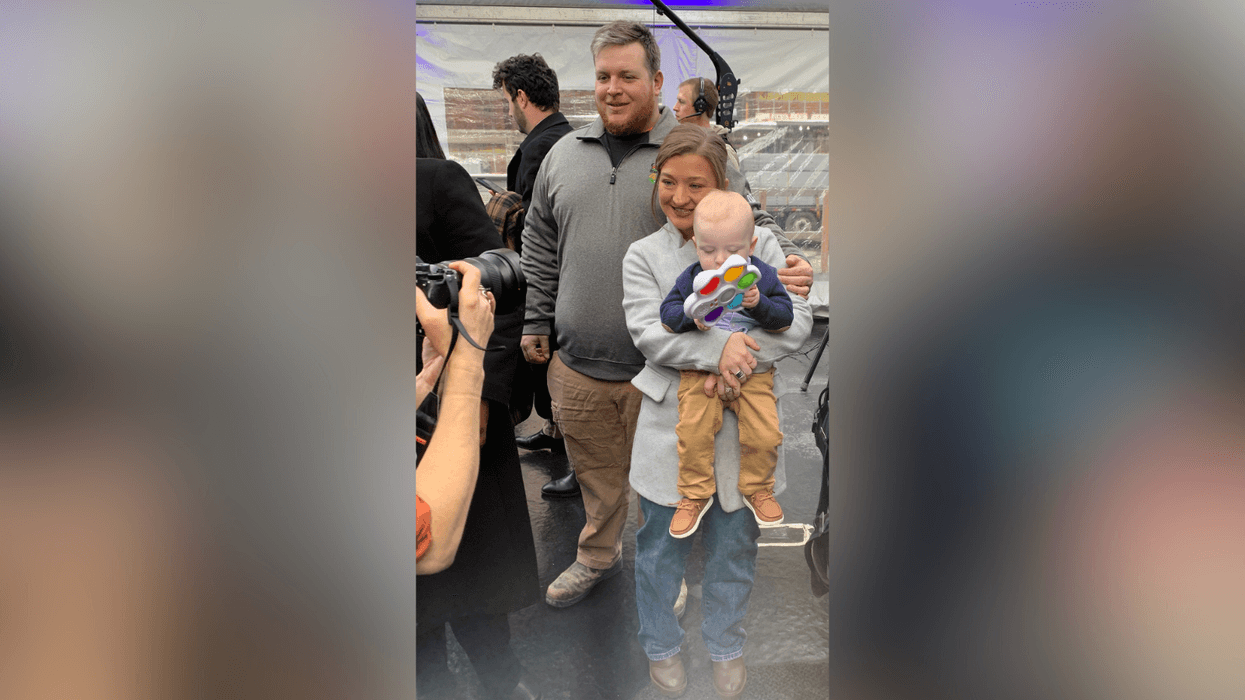

PHILADELPHIA (KYW Newsradio) — VIPs gathered last week for the final beam placement in Children's Hospital of Philadelphia's new 26-story tower. But the star of the show was a toddler who embodies CHOP's future as much as the tower.
"On August 1, 2024, KJ came into the world a beautiful, 4-pound, 9-ounce little baby. Very quickly, his will to live would be tested as he would fight very high levels of ammonia in his body," said Kyle, the father of 18-month-old KJ Muldoon.
KJ is the first person in human history to receive gene-editing therapy built specifically for his illness, which was a rare genetic disease that caused his liver to turn protein into life-threatening ammonia, instead of harmless urea. He needed a new liver or faced brain damage and early death.
The 18-month-old's father spoke at the beam placement about the leap of faith the family made when offered the revolutionary treatment, in which doctors had designed a custom gene editor specifically for the mistake in KJ's DNA. They got permission to infuse it into his bloodstream to fix the error.
"In the following months, this pipe dream that sounded like it came from a science fiction movie became our reality, the answer to our wish for KJ," he said.
KJ was an inpatient for nearly a year.
His parents took shifts at the hospital while attending to the needs of their other children.
Then, as CHOP began building the tower, they connected Kyle, who was out of work and looking for a job, to the steamfitters' union. He's now helping build the new facility.
"Being able to bounce back and forth between work and the hospital was a welcome relief. Though they were some of the toughest times in our lives, I will reflect on them fondly, all because of the people around us who supported us," Kyle said.
Muldoon thanked CHOP, but CHOP CEO Madeline Bell thanked the Muldoons.
"They believed in us and agreed to do this therapy," Bell said.
The Muldoons' faith helped CHOP demonstrate that tailor-made gene editing can save lives, offering hope for a future where rare genetic diseases need not be death sentences.
KJ still needs medications and has a restricted diet, but his blue eyes twinkled as his father spoke. He reached for the microphone as if he wanted to tell his own story, which, no doubt, someday, he will.